












Most scent-control advice on the market is built around the same idea: cover up your smell with something stronger — apple, fox urine, skunk, pine. It’s intuitive, it’s been sold for decades, and it doesn’t really work. Understanding why gets you most of the way to understanding what does.
Deer Smell in a Different League
A deer’s sense of smell is estimated to be roughly 10,000 times more sensitive than a human’s, with a proportionally large share of their brain devoted to processing scent. Deer can reportedly distinguish multiple distinct odors at once and use scent for territory marking, mate recognition, and threat detection — it’s not a secondary sense the way it is for us, it’s closer to their primary one.
That level of sensitivity is exactly why a “cover scent” strategy tends to backfire. A cover scent doesn’t erase human odor — it just adds a second, usually unnatural, odor on top of it. To a nose that sensitive, a strong smell of apple or fox urine coming from a spot on the landscape where those things don’t belong isn’t camouflage. It’s a second signal, layered on top of the first one, and deer are perfectly capable of learning to associate the two. Once a buck has smelled your cover scent alongside a poorly-scent-controlled hunter once, that cover scent itself becomes a warning sign the next time he encounters it — even from a distance, even without seeing you.
The honest answer to “how do you fool a deer’s nose” is: you largely don’t. The more realistic goal is reducing your own odor output to as close to nothing as possible, rather than trying to hide it under something else.
Masking vs. Elimination
Most household and commercial odor products — for skin, laundry, carpet, anything — are built around masking. They introduce a second, “cleaner” smell to compete with or cover the objectionable one. That’s a reasonable approach for a bathroom. It’s a poor one for hunting, because it assumes the goal is to smell pleasant rather than to smell like nothing.
Elimination is a different mechanism entirely. Instead of adding a competing odor, an oxidizing agent chemically converts odor-causing organic compounds into new, non-volatile compounds that don’t register as an odor at all — the same basic principle behind how chlorine breaks down organic waste in a pool, minus chlorine’s own strong smell. Baking soda and washing soda, common ingredients in a lot of “odor eliminating” hunting products, work on a related but much weaker principle: they raise skin pH slightly to slow bacterial odor production, but they have limited actual odor-absorbing capacity and can re-release what they’ve absorbed once they’re wet.
The practical difference matters in the field: a masking product runs out of “cover” the moment your own odor output exceeds it, while a true oxidizer keeps working on odor as it’s produced rather than trying to out-compete it.
A Practical Scent-Control Routine
Before the trip:
- Items that can’t be laundered (boots, packs) benefit from advance odor treatment — a couple of weeks ahead if possible, then sealed until use. Launder everything washable in a scent-free, no-residue detergent. Standard detergents leave behind fragrance and residue that gives odor-causing bacteria something to work with. Store gear with something scent-neutral — a bit of local leaf litter or dirt from your actual hunting area works better than a commercial “earth” scent, since deer can often tell the difference between odors that genuinely belong to a location and ones that don’t.
Morning of:
- Shower with a scent-free soap rather than a fragranced one if at all possible — it buys hours before odor-causing bacteria repopulate. If a shower isn’t an option, a full-body application of a scent-elimination spray is a reasonable substitute.
Getting dressed and heading out:
- Treat your outer layer — collar, cuffs, sleeves — right before heading afield, along with boot exteriors, to avoid leaving a scent trail on the way in. Reapply through the day as needed, especially to sweat-prone areas, gloves, and anything else you’ll be handling.
On stand:
- Address any fresh spills, sweat, or contact odors as they happen rather than waiting until the next full wash. None of this requires eliminating 100% of your scent — that’s not realistic. The goal is minimizing it enough, and often enough, that you’re not leaving an obvious trail a deer’s nose can’t miss.
How Atsko Products Help Hunters
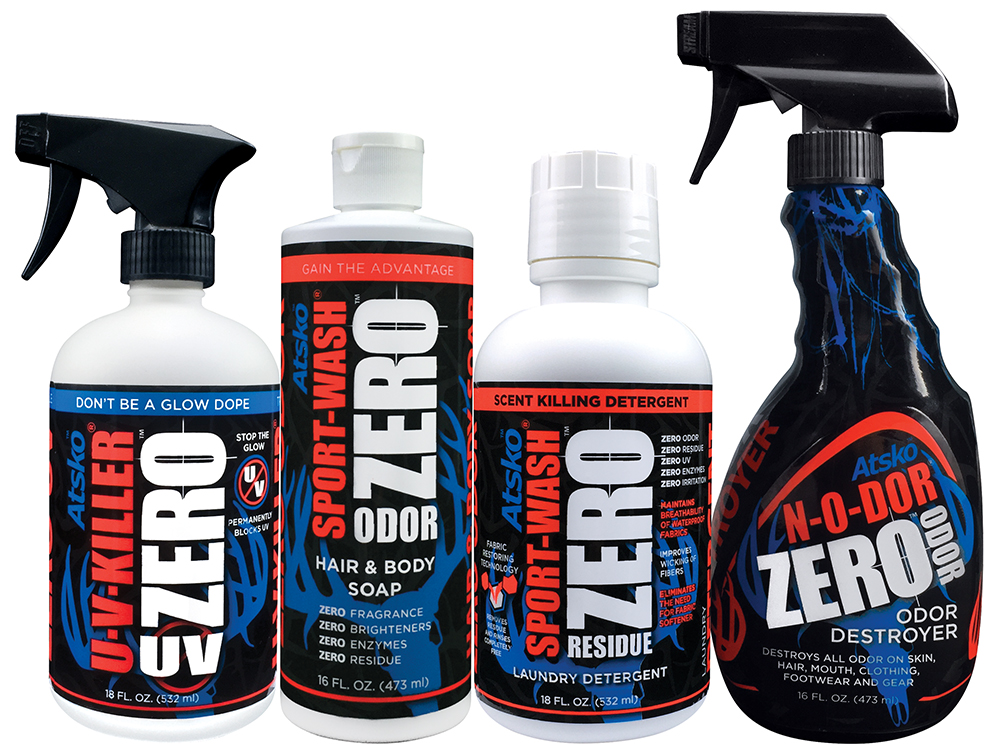
Atsko’s scent-control line is built around the elimination principle rather than masking — Sport-Wash laundry detergent removes residue and odor-causing buildup completely rather than leaving fragrance behind, and ZERO N-O-DOR Oxidizer spray works by oxidizing odor at the source instead of covering it with a competing smell. If you’re rethinking your scent routine based on how deer actually process odor, that’s the starting point.
Related Reading
- Can Deer Really See UV? — the science on UV sensitivity and why brighteners in fabric matter
- Why Deer See So Well in Low Light — the anatomy behind a deer’s superior vision
- How to Check Your Hunting Gear for UV Brighteners — step-by-step testing and treatment guide