







Flammability of Children’s Sleepwear Washed with Sensi-Clean

FROM:
Robbie Nicholson, Research Specialist
Physical Evaluation Laboratory

TO:
Mr. Dan Gutting
Atsko, Inc.
2530 Russel S.E.
Orangeburg, S.C. 29115

DATE: June 04, 1996

SUBJECT: Flammability – Children’s Sleepwear

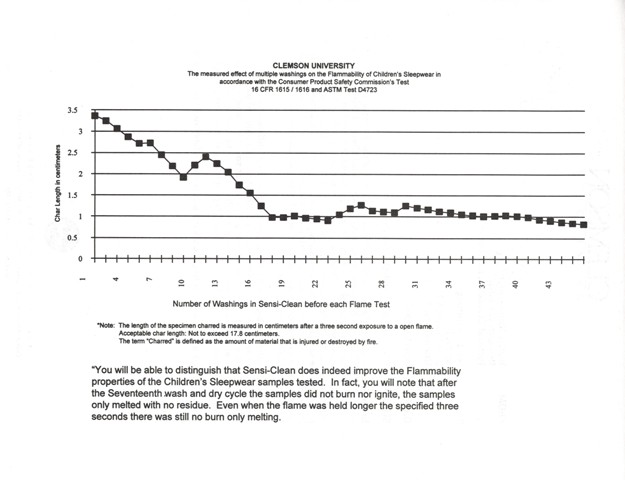
Enclosed are copies of the data gathered from the testing of the Flammability properties of Children’s Sleepwear after washing with Sensi-Clean. I believe that you will be able to distinguish that Sensi-Clean does indeed improve the Flammability properties of the Children’s Sleepwear samples tested. In fact, you will note that after the Seventeenth wash and dry cycle the samples did not burn nor ignite, the samples only melted with no residue. Even when the flame was held longer than the specified three (3) seconds there was still no burn, only melting. All of the samples were tested in accordance to the specifications of the Federal Test Methods for Children’s Sleepwear.

CLEMSON UNIVERSITY
The measured effect of multiple wasing on the Flammability of Children’s Sleepwear in accordance with the Consumer Product Safety Commission’s Test 16 CFR 1615/1616 and ASTM Test D4723

*Note: The length of the specimen charred is measured in centimeters after a three second exposure to a open flame. Acceptable char length: Not to exceed 17.8 centimeters. The term “Charred” is defined as the amount of material that is injured or destroyed by fire.

You will be able to distinguish that Sensi-Clean does indeed improve the flammability properties of children’s sleepwear samples tested. In fact, you will note that after the Seventeenth wash and dry cycle the samples did not burn nor ignite, the samples only melted with no residue. Even when the flame was held longer than the specified three seconds there was still no burn only melting.
Sensi-Clean Detergent Evaluation

FROM:
Robbie Nicholson, Research Specialist
Physical Evaluation Labratory

TO: Mr. Dan Gutting, Mr. Kurt Von Busser

DATE: May 15, 1995

SUBJECT: Detergent Evaluation

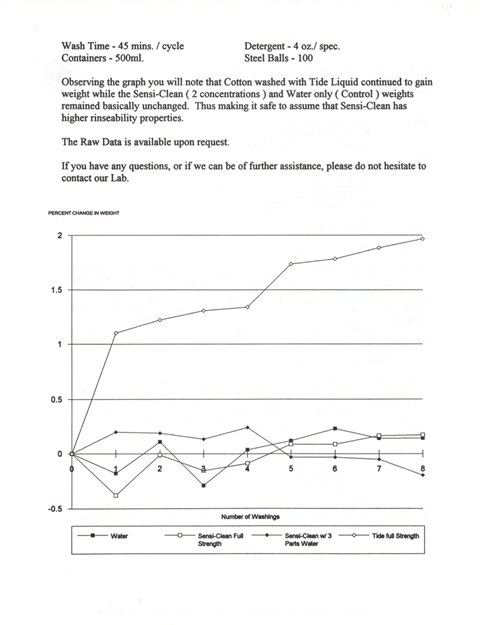
The object of this research is to determine the rinseability differences between a new product SENSI-CLEAN and TIDE LIQUID. Attached is the Graph obtained from data of test results performed at the request of Mr. Dan Gutting, Atsko, Inc. These results were obtained from testing rinseability of 100% Cotton Diapers during numerous wash cycles. Detergents supplied were SENSI-CLEAN 1 (4 times recommended amount), SENSI-CLEAN (recommended amount), and TIDE. Also cycles were completed using Water only (Control), no detergent. All tests were conducted utilizing the Launder-Ometer (Commercial Laundering). The Launder-Ometer rotates closed containers in a thermostatically controlled water bath at 40 rpm.

Three (3) fabric specimens were laundered in each of the detergents. Each Detergent was measured to insure ounce per ounce equivalency. Conditions during the wash cycle were determined from careful viewing of AATCC Test Method #61 (Colorfastness to Laundering, Home and Commercial Accelerated). Due to the need to simulate the most stringent test the following procedure and conditions were followed

Detergents:

TIDE LIQUID (Mfg. recommended amount)

SENSI-CLEAN 1 (4 times Mfg. recommended amount)

SENSI-CLEAN (Mfg. recommended amount)

WATER (Only) – (Control)

Each specimen was washed in a water bath, dried, and conditioned at 70 degrees F. and 65% R.H. before Original weight recorded. After the Wash cycle each specimen was dried for 50 mins., Cotton setting, to assure complete dryness before reweighing.

Wash Time – 45 mins. / cycle

Detergent – 4 oz. / spec.

Containers – 500ml

Steel Balls – 100

Observing the graph you will note that Cotton washed with Tide Liquid continued to gain weight while the Sensi-Clean (2 concentrations) and Water (Control) weights remained basically unchanged. Thus making it safe to assume that Sensi-Clean has higher rinseability properties.

The Raw Data is available upon request.

If you have any questions, or if we can be of further assistance, please do not hesitate to contact our Lab.

sensi-clean eval chart

Sport-Wash Detergent Evaluation

FROM:
Robbie Nicholson – Research Specialist
Physical Evaluation Labratory

TO:
Mr. Dan Gutting, Mr. Kurt Von Busser
Atsko, Inc.
2530 Russel S.E.
Orangeburg, S.C. 29115

DATE: May 15, 1995

SUBJECT: Detergent Evaluation

The object of this research is to determine the rinseability differences between a new product SPORT-WASH and TIDE LIQUID. Attached is the Graph obtained from data of test results performed at the request of Mr. Dan Gutting, Atsko, Inc. These results were obtained from testing rinseability of 100% Cotton Diapers during numerous wash cycles. Detergents supplied were SPORT-WASH 1 (4 times recommended amount), SPORT-WASH (recommended amount), and TIDE. Also cycles were completed using Water only (Control), no detergent. All tests were conducted utilizing the Launder-Ometer (Commercial Laundering). The Launder-Ometer rotates closed containers in a thermostatically controlled water bath at 40 rpm.

Three (3) fabric specimens were laundered in each of the detergents. Each Detergent was measured to insure ounce per ounce equivalency. Conditions during the wash cycle were determined from careful viewing of AATCC Test Method #61 (Colorfastness to Laundering, Home and Commercial Accelerated). Due to the need to simulate the most stringent test the following procedure and conditions were followed.

Detergents:
TIDE LIQUID (Mfg. recommended amount)

SPORT-WASH 1 (4 times Mfg. recommended amount)

SPORT-WASH (Mfg. recommended amount)

WATER (Only) – (Control)

Each specimen was washed in a water bath, dried, and conditioned at 70 degrees F. and 65% R.H. before Original weight recorded. After the Wash cycle each specimen was dried for 50 mins., Cotton setting, to assure complete dryness before reweighing.

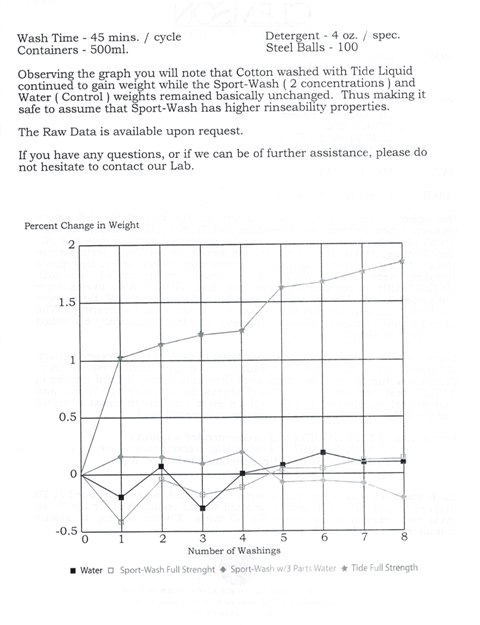
Wash Time – 45 mins. / cycle

Detergent – 4 oz. / spec.

Containers – 500ml

Steel Balls – 100

Observing the graph you will note that Cotton washed with Tide Liquid continued to gain weight while the Sport-Wash (2 concentrations) and Water (Control) weights remained basically unchanged. Thus making it safe to assume that Sport-Wash has higher rinseability properties.

The Raw Data is available upon request.

If you have any questions, or if we can be of further assistance, please do not hesitate to contact our Lab.

sport wash eval chart
LEAD Technologies Inc. V1.01

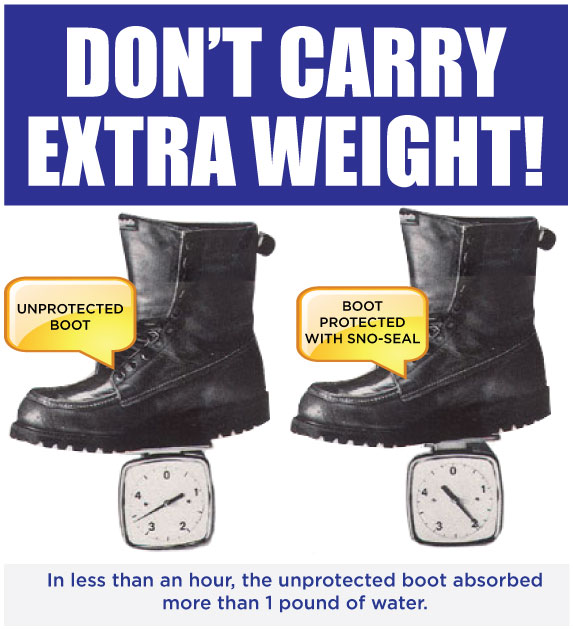
Don’t Carry Extra Weight

If your boots are wet, you’re lifting an extra three pounds with every step you take.

Ad for Sno-Seal boot protector

Learn the importance of dry comfortable footwear. Unprotected leather absorbs and retains water. Not only does this make your feet feel cold and wet but water increases the weight of you boots which makes walking tiring. Even GORE-TEX® lined boots need protection. GORE-TEX® keeps your feet dry but the leather and liners soak up water making the boot heavy and pulling heat away from your feet. Your feet are cold and feel wet. When each boot is only 1 lb. heavier you will lift an extra 2212 lbs. to walk one mile. That’s tiring.

WATERPROOF YOUR BOOTS WITH SNO-SEAL® AND BE LIGHT, WARM, AND DRY.

Water-Guard Family of Products

Water-Guard is a family of water repellent products from Atsko, Inc., the makers of Sno-Seal the original beeswax waterproofing for leather. Water-Guard products include silicone in solvents systems and polymer in water systems.

The most versatile are the polymerizing silicone products, Silicone Water-Guard and Water-Guard Extreme Aerosol’s and Liquid Silicone for special applications including shoes, arrow fletchings and fishing flies. These are all heavy-duty formulas for maximum water resistance. The newest addition to the Silicone Water-Guard family is called Fast Dry. It is an aerosol with less potential for visible change on Suede and light colors but adequate protection for light or infrequent exposure.

Silicone Water-Guard products can be applied to just about anything from concrete to nylon windbreakers and makes them all bead water. Silicone eventually washes away and must be reapplied. Silicone Water-Guard products all offer some degree of Sun protection and mold/mildew resistance. Water-Guard Extreme has the highest concentration and incredible durability in continuous outdoor exposure while Fast Dry at the other end of the spectrum is ideal for Suede, Ties and upholstery. If a heavy-duty product is being used on a “Light” application we suggest making the application lighter by spraying the product on a clean cloth and using the cloth to gently wipe the silicone onto the surface. You can always apply more if necessary.

Enjoy the Sun, but Don’t Get Burned

(ARA) – Most people believe that if clothing and sunscreens reduce reddening of the skin, they are providing enough protection. Unfortunately, blocking UVB, which causes redness, may give a false sense of security. Dangerous UVA radiation can cause aging and cancer without allowing redness to occur.

If you extend sun exposure because light clothing or sunscreen seems to be protecting you, the result could be more damage than you would have sustained if you had seen the effects of the sun. The SPF scale is based on reddening of human skin and therefore is only measuring UVB, so sunscreens can have a high SPF number but not protect against UVA. This is why people are now cautioned to look for products that protect against both UVA and UVB, but the amount of UVB protection is not stated.

Special sun protective fabrics are tested for both UVA and UVB. Unlike sunscreens, they are rated very conservatively and the rating system includes UVA. “These specially labeled fabrics really do protect you, but they are very expensive and are available only in limited styles” says Dan Gutting of Atsko, Inc., makers of U-V-Block a do-it-yourself product you can apply to light summer fabrics. “With U-V-Block you can treat the kids’ favorite shirts and know that they are protected if they are wearing the shirt.”

The company claims that the protection lasts thru dozens of washings and Mr. Gutting adds that the shirt will actually last longer and fade less because of the U-V-Block Treatment. “We have customers treating flags, umbrellas and sail covers to make them last 2 to 4 times as long in sun exposure.

Treating high coverage clothes with U-V-Block is effective and economical, but there is no alternative to sunscreen for exposed skin. Be sure to select a product that protects against both UVA and UVB and has a high SPF. Follow the directions carefully. It takes a lot of product and frequent applications to maintain the protection advertised on the bottle. Sunscreen labels state: apply 20 minutes before exposure, reapply every 30 minutes, use a full ounce to cover adult body. Few people follow this prescription.

With increased UV radiation reaching the earth because of ozone depletion and more leisure time to enjoy the outdoors, skin cancer is the fastest increasing cancer in the country.

Skin damage from the sun takes 20 years to appear. Children are far more susceptible to sun damage than adults, and we receive more than half of our lifetime sun exposure before age 18.

U-V-Block on your favorite summer fashion is the most effective, most convenient, and most economical alternative for people who want to enjoy the sunshine. It also reduces exposure to the irritating chemicals found in most sunscreens.

One bottle will treat 4 long sleeve shirts for years of cool protection without heavy dark fabrics or chemical exposure. U-V-Block Item #2344 (17 fl. oz. for $13.20)

U-V-Block is a registered trademark of Atsko Incorporated.

This article is from Wounds1.com.

ASTM Releases U.S. Standards for UV-Protective Textiles

Contact: Kathryn Hatch, Ph.D.
Chair, ASTM D13.65 Subcommittee
(520) 621-7134 or [email protected]

West Conshohocken, PA, January 2001 –The American Society for Testing and Materials (ASTM) has released two standard documents (D6544 and D6603) related to textile products sold with a claim of being UV protective.

ASTM D6544 “Standard Practice for Preparation of Textiles Prior to Ultraviolet (UV) Transmission Testing” is unique among the world’s UV Textile documents. It was drafted to ensure that the UV protection claimed on labels reflects the least or lowest degree of protection when the fabric is new. To accomplish this, fabric will be required to undergo 40 launderings, exposure to 100 AATCC fading units of simulated sunlight, and simulated exposure to chlorinated water (for swimsuit fabrics) prior to UV transmission testing. A unique inclusion in ASTM D6544 is reference to ASTM sampling documents to help ensure that label information is specific to a production lot.

ASTM D6603 “Standard Guide for Labeling of UV-Protective Textiles” requires UV-protective clothing to be labeled with a UltraViolet Protection Factor (UPF) value. The lowest possible value is 15 UPF and the highest is 50+ UPF. D6603 adopts the Australian/New Zealand classification categories are then: Good UV protection when the UPF is 15 – 24, very good UV protection when the UPF is 25 – 39, or Excellent UV Protection UV protection when the UPF is 40 – 50+. UPF is a relative ranking of the UV protective capabilities of a textile and is the correct designator for the UV protection provided by a fabric. Products may claim that skin covered by the UV-protective fabric is protected against sun exposure and sunburn. Products may not clain that they prevent skin cancer or photoaging of the skin.

“When combined with AATCC 183, these new standards provide excellent guidance for the sampling, preparation, UV Transmittance testing, and labeling of UV-Protective fabrics,” said Dr. Kathryn Hatch, ASTM D13.65 Subcommittee Chair and Uiversity of Arizona Textile Professor. “Manufacturers of UV-Protective fabrics and clothing should access and adopt these new standards with due haste for their own legal protection and, ultimately, the health and safety of their consumers.”

Over exposure to the sun’s radiation is associated with serious skin and eye damage, including skin cancer. Over 1.3 million new cases of skin cancer are diagnosed each year in the U.S. This figure is expected to increase annually unless precautions are taken to reduce sun exposure. Clothing with UV-protective properties may help reduce exposure to harmful UVA and UVB rays.

The Federal Trade Commission and the Consumer Products Safety Commission have assisted in the development on the new standards. They intend to ensure that all textile products that claim to be UV-Protective have been prepared, tested, and labeled according to the AATCC and ASTM standards.

Established in 1898, ASTM is one of the world’s largest voluntary standards development organizations. ASTM standards are among the most widely accepted and used documents in the world. The acquire licensed copies of the new standards, or more information, contact Ms. Bode Hennegan at ASTM at 610-832-9740.

Change Clothing into a UV Barrier

Skin cancer is increasing. People who work or play in the sun are never adequately protected because sunscreens need frequent reapplications and regular clothing must be heavy or dark colored (Hot) for full protection from harmful ultraviolet radiation. Many lightweight, light color fabrics that are cool and comfortable offer little protection from UV radiation. A white tee shirt may provide only UPF 5 (Ultra Violet Protection Factor) when dry and far less when wet or stretched. While sunscreens are rated in SPF (Sun Protection Factor) based on very optimistic assumptions about rate and frequency of application, fabric protection is rated in UPF (Ultraviolet Protection Factor) a minimum level of protection expected based on instrument testing. Special clothing has been created to offer comfort and UPF 30+ protection but it is expensive and limited in style, size, and availability.

You can now apply UV protection to white or light colored (cool) clothing instead of skin. Eliminate the repeated chemical exposure and cost of applying sunscreen to the skin. U-V-Block treats any fabric. On many fabrics U-V-Block will achieve UPF 50+, the highest rating allowed by ASTM Fabric Labeling Standard, in just one application.

Treat your own clothes, old or new, to add UV protection. Apply U-V-Block to the clothes you choose to wear in the sun. The spray application dries quickly and can be cured in the dryer or with an iron to endure repeated washings without loss of protection. A 17-ounce bottle of U-V-Block will treat about 4 white dress shirts. Each shirt will protect for several seasons for less than the price of one bottle of sunscreen.

Treating your clothing with U-V-Block is an effective, economical, and comfortable way to reduce the risk. A day of work or play in the sun is less tiring when light, white, treated clothing is used to reduce heat stress and UV exposure. Warning: Do not extend sun exposure time without increasing protection of eyes and uncovered skin.

Wide brim hats, long sleeve shirts, and long pants cover more skin and skin must be covered to be protected. Enjoy the light, white summer clothes of your choice with the added comfort of U-V-Block protection. The garment you treat will actually last longer because of U-V-Block. A typical printed poly cotton blend will last 4 times longer in outdoor exposure.

The use of sunscreen is important and may never be replaced for the face and hands, but it is surprisingly expensive and inconvenient to achieve advertised protection of the entire body. Just read the instructions which must be followed to achieve the SPF rating claimed. “Apply 20 minutes before exposure”. “Apply liberally, 1 ounce will cover a typical adult” “Reapply every 30 minutes if perspiring or swimming”. That’s 8 applications in 4 hours? At $8 per bottle, a family of 4 should apply $64 per day or $400 for a one-week vacation. Most people will get far less protection than advertised. Even when limited to the face and hands this represents significant cost and chemical exposure. Sunscreen labels usually list multiple active ingredients because most ingredients don’t cover both UVA and UVB wavelengths and it would be very irritating to use an effective amount of any one ingredient.

U-V-Block treated outdoor fabrics like tents and flags will keep their color and strength 4 times longer. Isn’t this the kind of protection you want for your skin? Tell others about U-V-Block, permanent UV Protection, the sensible alternative.

Skin Cancer About to Take Center Stage

U-V-Block, a new product from Atsko/SNO-SEAL, provides a practical alternative that every parent and every outdoor enthusiast should know about. U-V-Block is a permanent treatment that you spray on clothing to create an ultraviolet barrier. Most of your favorite lite summer fabrics offer very little protection. A white cotton knit like a “T” shirt may provide a UPF of only 5 when dry and even less when it is wet or stretched. U-V-Block can provide UPF up to 50+ depending on the fabric.

There is no need for me to give you the headlines and quote statistics of morbidity and mortality. These will be coming from every direction. Visit a web site on Skin Cancer, American Cancer Society, American Sun Protection Association or any related topic and you will know the danger is real and serious.

Many of you have direct knowledge, perhaps too direct, but the majority mindset has been to ignore it. We all know that a tanned body looks healthier and a constituency has grown to profit from this view.

Now as the human and healthcare costs accelerate, behavior will be changed and we can assist, resist, or just exist. To make a positive contribution you must understand the alternatives.

Staying out of the sun totally is completely unrealistic and would signal the end of the enjoyment of the outdoors as we know it because exposure can be dangerous even on a cloudy day.

The use of sunscreen is important and may never be replaced for the face and hands, but it is surprisingly more expensive and less effective when you try to protect the rest of the body. Just read the instructions.

“Apply 20 minutes before exposure.” How does this happen when a runner, cyclist, roofer, or any outdoor competitor rips off his shirt without breaking stride as it becomes too hot for optimum performance.

“Reapply every 30 minutes if perspiring or swimming.” I count 8 applications in 4 hours.

“Apply liberally, 1 ounce will cover a typical adult.” At $8 per bottle, a family of 4 should apply $64 per day or $400 for a one-week vacation. Most people will get far less protection than advertised. Even when limited to the face and hands this represents significant cost and chemical exposure.

Protective clothing is the only effective alternative, but LIGHTWEIGHT WHITE CLOTHING OFFERS ALMOST NO PROTECTION. Wearing heavy opaque clothing can be so uncomfortable as to be abandoned each day by the time the sun reaches a dangerous angle.

Specially designed clothes that are tested and labeled for UV protection are enormously expensive ($70-80 per shirt) but they can be comfortable while being protective. The American Society for Testing and Materials (ASTM) has just finished a guide to the preparation and labeling of UV protective fabrics. It is available at www.astm.org. In a few years UPF (Ultraviolet Protection Factor) rated clothes will begin to show up at the discounters, but for the present they are unlikely to be found on the fast growing little tykes who have the greatest need for protection and spend the most time in the sun.

Other countries are ahead of the USA in this area. In Australia, for example, children on playgrounds are protected by hats and long sleeved shirts in the middle of summer. Their OSHA requires that employers provide sun protective clothing for outdoor workers. Cancer prevention need not be mutually exclusive and a love of the out-of-doors.

Ultraviolet protection will receive so much coverage that we may tire of the subject. When you really you are ready for effice practical and economical protection for your self and your loved ones, choose U-V-Block for permanent UVA and UVB Protection

The unique perspective and practical solutions you can provide will save lives.

Protect Yourself from the Sun

Ordinary Clothing doesn’t protect you from UV Damage.
Thin light comfortable summer fashions offer very little protection from cancer causing sun exposure. Many people will burn while wearing a “T” shirt because if offers only UPF 3 – 5. Clothing must be heavy or dark or layered (hot and uncomfortable) ao pretreated (expensive and limitied styles available) to offer good protection. Ordinary clothing, just as sunscreens, may block the UVB (Tanning rays) more effectively than the UVA Rays that cause skin damage. The heat reduction and lack of redness can make you think you are well protected, but you’re not!

U-V-Block makes light summer fabrics block UVA and UVB.
The summer clothes you already own and want to wear can be treated to provide UV protection up to UPF 50+. U-V-Block does not come off when you swim or perspire. One bottle treats four shirts. The treatment is washing machine safe to last all season. Kids often have a favorite shirt they will wear without coaxing, treat it with U-V-Block. It will even make the shirt last longer.

U-V-Block is reliable and affordable.
Following label directions a family of 4 could spend $400.00 on sunscreen for a week in the sun. For advertised protection sunscreens should be applied to the skin every 1/2 hour. Sunscreen labels recommend using a full ounce per adult application. That’s a lot of exposure to irritating chemicals. It is difficult to be sure that kids are protected unless they wear a shirt and hat that can be seen. You should still call them in to reapply sunscreen on exposed skin.

Avoiding Chemical Exposure

An increasing number of people are suffering from rash, redness, and skin irritation that can be relieved without medication or life style change. Three major sources of chemical assault are laundry product residue, shampoo and hand soap residue, and exposure to chemicals and cleaners at work and at home

Laundry products leave residues averaging 2% of the weight of fabric. They surround us 24 hours a day. They are mainly surfactants, salt, fragrances, U-V brightening dyes and organic goo to hold it all in place. Many products claim to be “Free” of dye and perfume but independent studies from Clemson University support our claim that Sensi-Clean is the only Residue-Free detergent. We are happy to provide you with copies of the test results, but the real proof is the relief experienced by people who suffer rash, redness, and irritation from ordinary laundry products.

Four groups suffer most from laundry chemical residue. (1) Infants whose immune systems are not yet able to resist these chemicals. (2)Those who have increased chemical sensitivity as a result of disease (such as lupus, psoriasis etc.), because of previous exposure, or caused by currently high levels of chemical stress. (3) The elderly who have less resistance to all chemical exposure and decreased healing and regenerative rates. (4) Athletes who perspire heavily activating the residues with moisture and heat so that they are easily absorbed into warm moisture-softened skin.

Sensi-Clean detergent has been so beneficial that we now have 1,100 hospital’s delivery rooms and 1,500 private physicians in allergy, dermatology, and pediatrics providing samples of Sensi-Clean to patients who will benefit by eliminating exposure to laundry detergent residue

The next major source of day and night chemical exposure is personal care products.Sensi-Clean Shampoo & Body Gel enables people to completely cleanse hair and skin with no chemical residue. Most shampoos and body cleansers distinguish themselves by the fragrances and fad ingredients they contain. Sensi-Clean Shampoo & Body Gel, by contrast, goes beyond hypoallergenic by leaving nothing on the hair and skin. This eliminates irritation and makes medication and other personal care products more consistent and effective at lower application rates by eliminating interaction with shampoo and soap chemicals.

Recurring yeast infections are usually eliminated by the combination of residue free clothes and residue free skin. This can only be achieved by the use of Sensi-Clean Laundry detergent (without fabric softener) for all your clothes washing along with Sensi-CleanShampoo & Body Gel for the shower. This combination also reduces the episode frequency of reactive conditions such as psoriasis

The third line of defense is literally a wax barrier for the skin called Pro-Tech-Skin. The Beeswax formula is insoluble in water and provides all day protection against all waterborne agents, wind burn, sun, and repeated washings.

Apply Pro-Tech-Skin to areas of dry or damaged skin immediately after your residue-free shower with Sensi-Clean Shampoo & Body Gel. Pro-Tech-Skin seals out all irritants while sealing in the bodies own moisture so that skin can heal itself.

Pro-Tech-Skin should be applied before exposure to paint, chemicals, and soil as it will enable thorough cleansing with

Sensi-Clean Shampoo & Body Gel instead of an unnecessarily aggressive cleanser,

Please test these products yourself. This system of 3 no-nonsense products can achieve results where medications and expensive personal care products consistently fail. Instead of adding new chemicals to the problem, Sensi-Clean, Sensi-Clean Shampoo & Body Gel, and Pro-Tech-Skin simply remove the original source of irritation.

Residue-Free Cleansing

Disclaimer: Sport-Wash Hair and Body Soap also sold as Sensi-Clean Shampoo and body gel contains no regulated ingredients for the treatment of dandruff, flaking, eczema, or psoriasis.

It can, however, make the products you use to treat these conditions much more effective.

Medications, treatments, and indeed all personal care products are impeded by residues on the skin and hair. Residue, whether from inadequate cleansing or a remnant of the cleaner or another product, can have unintended consequences. It is first of all a barrier. It can prevent good cleaning, good air and moisture transfer, proper dispersion of chemicals excreted by the skin, and also prevent medication from contacting or penetrating the skin and hair. Residue also holds odor, feeds bacteria, and can suck moisture out of the skin and hold it on the surface.

Complete residue-free cleaning with Sensi-Clean Shampoo and Body Gel or Sport-Wash Hair and Body Soap is the only way to assure that your expensive medications, rinses or shampoos have a chance to reach their intended target. Always wash with Sensi-Clean Shampoo and Body Gel or Sport-Wash Hair and Body Gel and rinse before using medicated products.

The importance of residue-free-cleansing cannot be overstated. It will make other personal care products such as conditioners, moisturizers, and fragrance more effective and more predictable with lighter applications.

Keep in mind that the perfumee, chemicals, essential oils and fad ingredients found in ordinary personal care products and the residues of laundry detergent and fabric solutions are the most common sources of skin irritation. You may benefit by minimizing the use of perfumed personal care products and also washing all your clothes in residue-free Sport-Wash or Sensi-Clean Laundry Detergent. In some cases such as MCS (Multiple Chemical Sensitivity) medications become major irritants. The body can also become reactive to its own debris. For such individuals residue-free cleansing of the hair and body and the use of residue-free laundry detergent without fabric softener will be the only relief.

Fortunately, for many of us, our flaking scalp is not dandruff but simply the result of poor cleansing with shampoos that deposit more than they remove. In these cases you will find that when a residue-free cleansing routine is established, the need for medicated products will disappear.

Tips for Using Pro-Tech-Skin

Pro-Tech-Skin retains moisture while sealing out irritating chemicals. It is drastically different from most skin care products. Most products are water-soluble, they offer little or no protection against water and waterborne irritants such as soaps and household chemicals. They contain long lists of ingredients – many of which can be irritating. Often these chemicals are homogenized or emulsified for suspension in water. This reduction in particle size makes them more invasive. Finally, after the water has evaporated such products will actually draw additional moisture from the skin you are trying to protect.

Pro-Tech-Skin contains no water. The Bees Wax formula contains no fad ingredients like milk, vitamins, essential oils, fragrance, etc. It contains only inert waxes that form a protective barrier to conserve your skins own moisture. The waxes are huge chains of molecules that do not penetrate living cells as emulsified chemicals can. Pro-Tech-Skinactually enables the outer layers of cells to better protect the living cells below by retaining your body’s own oils and moisture which enhance healing and prevent damage.

Pro-Tech-Skin is the same Beeswax formula that has been protecting hard working leather since 1933 in Sno-Seal. (We have replaced Sno-Seal’s softening agent with one recognized by the FDA for cosmetic use.) This volatilizes just as the softener in Sno-Seal, leaving the same tenacious barrier of protective wax. The only odor is that of natural unbleached beeswax.

Apply Pro-Tech-Skin after washing for all day protection of hands (especially knuckles, cuticles, and finger tips), faces, knees, elbows, feet, scar tissue, and all damaged skin. We all know how good our hands feel immediately after washing and drying. Pro-Tech-Skinlocks in the extra moisture to make that great feeling last while protecting skin from further damage and retaining natural moisture.

Pro-Tech-Skin enables your skin to heal itself. Hands will look and feel healthier immediately and continue to improve as natural healing occurs. You be the judge.

Many conditions such as Lupus, Eczema, Psoriasis, chemical sensitivity, aging, and U-V exposure cause the skin to react adversely to chemical exposures that other people can tolerate. Pro-Tech-Skin forms a barrier that isolates reactive skin from chemical exposure without causing irritation itself. Allergists and Dermatologists recommend Pro-Tech-Skinbecause it reduces sensitivity while conserving moisture to enable skin to heal itself.

Pro-Tech-Skin is ideal for those who wash their hands frequently with detergents that leave skin rough, red, raw, chapped, and cracked. Applied once in the morning, the protection continues all day thru repeated washings. Campers, nurses, care givers, florists, climbers, runners, sailors, skiers, hikers, hunters, fishermen, painters, plumbers, mechanics, electricians, brick layers, and all tradesmen will enjoy greatly improved skin. The more you abuse your skin – the more you need Pro-Tech-Skin. Application before exposure to paint, grease, dirt, chemicals, etc. makes clean-up quick and easy with the mildest of cleaners.

A little bit of Pro-Tech-Skin goes a long way because there is no water or clay filler in it. The 1/3 ounce sample pack provides about 7 applications for the average pair of hands. Regular users will find Pro-Tech-Skin very economical compared to the water products that don’t work nearly as well. From Abrasions to windburn the most effective protection is Pro-Tech-Skin.

High Efficiency (HE) Washing Machines

Computer-controlled front loading HE machines are superior to Top Loading agitator machines. They save energy, water and money while increasing the life of clothing. They even enable you to wash things that required dry cleaning.

But if you use the same old brand detergent, all you get is the same old results of depositing residue, fragrance and brightener. You might as well keep your old machine and capture the rinse water for the next wash. If you find this concept disgusting listen up.

Brand name detergents for HE machines are reformulated for compatibility with the horizontal axis machines, but their purpose remains the same. It is to deposit fragrance, optical brighteners, surfactants, lubricants, softeners, PVP etc. These chemicals give the illusion of clean clothes and a way for different brands to distinguish themselves, by odor but they are actually counterproductive. The chemical residue irritates skin and eliminates water repellency, breathability, wicking, rapid drying, softness, insulation and elasticity of fabrics.

Because HE machines rinse so well, detergent manufacturers need to use more fragrance etc to ensure that they can leave enough in your clothes. They actually charge more for “HE” formulas. They should be called “anti HE” because they are designed to overcome your new machine’s ability to leave less residue.

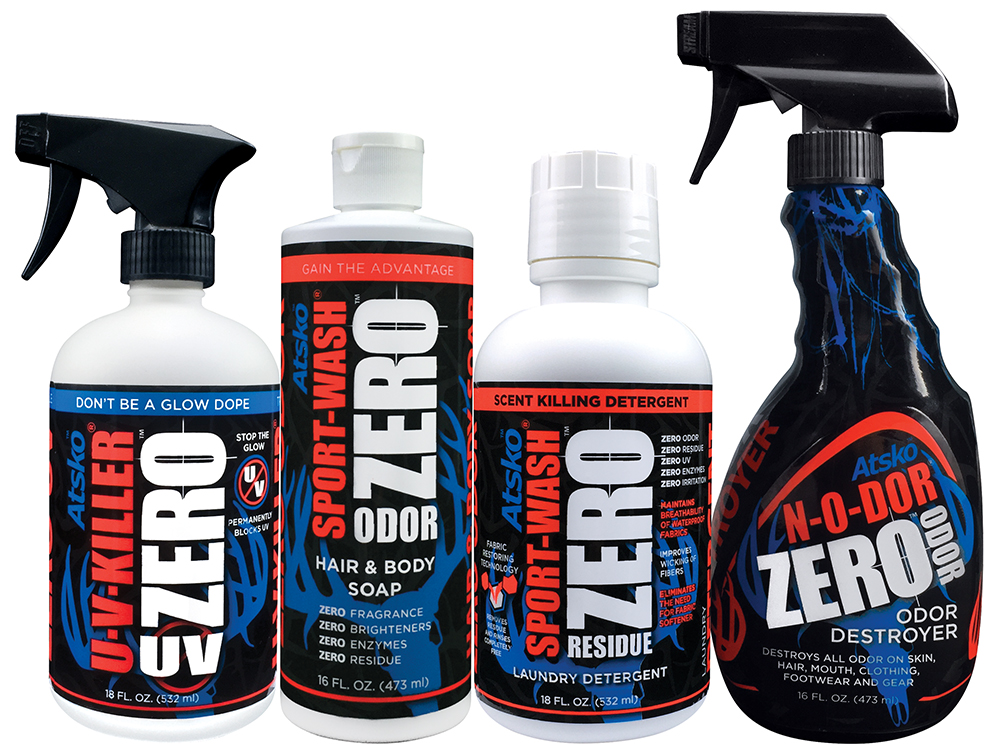
To get the cleanest residue free clothes use Sport-Wash® Residue-Free Detergent (RFD).Sport-Wash® has no fragrance, brightener, oil, softener, silicone, lubricant, enzymes, PVP or anything else that doesn’t rinse completely. Sport-Wash® is different from all other detergents, HE and regular. It is formulated to rinse completely, so it is not fighting your machine to leave residue behind. With Sport-Wash® in your HE machine your clothes smell like fresh air, not a flavor called “Fresh Air”. Because Sport-Wash® rinses completely it allows repellents to work like new. It restores breathability, wicking, rapid drying, softness, insulation and elasticity. Sport-Wash® RDF makes color, fibers and elastomers last longer. It has no oxidizers which destroy colors and weaken fibers. It cleans by using superior surfactency to release the oils that hold soils, stain and smells. While the residue of other detergents erodes fibers with particles that fissure and crack them, Sport-Wash® keeps them new and smooth so you don’t need lubricants or softeners for soft feel and you don’t need PVP or other sealants to maintain color. The residues of other detergents hold more odor than the fibers themselves so by leaving no residue, Sport-Wash® actually reduces the ability of the garment to retain odors. This makes it possible to enjoy polypropylene and other olefin base layers without the odor retention problems.

With a new HE machine and Sport-Wash® Residue-Free Detergent (RFD) you can experience a new level of clean without the chemicals you have been marinating in since your were born. Eczema, psoriasis, contact dermatitis and other reactive skin disorders are constantly triggered by exposure to detergent and softener chemicals. These can all be eliminated with Sport-Wash® Brand RFD and an HE Machine. Sport-Wash® will make any machine leave less residue, but the results are best with an HE machine. Many HE manufacturers recommend a maintenance cycle ones a week with hot water and no clothes to clean residue out of the machine to prevent odor. With Sport-Wash® this is never necessary. Sport-Wash® will clean up any old machine and keep a new one in pristine condition.

Finally, Sport-Wash® will save you money. It costs less to use and completely eliminates the need for Fabric Softeners and Hot water. You only use 1 oz per wash load of Sport-Wash® versus 3 to 4 ounces of other products. Saving millions of tons of fuel for transport.

Sport-Wash® Brand is a net savings to the environment because it’s use eliminates early failure and replacement of everything you wash, saving you and the environment many times the cost of our product.

Water Repellent Durability

The ASTM D-1913 Water Spray Test indicates what performance could be expected for one minute of rain exposure.

A pattern of rain can easily take an hour to pass. We believe this can be represented by 50 consecutive water spray cycles. The fabric is exposed to 30 seconds of heavy spray alternating with 30 seconds of soak time, repeated 50 times for a total of approximately 50 minutes. The results show significant differences in the performance of the products tested. Some won’t protect you for more then a few minutes, maybe a short sprint from a small parking lot, but not much more.

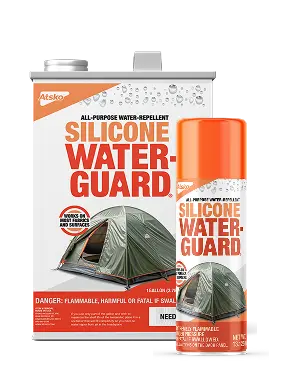
Silicone Water-Guard® gives long lasting real protection but like all silicones does not survive washing in detergent or dry cleaning.

TEST PROTOCOL

Test fabrics were sprayed in accordance with manufacturer’s Directions.
Test fabrics were then dried in accordance with manufacturer’s Directions.
Treated fabrics were evaluated by ASTM Standard Water Spray Test D-1913.
Testing was conducted as follows: Spray rate = 8-fl. oz. per 30 seconds.
At the end of each spray cycle the test fabric was evaluated and scored in accordance with the Standard Spray Test Ratings.

STANDARD SPRAY TEST RATINGS

100 No Sticking or Wetting of Upper Surface
90 Slight Random Sticking or Wetting of Upper Surface
80 Wetting of Upper Surface at Spray Points
70 Partial Wetting of Whole of Upper Surface
50 Complete Wetting of Whole of Upper Surface
0 Complete Wetting of Whole Upper and Lower Surface
Water-Guard® is a registered trademark of Atsko, Inc.
TX-Direct® is a registered trademark of Nikwax Waterproofing Ltd.
Tent & Gear Proof® is a registered trademark of Nikwax Waterproofing Ltd.
Woolite® is a registered trademark of Rickett and Colman.

50 Consecutive Test Durability
by continuous repetition of ASTM Water Spray Test D-1913