How to Properly Wash an ACU (Army Combat Uniform)

The ACU is a highly engineered piece of gear, and washing it wrong can undo a lot of that engineering — fading the OCP pattern faster than it should, degrading the fabric’s moisture-wicking and durability features, and in one specific way that’s easy to overlook, working against the uniform’s actual purpose.

Why Detergent Choice Matters More Than People Think

ACUs are manufactured under military specification to be free of optical brighteners — the same additives found in many consumer laundry detergents that make white and light-colored fabric look “brighter” under UV light. The Army has restricted the use of optical brighteners in uniform manufacturing since 1984, for a straightforward reason: brighteners absorb UV energy and re-emit it as a highly visible glow, which defeats the point of a low-visibility uniform under night-vision and UV-sensitive optics, not just to the naked eye in daylight.

The uniform ships brightener-free. What happens to it after that is up to the detergent it’s washed in. Many consumer detergents contain optical brighteners — sometimes disclosed on the label as “Fluorescent Whitening Agents” or similar terms, sometimes not clearly disclosed at all, since manufacturers aren’t required to spell out “optical brightener dye” on the front of the package. That inconsistency means checking the ingredient label alone isn’t a reliable way to know whether a given detergent is safe for a uniform that needs to stay brightener-free.

How to Actually Check a Detergent

The reliable method isn’t reading labels — it’s testing directly with a UV (black light) source, the same approach used to test camo and blaze orange for brighteners (see our guide on checking gear for UV glow for the full method and safety notes). In short: in a dark room, a UV-A “BLB” black light will make brightener-treated fabric or liquid detergent glow blue-white. A genuinely brightener-free detergent won’t produce that glow.

If you want to confirm a specific detergent before committing your uniform to it, this is a five-minute test you can run yourself rather than relying on a label or a third-party list, since labeling practices for brighteners vary and aren’t always consistent from brand to brand.

Wash Instructions for the ACU

  1. Prep the garment. Remove all patches from the coat and empty all pockets before washing. Close all hook-and-loop (Velcro) fasteners to prevent snagging.
  2. Turn inside out. This helps protect the Velcro and reduces color fading on the OCP pattern.
  3. Wash in cold water using a brightener-free detergent, on a permanent press cycle, or hand wash.
  4. Make sure the detergent rinses completely. Detergent residue left in the fabric can interfere with the uniform’s performance features over time — the same issue that affects moisture-wicking and water-repellent treatments on other technical fabrics.
  5. Do not wring or twist the fabric. Hang dry, or machine dry on low-to-medium heat (roughly 140–160°F; for the cap specifically, stay under 130°F).
  6. No bleach — chlorine or non-chlorine.
  7. No fabric softener.
  8. No dry cleaning, starching, or commercial hot pressing.
  9. No heat or ironing directly on hook-and-loop fastener areas — this can damage the material.

How Atsko Products Help

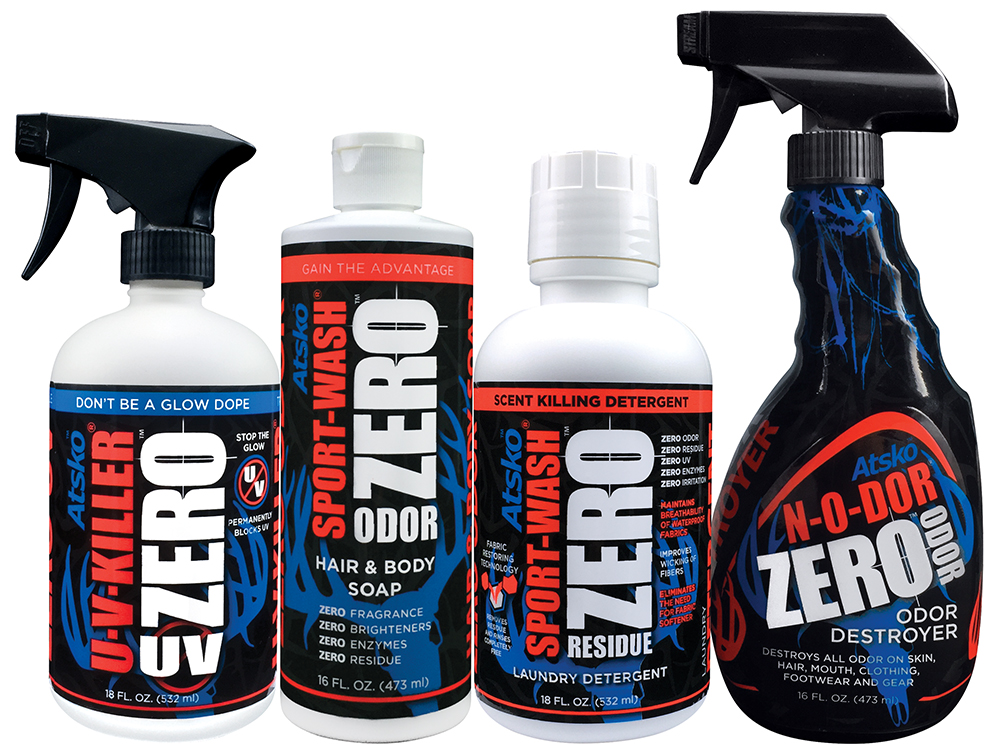
Sport-Wash laundry detergent is formulated without optical brighteners of any kind and is designed to rinse completely, which addresses both concerns above — no brightener contamination, and no residue left behind to affect the uniform’s technical performance. If a uniform has already picked up brighteners from a previous wash in a different detergent, rewashing in a brightener-free detergent going forward stops the problem from continuing, though it won’t remove what’s already bonded to the fabric — for that, the same UV-blocking treatment approach used on hunting camo (see our UV brightener guide) applies here too.

Related Reading

The Detergent Conspiracy

Why your clothes are less clean each time you wash them

It seems like common sense that washing clothes would remove obvious dirt and everything else. You believe washed clothes are cleaner, but are they? If you believe that clean means there is less “stuff” in your clothes, the answer is certainly NO. How is this possible? How can this deception be maintained? How can so many people be wrong about such an obvious assumption?

Tests done in 1995 at the Clemson University School of Textiles and Polymer Science  showed that washing in regular grocery store detergent actually added a measurable amount of weight (contamination) to the clothes. Washing added 2% of the weight of the cloth in just 10 washings. The residue was equal to the full amount of detergent recommended to wash clothes. Let me be specific about this. When you pour in the detergent before the wash cycle, the scoop of powder or cup of liquid, you use is equal to the amount of chemical you will have in your clothes after 10 washes. It doesn’t increase much beyond 10 washes because you reach a point where you are washing out as much as you are washing in.

This is not a closely guarded secret. The laundry ball and laundry disk products were based on the idea that for 30 days of use you would still have “clean” clothes from the detergent residue that was already in your clothes from your previous washings. This is a lot of chemical to wrap your body in 24/7. No wonder some people become sensitive to laundry products.

So what are these chemicals and why are they in our clothes. More importantly, what do they do to clothes and to us. There is a long list of chemicals in most laundry products. It would seem that if you can’t clean clothes with less than six chemicals, maybe you’re not focused on cleaning. The distinctions between green, natural and free, or between detergents and soaps are relatively small. Every washing agent should contain chemicals to separate soil from fabric and carry it away with the water. These are called surfactants and they do whatever cleaning occurs. All the other ingredients are there to help the surfactants or to make you believe your clothes are clean, and these must remain in your clothes to be effective.

Two obvious additives are fragrance and brighteners. There are thousands of fragrances and over 200 brighteners which might be called dyes, colorants, color enhancers, color safe bleach, fluorescent whitening agents (FWA), etc. Then we add oils, silicones, and polymers to attach the fragrances and brighteners. Lubricants to make the fabrics less stiff, other lubricants for your washing machine pump, polyvinylpyrrolidone to seal the surfaces and ends of fibers, antiredeposition agents, perhaps sanitizers, enzymes and oxidizers, also softeners, and of coarse inert fillers so you know by the size of the expensive containers that you got your money’s worth.

These ingredients are almost universal across standard brands, greens, naturals, frees, and other specialties. For example most free and clear products will glow under a UV light, as will most brands declared “Safe” for army camouflage. The highest levels of fragrance are often found in “Baby” detergents. Perhaps, so you will be trained regarding how a clean baby should smell, or so your friends won’t be offended when the diaper needs changing. Detergents for colors and blacks have higher levels of polymer to hide the scattering “fading” caused by fiber erosion.

The latest news in home laundry detergents is P&G’s Proprietary Protective Fiber Complex. This goes beyond polymers to a new silicone complex that not only provides additional lubrication, but also forms little cells of oiliness to keep the silicone complex and other care ingredients from washing away.

This technology is especially important for HE machines. The new machines not only save water and power, but rinse clothes more completely. The designers of HE machines apparently are not part of the conspiracy. Better rinsing is good for you but makes it difficult for the detergent makers to leave enough residue to assure you that your clothes are clean. Detergent makers had initially been forced to add more of the “care” chemicals, but this new technology allows them to overcome the great rinsing performance of you new HE machine and attach exactly the right amount of residue to your clothes.

All this residue is not without consequence. It impacts every feature and benefit of modern high tech clothing. Wicking, breathability, rapid drying and water repellency are all degraded in just a few washings. Over time detergent residue actually erodes the fibers and color much as water and ice destroy mountains. Oxidizers and enzymes attack the smooth surface of the fibers causing tiny pits and fissures that hold particles of residue. As temperature and humidity change, these imperfections swell and shrink. The crystals force the pits and fissures to deepen the spread. The eroded surface scatters light causing colors to look bleached and faded and the fibers weaken, loose memory, and even break. Elastomers fail quicker than other fibers causing daily washed swimwear and exercise outfits to degrade in just a few weeks. Even the flame resistance of children’s 100% polyester sleepwear is lost. Detergent residue not only slows drying, but will rehydrate itself when dry by drawing moisture from the air or from you. PVP (polyvinylpyrrolidone) for example will hold 40% of its weight in water. Extra moisture reduces the efficiency of insulation. Insulation is also less able to loft up when coated with sticky residue, this further decreases effectiveness. Fabrics feel stiffer when coated with sticky chemicals because fibers cannot slip against each to allow a soft hand. Detergent manufacturers try to overcome some of this friction with silicone but deliberately leave some stiffness to ensure an opportunity to sell fabric softener. It is only a small exaggeration to say that washing clothes in regular detergents destroys them as fast as not washing them at all.

What are the effects of laundry residue on humans? An increasing slice of the population is experiencing episodes of eczema, psoriasis, and other reactive skin irritations loosely referred to as contact dermatitis. In cases where the irritation clearly stops where clothing contact stops, most pediatricians, dermatologists, and allergists will recommend elimination of fabric softener. This would be a halfway solution if it was possible, but within a few weeks the clothes become stiff and scratchy, causing the patient to return to using fabric softeners before the next disappointing visit. Since babies are perfumed from birth to smell like baby powder they have ample opportunity to develop sensitivity to laundry chemicals before their own immune system matures. Some people experience burning eyes, and headaches or nausea in the detergent aisle, but most are conditioned to surround themselves with “Natural” fragrances and don’t ever connect the dots to the allergies and discomfort they spend good money to control.

IS THIS REALLY A CONSPIRACY?

A conspiracy implies that people are secretly plotting to cause something. Everyone knows that diapers and baby detergents all smell like baby powder. Everybody knows what the detergent aisle smells like at the grocery store. You may know someone who has spent a fortune on allergy shots; perhaps to be desensitized to one detergent he can use the rest of his life. There is no secrecy here.

So why don’t people choose clean instead of perfume, brighteners, and other residues? Why are scented candles and perfume considered desirable when they were originally invented to cover foul odor in ages before personal hygiene? Indeed, for most of the last 30 years, laundry care detergents have borrowed heavily from the personal care products industry. Much of the marketing is remarkably similar. The world leader in personal care also leads the pack in laundry care and they are both sold to the same consumers. We should not expect the world leaders to change the strategies that have succeeded for three generations, and we can expect that their competitors will continue to copy winning ways.

Does this mean that there will never be laundry products to simply clean your clothes and thus restore brand new performance? No, it just tells us not to expect “clean” from the world leaders. An alternative product, a Residue-Free Detergent (RFD), has been available for over 20 years. It grew out of necessity for special users like hunters, athletes, infants, and elderly where regular detergents simply don’t work. Now as the need for an RFD becomes more apparent, there are copy cat products making remarkably similar claims. Some make a feeble attempt to mimic our formulation but most simply follow the world leaders while applying a label that suggests suitability for the growing applications that require a Residue-Free Detergent. So the need and the product are here, but the conspiracy persists.

Let’s examine how this legacy of contamination is maintained (right under our noses) and try to determine if there is really a conspiracy or just the invisible hand of capitalism? Remember; there are no secrets. What I’m about to reveal is obvious to everyone. I am simply going to help you connect the dots.

Let’s arbitrarily begin at birth. The newborn has been listening and feeling for months but will begin seeing and smelling for the first time ever. The eyes will take a few weeks to reach good acuity and several years for the brain to learn to see efficiently with techniques like pattern completion. All smells are new smells so they are more important now than sight, sounds, or touch. Other animals permanently imprint at birth to parents and location. So what does our newborn smell first? How about the hospital’s laundry detergent? Arriving at home he encounters baby powder, baby oil, and more laundry detergent and fabric softener and perhaps flavored surface cleaners, sanitizers, and room deodorizers. Every time mom rescues baby from hunger, boredom, or a wet diaper, the love is reinforced with the fragrance she uses accidentally, or deliberately, in her hair, skin, and clothes. Can this be a conspiracy if it is not secret?

In some infants this overload of perfume causes immediate problems, but in either case it is likely to continue and be reinforced with over-flavored foods and intentional perfuming of the house. Recent developments for this purpose include time release fabric softener, heated smell producers, and devices that release different odors in sequence because we tend to acclimate rapidly to odor making it less noticeable after just a few minutes. So we keep releasing new odors so they are noticeable again. New laundry products promise to attach little capsules of fragrance that release upon touch. Now every time mother and baby touch, the smell of fresh laundry will be positively reinforced upon the baby. Odor recognition may have helped our ancestors avoid bad food and other dangers but these skills are long lost because most of us are reared in an artificially flavored world. There may also be serious long term consequences for the human race.

The phrase “opposites attract” pays homage to the need for nature to maintain maximum genetic variation. Diversity provides protection against any species becoming so homogenous that a single microbe could eradicate them completely. Two similar immune systems could not endow the offspring with significant new capabilities; but two very different immune systems could create a being with ability to survive what neither of the parents could survive. So how does nature select for most opposed immune capabilities? People with opposite immune compatibilities are naturally attracted to each other’s odor.

In a world of artificial fragrances, where your natural odor is replaced by multiple commercial fragrances we are attracted to individuals without regard for the natural choice that would improve the survivability of our species. So now we have artificial fragrances causing people to choose the wrong mates.

When this leads to dissatisfaction, incompatibility, and unhappiness the market has a solution. People can simply eat more to feel better by associating food and flavor with mothers love. This is profitable for industry, but it is also fattening. People must control their eating so they go to BB&B or Ye Olde Candle & Soap Shop where they can indulge in the fragrance of mothers love. This enables them to feel better without gaining weight.

It is clear that, whether by conspiracy or not, fragrances and the goo to paste them on your clothes are going to remain central to the mainstream laundry products. Successful companies in the business of brightening and flavoring clothes are unlikely to choose to also promote brands to do the opposite. This is understandable, but surely there are others who would benefit by promoting residue free cleaning.

How about the people that manufacture high tech, high performance, clothing? Their business depends on offering special features like wicking, breathability, rapid drying, water repellency, and superior insulation. If they choose to recommend residue-free detergent (RFD), their products can provide a lifetime of superior performance that will ensure customer satisfaction. Yet over the last 20 years dozens of companies have avoided making the single care recommendation that could keep customers happy and their warrantee claims near zero, the recommendation for an RFD.

So how are they drawn into the conspiracy? Is there any way they can benefit from failure and disappointment? Yes, indeed. Making the claim is what sells the garment the first time, but keeping the promise won’t necessarily sell a second one. More than likely, if the jacket is still warm, dry, comfortable, and looking good, 5 years later, it will become an object of love and be kept for another 10. If every garment lasted 3 times as long before recycling, the manufacturer could make only 1/3 as many. Worse yet, the dealers could only sell 1/3 as many. Are the dots coming into focus?

Another big disincentive is the fear of becoming a “special needs” item. If a manufacturer admits that his super hot, new technology has to be residue-free for maximum performance, he puts himself at a huge disadvantage to all of his competitors. They say “no special care”, “just wash with your regular detergent”.

This is also a win-win for the garment retailer, and he enjoys a third win. He can often sell a high priced imported treatment to “restore” repellency. Win #4 is that after a few more washes to apply more residue, it’s time for another expensive revival. Or win #5, a new jacket. In these challenging economic times it doesn’t take much of a conspiracy to encourage all parties to keep the secret.

Before this message self-destructs I want to offer you a mission. Should you decide to accept, we will be available to help you get maximum performance from all your clothing, foot wear, and outdoor gear.

Atsko, Inc. wants to give you a 1 wash load sample of Sport-Wash (RFD) Residue-Free Detergent. All we ask is that you try it on your worst, most hopeless, hasn’t-worked-since-new piece of high tech disappointment.

Let me tell you what to expect. NOTHING, no residue at all. Not very glamorous or attractive, no wonder it’s not at the top of every label. But now let me summarize the benefits. Residue free clothes look better, perform better, and last longer. Special features and benefits are restored and maintained.

Water repellency of fabrics with factory durable water repellent (DWR) can be restored again and again simply by washing in Sport-Wash and reactivating with heat. Our own DWR’s called Permanent Water-Guard are guaranteed to repel water for 25 washes in Sport-Wash.

Odors are easily removed with Sport-Wash, even from polypropylene and other olefin fabrics. It simply removes the oils that retain the odors. Odor removal has made Sport-Wash #1 with hunters and outdoorsmen for over 20 years. Residue-free fabrics hold very little odor. Most odor is held by the residue of other detergents, especially the oils and polymers that are used to hold the fragrance and brighteners.

Breathability is lost when materials are coated with oils and detergent residue, but restored when washed with Sport-Wash. If a waterproof breathable fabric is coated with residue, the outer surface will wet-out in the rain. This forms a film of water that is an excellent barrier to air and vapor passage. When washed with Sport-Wash the repellent keeps the surface dry, allowing air and moisture to pass though for maximum comfort.

Rapid drying depends upon moving moisture away quickly. Wicking fibers have special surfaces that move water by capillary action which is much faster than wicking like cotton. When coated, the high speed capillary action is replaced by slow wicking and slow drying. Sport-Wash restores the high speed drying.

Softness is lost when residue causes fibers to adhere to each other. Clean fibers slip easily against each other so Sport-Wash eliminates the need for fabric softener. Stiff fabrics also wear faster and abrade the skin. Residue free fibers feel soft, control friction, and reduce wear so your clothes stay new longer. If every household in the US eliminated just 1 box of fabric softener sheets it would reduce land fill by 6000 tons. ‚

Insulation is restored to maximize loft and efficiency when residue free. Washing down and other insulations in Residue Free Detergent (RFD) will make them fluff up better than new because the feathers dry better and have no oil to paste them together.

Flame resistance of children’s 100% polyester sleepwear is ruined by detergent and softener residue. In tests done by Clemson University, Sport-Wash RFD actually reduces the char length test results of 100% polyester to less than when tested new.

Residue-free detergent can eliminate rash, redness, and irritation caused by contact with laundry chemicals. Over 1500 dermatologists, allergists, and pediatricians have recommended Sensi-Clean, another label of Sport-Wash, for their patients with various forms of contact dermatitis. RFD eliminates the irritation caused by detergent without introducing new, potentially more irritating chemicals. People with reactive skin conditions frequently ask what ingredients are used in a detergent. This is the wrong question. It assumes that all the ingredients will contact your skin and you just need to avoid the one that can be identified as irritating to you.

This approach is clumsy, expensive, and unreliable as most products are continuously changing. The simple, effective, reliable and free alternative is to select an RFD (Sport-Wash or Sensi-Clean). When a product rinses completely there is no trace of the ingredients, so by definition, irritation is impossible.

To get all the benefits of residue-free clothes you might expect to pay a fortune or give up convenience and versatility, or have to risk destroying your clothes, your washer, your septic tank system, or the environment? Quite the opposite is true.
Sport-Wash RFD is safe for all washable fabrics including washable wool, silk, down, and with extra care, it can replace a lot of dry cleaning. It is gentle to fibers and colors and maintains elastics and other sensitive treatments such as screen printing and glued on decorations. Frequently washed items will last noticeably longer.

Sport-Wash is right for all washers from the oldest top loaders to the most advanced HE. It is low sudsing and it eliminates the need for periodic “cleaning” cycles. RFD releases the full potential of HE machines to leave less residue while using less water and power. It works well in hot or cold and hard or soft water for more savings and completely eliminates the need for fabric softener while leaving your clothes softer and more absorbent than ever before.

Sport-Wash RFD is READILY biodegradable so it actually helps your septic system operate more efficiently. It is renewable, made from coconut based straight chain surfactants and cannot cause skin irritation because it rinses away completely. Optical brighteners found in other detergents are so indestructible in the environment that population studies often utilize data gathered by measuring the amount of brighteners found in rivers, lakes, and streams. In Sport-Wash we never use optical brighteners of any kind.

Sport-Wash is highly efficient using only 1 ounce per standard wash load. This is in part because it has no counter productive ingredients. Every fragrance and dye the world leaders deposit in your clothes, and all the new agents they use to keep them there, are fighting their cleaning agents so they must use more of both. It all winds up in the environment. When you only CLEAN clothes and leave no residue, it takes a lot less chemicals to do the job. This is part of why Sport-Wash is able to be competitive with major brands. We also save packaging and freight by making it in the USA and keeping it concentrated so you need only 1 oz per wash load. Major brands in the USA still require over 1 oz to wash a standard load of clothes, a big waste to justify a big price.

Now you know the rest of the story and you can choose to wash with a residue-free detergent. It will save many times its small cost by ending the premature recycling of perfectly restorable items. With the time, money, travel, and shopping you save you can get out and enjoy the environment more. Please enjoy your free sample of Sport-Wash and tell you friends about RFD’s. Many are unaware that there is any alternative to perfume and dyes, poor performance and early replacement. They are victims of the detergent conspiracy. “The truth is out there”, just connect the dots.

If you enjoyed this read you may also appreciate “The Camo Conspiracy.” It and many more technical essays on the care of clothing, footwear, and gear can be found at atsko.com.

Enjoy the outdoors more,
Dan Gutting
Vice-President
Atsko, Inc.

References:
May 1995, Nicholson, R. Detergent Evaluation, Clemson University, College of Engineering and Science.
January 2009, Esposito, Christine, Happi Pages 78-80.
June 1996, Nicholson, R. Flammability-Children Sleepwear, Clemson University College of Engineering and Science.

Don’t Wash Away Performance

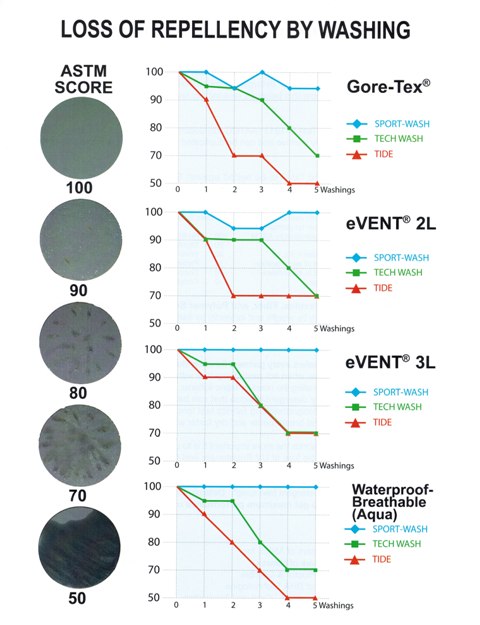
Laundry detergent residue stops features including wicking, breathing, water repellency, and the ability to dry quickly. The decrease in test scores appears to indicate that the water repellency has washed away. In reality, the chemical residue of the other detergents has coated the fabric enabling water to stick and penetrate the outer lining. We know this because re-washing failed fabrics with Sport-Wash® restores water repellency.

The ASTM standard Water Spray Test D-1913 (AATCC 22) documents the loss of repellency caused by detergent residue. This test is highly intuitive and can be duplicated by ordinary users without elaborate test instruments.

We have chosen Tech Wash® and Tide® to be tested against Sport-Wash® because Tech Wash® is extensively promoted as a specialty detergent to maintain High Tech Outdoor clothing, and Tide® because it is well known and typical of conventional detergents.

Test fabrics were washed in accordance with manufacturers directions. Test fabrics were dried in a dryer on permanent press setting until dry. Test fabrics were evaluated by ASTM Standard Water Spray Test D-1913.

Testing was conducted as follows: Spray rate = 8 fl. oz. (237 ml.) water per 30 seconds. At the end of each iteration the test fabrics were evaluated and scored in accordance with the ASTM Standard Spray Test Ratings.

Standard Spray Test Ratings:

100 No Sticking or Wetting of Upper Surface
90 Slight Random Sticking or Wetting of Upper Surface
80 Wetting of Upper Surface at Spray Points
70 Partial Wetting of Whole of Upper Surface
50 Complete Wetting of Whole of Upper Surface
Complete Wetting of Whole Upper and Lower Surface

Clemson University School of Textiles, Fiber, and Polymer Science has also testedSport-Wash® measuring detergent residue directly by weight and indirectly by flame resistance. The details of these tests are on our website (www.atsko.com). Additional tests by gas chromatography and residue vaporization all confirm the unique rinsability of Sport-Wash®

Freedom from detergent residue makes every garment function like new. Down and synthetic insulation can fluff up for maximum insulation value when not pasted together with detergent residue. Totally clean fibers move easily against each other eliminating the need for fabric softener. Rash, redness, and irritation are caused by continuous exposure to laundry detergent residue that can be eliminated by Sport-Wash®. Clothes, ropes, webbing, and working/moving/stretching fabrics last longer when free of abrasive particles of detergent residue. Fabrics wick and breath better and dry faster when free of chemical residue.

The more you depend on Hi-Tech fabrics the more important it is to use only Sport-Wash®to maintain them. Hunters and photographers must be free of UV Brighteners and fragrances to avoid spooking animals. Fire turnout gear must be free of flammable residue to prevent flashover. Every time the care tag says, “Wash with a residue-free detergent” you will get better results with Sport-Wash®. Don’t settle for “Sport-Wash type”. Don’t fall for “detergent free soap”. Detergent replaced soaps because soap rinses so poorly, especially in hard water. To get maximum performance use Sport-Wash®.

repellency loss chart

Sport-Wash® is a registered trademark of Atsko, Inc.
Tech Wash® is a registered trademark of Nikwax
Tide® is a registered trademark of Proctor & Gamble
eVENT® is a registered trademark of BHA Technologies
Gore-Tex® is a registered trademark of W.L. Gore and Associates

Flammability of Children’s Sleepwear Washed with Sensi-Clean

FROM:
Robbie Nicholson, Research Specialist
Physical Evaluation Laboratory

TO:
Mr. Dan Gutting
Atsko, Inc.
2530 Russel S.E.
Orangeburg, S.C. 29115

DATE: June 04, 1996

SUBJECT: Flammability – Children’s Sleepwear

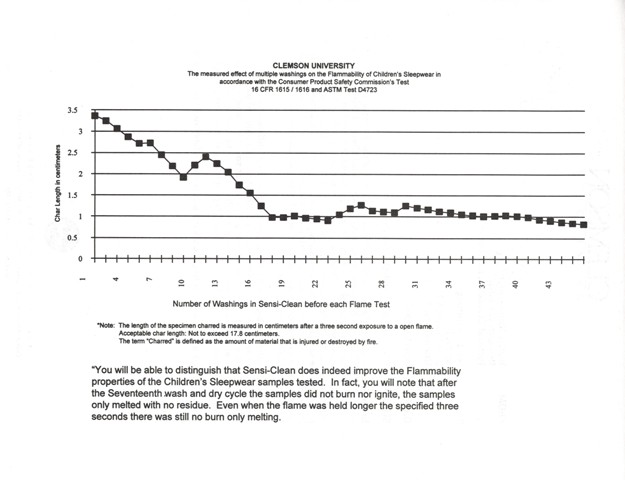
Enclosed are copies of the data gathered from the testing of the Flammability properties of Children’s Sleepwear after washing with Sensi-Clean. I believe that you will be able to distinguish that Sensi-Clean does indeed improve the Flammability properties of the Children’s Sleepwear samples tested. In fact, you will note that after the Seventeenth wash and dry cycle the samples did not burn nor ignite, the samples only melted with no residue. Even when the flame was held longer than the specified three (3) seconds there was still no burn, only melting. All of the samples were tested in accordance to the specifications of the Federal Test Methods for Children’s Sleepwear.

CLEMSON UNIVERSITY
The measured effect of multiple wasing on the Flammability of Children’s Sleepwear in accordance with the Consumer Product Safety Commission’s Test 16 CFR 1615/1616 and ASTM Test D4723

*Note: The length of the specimen charred is measured in centimeters after a three second exposure to a open flame. Acceptable char length: Not to exceed 17.8 centimeters. The term “Charred” is defined as the amount of material that is injured or destroyed by fire.

You will be able to distinguish that Sensi-Clean does indeed improve the flammability properties of children’s sleepwear samples tested. In fact, you will note that after the Seventeenth wash and dry cycle the samples did not burn nor ignite, the samples only melted with no residue. Even when the flame was held longer than the specified three seconds there was still no burn only melting.

Sensi-Clean Detergent Evaluation

FROM:
Robbie Nicholson, Research Specialist
Physical Evaluation Labratory

TO: Mr. Dan Gutting, Mr. Kurt Von Busser

DATE: May 15, 1995

SUBJECT: Detergent Evaluation

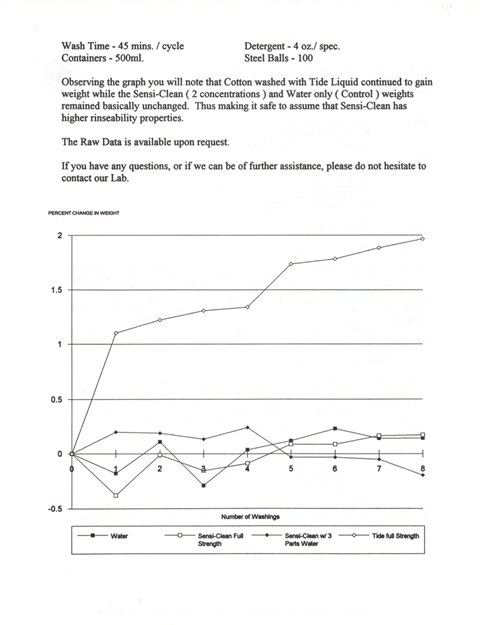
The object of this research is to determine the rinseability differences between a new product SENSI-CLEAN and TIDE LIQUID. Attached is the Graph obtained from data of test results performed at the request of Mr. Dan Gutting, Atsko, Inc. These results were obtained from testing rinseability of 100% Cotton Diapers during numerous wash cycles. Detergents supplied were SENSI-CLEAN 1 (4 times recommended amount), SENSI-CLEAN (recommended amount), and TIDE. Also cycles were completed using Water only (Control), no detergent. All tests were conducted utilizing the Launder-Ometer (Commercial Laundering). The Launder-Ometer rotates closed containers in a thermostatically controlled water bath at 40 rpm.

Three (3) fabric specimens were laundered in each of the detergents. Each Detergent was measured to insure ounce per ounce equivalency. Conditions during the wash cycle were determined from careful viewing of AATCC Test Method #61 (Colorfastness to Laundering, Home and Commercial Accelerated). Due to the need to simulate the most stringent test the following procedure and conditions were followed

Detergents:

TIDE LIQUID (Mfg. recommended amount)

SENSI-CLEAN 1 (4 times Mfg. recommended amount)

SENSI-CLEAN (Mfg. recommended amount)

WATER (Only) – (Control)

Each specimen was washed in a water bath, dried, and conditioned at 70 degrees F. and 65% R.H. before Original weight recorded. After the Wash cycle each specimen was dried for 50 mins., Cotton setting, to assure complete dryness before reweighing.

Wash Time – 45 mins. / cycle

Detergent – 4 oz. / spec.

Containers – 500ml

Steel Balls – 100

Observing the graph you will note that Cotton washed with Tide Liquid continued to gain weight while the Sensi-Clean (2 concentrations) and Water (Control) weights remained basically unchanged. Thus making it safe to assume that Sensi-Clean has higher rinseability properties.

The Raw Data is available upon request.

If you have any questions, or if we can be of further assistance, please do not hesitate to contact our Lab.

sensi-clean eval chart

Sport-Wash Detergent Evaluation

FROM:
Robbie Nicholson – Research Specialist
Physical Evaluation Labratory

TO:
Mr. Dan Gutting, Mr. Kurt Von Busser
Atsko, Inc.
2530 Russel S.E.
Orangeburg, S.C. 29115

DATE: May 15, 1995

SUBJECT: Detergent Evaluation

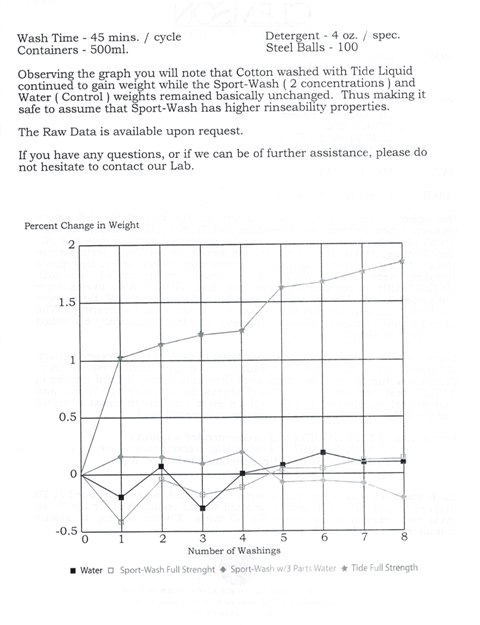
The object of this research is to determine the rinseability differences between a new product SPORT-WASH and TIDE LIQUID. Attached is the Graph obtained from data of test results performed at the request of Mr. Dan Gutting, Atsko, Inc. These results were obtained from testing rinseability of 100% Cotton Diapers during numerous wash cycles. Detergents supplied were SPORT-WASH 1 (4 times recommended amount), SPORT-WASH (recommended amount), and TIDE. Also cycles were completed using Water only (Control), no detergent. All tests were conducted utilizing the Launder-Ometer (Commercial Laundering). The Launder-Ometer rotates closed containers in a thermostatically controlled water bath at 40 rpm.

Three (3) fabric specimens were laundered in each of the detergents. Each Detergent was measured to insure ounce per ounce equivalency. Conditions during the wash cycle were determined from careful viewing of AATCC Test Method #61 (Colorfastness to Laundering, Home and Commercial Accelerated). Due to the need to simulate the most stringent test the following procedure and conditions were followed.

Detergents:
TIDE LIQUID (Mfg. recommended amount)

SPORT-WASH 1 (4 times Mfg. recommended amount)

SPORT-WASH (Mfg. recommended amount)

WATER (Only) – (Control)

Each specimen was washed in a water bath, dried, and conditioned at 70 degrees F. and 65% R.H. before Original weight recorded. After the Wash cycle each specimen was dried for 50 mins., Cotton setting, to assure complete dryness before reweighing.

Wash Time – 45 mins. / cycle

Detergent – 4 oz. / spec.

Containers – 500ml

Steel Balls – 100

Observing the graph you will note that Cotton washed with Tide Liquid continued to gain weight while the Sport-Wash (2 concentrations) and Water (Control) weights remained basically unchanged. Thus making it safe to assume that Sport-Wash has higher rinseability properties.

The Raw Data is available upon request.

If you have any questions, or if we can be of further assistance, please do not hesitate to contact our Lab.

sport wash eval chart
LEAD Technologies Inc. V1.01

High Efficiency (HE) Washing Machines

Computer-controlled front loading HE machines are superior to Top Loading agitator machines. They save energy, water and money while increasing the life of clothing. They even enable you to wash things that required dry cleaning.

But if you use the same old brand detergent, all you get is the same old results of depositing residue, fragrance and brightener. You might as well keep your old machine and capture the rinse water for the next wash. If you find this concept disgusting listen up.

Brand name detergents for HE machines are reformulated for compatibility with the horizontal axis machines, but their purpose remains the same. It is to deposit fragrance, optical brighteners, surfactants, lubricants, softeners, PVP etc. These chemicals give the illusion of clean clothes and a way for different brands to distinguish themselves, by odor but they are actually counterproductive. The chemical residue irritates skin and eliminates water repellency, breathability, wicking, rapid drying, softness, insulation and elasticity of fabrics.

Because HE machines rinse so well, detergent manufacturers need to use more fragrance etc to ensure that they can leave enough in your clothes. They actually charge more for “HE” formulas. They should be called “anti HE” because they are designed to overcome your new machine’s ability to leave less residue.

To get the cleanest residue free clothes use Sport-Wash® Residue-Free Detergent (RFD).Sport-Wash® has no fragrance, brightener, oil, softener, silicone, lubricant, enzymes, PVP or anything else that doesn’t rinse completely. Sport-Wash® is different from all other detergents, HE and regular. It is formulated to rinse completely, so it is not fighting your machine to leave residue behind. With Sport-Wash® in your HE machine your clothes smell like fresh air, not a flavor called “Fresh Air”. Because Sport-Wash® rinses completely it allows repellents to work like new. It restores breathability, wicking, rapid drying, softness, insulation and elasticity. Sport-Wash® RDF makes color, fibers and elastomers last longer. It has no oxidizers which destroy colors and weaken fibers. It cleans by using superior surfactency to release the oils that hold soils, stain and smells. While the residue of other detergents erodes fibers with particles that fissure and crack them, Sport-Wash® keeps them new and smooth so you don’t need lubricants or softeners for soft feel and you don’t need PVP or other sealants to maintain color. The residues of other detergents hold more odor than the fibers themselves so by leaving no residue, Sport-Wash® actually reduces the ability of the garment to retain odors. This makes it possible to enjoy polypropylene and other olefin base layers without the odor retention problems.

With a new HE machine and Sport-Wash® Residue-Free Detergent (RFD) you can experience a new level of clean without the chemicals you have been marinating in since your were born. Eczema, psoriasis, contact dermatitis and other reactive skin disorders are constantly triggered by exposure to detergent and softener chemicals. These can all be eliminated with Sport-Wash® Brand RFD and an HE Machine. Sport-Wash® will make any machine leave less residue, but the results are best with an HE machine. Many HE manufacturers recommend a maintenance cycle ones a week with hot water and no clothes to clean residue out of the machine to prevent odor. With Sport-Wash® this is never necessary. Sport-Wash® will clean up any old machine and keep a new one in pristine condition.

Finally, Sport-Wash® will save you money. It costs less to use and completely eliminates the need for Fabric Softeners and Hot water. You only use 1 oz per wash load of Sport-Wash® versus 3 to 4 ounces of other products. Saving millions of tons of fuel for transport.

Sport-Wash® Brand is a net savings to the environment because it’s use eliminates early failure and replacement of everything you wash, saving you and the environment many times the cost of our product.

Water Repellent Durability

The ASTM D-1913 Water Spray Test indicates what performance could be expected for one minute of rain exposure.

A pattern of rain can easily take an hour to pass. We believe this can be represented by 50 consecutive water spray cycles. The fabric is exposed to 30 seconds of heavy spray alternating with 30 seconds of soak time, repeated 50 times for a total of approximately 50 minutes. The results show significant differences in the performance of the products tested. Some won’t protect you for more then a few minutes, maybe a short sprint from a small parking lot, but not much more.

Silicone Water-Guard® gives long lasting real protection but like all silicones does not survive washing in detergent or dry cleaning.

TEST PROTOCOL

Test fabrics were sprayed in accordance with manufacturer’s Directions.
Test fabrics were then dried in accordance with manufacturer’s Directions.
Treated fabrics were evaluated by ASTM Standard Water Spray Test D-1913.
Testing was conducted as follows: Spray rate = 8-fl. oz. per 30 seconds.
At the end of each spray cycle the test fabric was evaluated and scored in accordance with the Standard Spray Test Ratings.

STANDARD SPRAY TEST RATINGS

100 No Sticking or Wetting of Upper Surface
90 Slight Random Sticking or Wetting of Upper Surface
80 Wetting of Upper Surface at Spray Points
70 Partial Wetting of Whole of Upper Surface
50 Complete Wetting of Whole of Upper Surface
0 Complete Wetting of Whole Upper and Lower Surface
Water-Guard® is a registered trademark of Atsko, Inc.
TX-Direct® is a registered trademark of Nikwax Waterproofing Ltd.
Tent & Gear Proof® is a registered trademark of Nikwax Waterproofing Ltd.
Woolite® is a registered trademark of Rickett and Colman.

50 Consecutive Test Durability
by continuous repetition of ASTM Water Spray Test D-1913

Rinsability of Sensi-Clean

FROM:
Robbie Nicholson – Research Specialist
Physical Evaluation Laboratory

TO:
Mr. Dan Gutting, Mr. Kurt Von Besser
2530 Russel S.E.
Orangeburg, S.C. 29115

DATE: May 15, 1995

SUBJECT: Detergent Evaluation

The object of this research is to determine the rinsability differences between a new product SENSI-CLEAN and TIDE LIQUID. Attached is the Graph obtained from data of test results performed at the request of Mr. Charles Sutherland, Sutherland Products. These results were obtained from testing rinsability of 100% Cotton diapers during numerous wash cycles. Detergents supplied were SENSI-CLEAN 1(4 times recommended amount), SENSI-CLEAN(recommended amount), and TIDE. Also cyles were completed using Water only(Control), no detergent. All test were conducted utilizing the Launder-Ometer(Commercial Laundering). The Launder-Ometer rotates closed containers in a thermostatically controlled water bath at 40 rpm.

Three (3) fabric specimens were laundered in each of the detergents. Each Detergent was measured to insure ounce per ounce equivalency. Conditions during the wash cycle were determined from careful viewing of AATCC Test Method #61(Colorfastness to Laundering, Home and Commercial: Accelerated). Due to the need to stimulate the most stringent test the following procedure and condtions were followed.

Detergents:
1) TIDE LIQUID (Mfg. recommended amount)

2)SENSI-CLEAN (4 times Mfg. recommended amount)

3)SENSI-CLEAN (Mfg recommended amount)

4)WATER (Only) – (Control)

Each specimen was washed in a water bath, dried and conditioned at 70 degrees F. and 65% R.H. before original weight recorded. After the wash cycle each specimen was dried for 50 minutes., Cotton setting, to assure complete dryness before reweighing.

Wash Time – 45 mins./cycle Detergent – 4 oz./spec.

Containers – 500ml. Steel Balls – 100

Observing the graph you will not that cotton wash with Tide Liquid continued to gain weight while the Sensi-Clean (2 concentrations) and Waster only (control) weights remained basically unchanged. Thus making it safe to assume that Sensi-Clean has higher rinsability properties.

Caring for Waterproof Fabrics

Waterproof breathable materials allow water vapor to pass thru while stopping liquid water. This is done with a membrane of Fluoropolymer (Teflon type) material that has very small spaces allowing single molecules of water vapor to pass, but stopping water droplets.

These materials are made by manufacturers such as W.L. Gore® and Associates (makers of Gore-Tex®) and others. They are made in different densities from very water resistant (limited breathability) to slight water resistance but excellent breathability. They are always sandwiched between two or more layers of material for physical protection against tearing, and abrasion. Being made of Fluoropolymer, nothing sticks to the membrane itself short of roofing tar. Fluoropolymers are resistant to all common chemicals, it matters little if the membrane is clean, or what is used to clean it. The most common problems to affect the Fluoropolymer membrane are damage from sewing, tearing, or stretching. Proper care is not dictated by any special needs of the Fluoropolymer membrane.

It is the outer shell that determines how the garment must be cared for. Typically jackets or pants that have a Fluoropolymer membrane will have an outer shell that is factory treated with a fluoropolymer water repellent coating. This has obvious advantages if the Fluoropolymer membrane should leak. It is always important however that the Fluoropolymer coated outer shell remain clean and dry to allow the water vapor to escape. This is because the body moisture that passes thru the Fluoropolymer membrane must be allowed to escape thru the shell or it will accumulate reducing further evaporation and in some cases condensing making the garment feel wet. When it is raining the Fluoropolymer coating on the outer shell must keep beading and shedding the rain. Saturation of the shell stops its breathability, leaving nowhere for the body moisture to go.

So how do you care for the shell to keep it dry and breathing? Mostly, it must be clean. Never wash with a soap or detergent that leaves residue behind. This detergent residue covers the Fluoropolymer coating making it ineffective, allowing the water drops to spread out and leak thru the shell. W.L. Gore® recommends powder detergents to avoid the suggestion that special care is required for their Fluoropolymer membrane. Unfortunately, the residue from typical laundry powders and liquids covers the durable Fluoropolymer coating on the outer shell. These residual wetting agents allow water to spread out and soak in instead of beading and running off. Another source of wetting agents is air pollution. A new raincoat can lose its ability to bead water just by hanging in the closet for a year. Dry cleaning is not recommended as it also leaves a residue behind that stops the beading action.

Tests conducted at Clemson University School of Textiles demonstrate that Sport-Washand Sensi-Clean Laundry Detergent leave absolutely no residue. They rinse completely, leaving nothing behind to cover the fluoropolymer coating while other laundry products deposit chemical residue totaling 2 to 3% of the weight of the fabric. Leaving no residue allows the fluoropolymer coating on the outer shell to work like new.

Ironing at the highest setting recommended by the garment manufacturer further enhances the effectiveness of the repellant by activating the fluoropolymer molecules so that they can optimize their orientation and maximize the beading action of the water droplets. People often claim that washing with Sport-Wash or Sensi-Clean has restored the waterproofing of their garment and ask for the detergent with the waterproofing in it. There was nothing wrong with the Fluoropolymer coating at all; it was only dirty, allowing the water droplets to spread out and soak thru the shell.

By washing the garment in Sport-Wash or Sensi-Clean you are restoring the water repellence and breathability of the outer shell therefore enhancing the performance of the Fluoropolymer membrane.

If washing in Sport-Wash or Sensi-Clean without fabric softener followed by ironing fails to restore the shell to water repellent condition you can be certain there is no repellent present. It is rare to find a waterproof breathable garment without a fluoropolymer type Durable Water Repellent (DWR). It may have been an error, it may have been treated with wax or silicone instead of a DWR because it is not washable, or the DWR may have been exhausted by age, use, and improper washing or dry cleaning.

For washable and ironable fabrics use our Permanent Water-Guard. It is a superior fluoropolymer DWR in a non-flammable solvent-free non-Volatile Organic Compound formula. When applied and cared for per our instructions Permanent Water-Guard will exceed the performance and durability of factory applied DWR’s because we do not use wax, silicone, or other extenders that make a big first impression and then wash away.

Permanent Water-Guard is guaranteed for 25 washings in Sport-Wash or Sensi-Cleandetergent. Keeping the shell dry and breathing assures you will enjoy the full benefit of your Waterproof/Breathable garment.

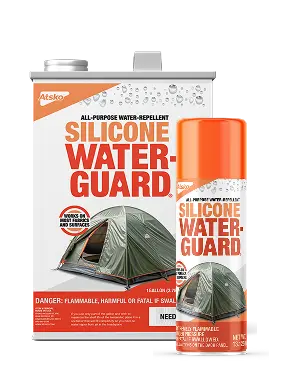
Leather, Suede or “Dry Clean Only” garments and boots can not be washed in Sport-Washor Sensi-Clean as required for fluoropolymer bonding, and can not be heated to cure and activate a DWR. For these applications use Silicone Water-Guard by Atsko, Inc. It is a heavy duty catalyzing silicone formula that cures without heat. Only one treatment is necessary but it does wash away in a few good soakings.

Waterproof breathable liners are often used in boots. Usually these boots will be silicone tanned because the liner would be useless if the boot soaked up water. Foot moisture passing thru the membrane must be absorbed by the leather in order to provide comfort. If the boot leather is soaked thru with oil, grease, animal fat, or water; the absorption and release of this foot moisture can not occur. Your boots will be heavy and your feet will feel wet and cold.

In boots as with garments, the Fluoropolymer membrane requires no special care. Simply care for the out side of the boot properly. If it is smooth top grain leather use Sno-Seal the original Beeswax Waterproofing. If silicone tanned, use Silicone Water-Guard. For split, suede, brushed, napped etc., use Silicone Water-Guard to preserve appearance, but for serious hard working water proofing use Sno-Seal, it will last longer.

Soap Versus Detergent

As a manufacturer of products to care for clothing, footwear, and outdoor gear, I am frequently asked about the difference between soap and detergent. I’m going to try to keep this as simple and general as possible so that it applies to cleaners from laundry detergents to baby shampoo. You can also look up the Soap and Detergent Association’s online info to see what they have to say. Remember, these folks are marketers for their industry and though their information is accurate, it may not be complete.

The FDA has a definition to distinguish soaps and detergents for the purpose of applying regulations. It gives special treatment to alkali salts of fatty acids. In fact, soap is just a very unspecial form of detergent. 100 years ago there was no such thing as detergent but almost every cleaning aid we had, especially everything called soap, is now under the definition of detergent. When someone says a cleaning product is a “Soap – Not a Detergent” or it is a “Non-Detergent” they are just marketing statements.

A detergent is anything that grabs onto dirt, soil, grease, oil, odor, etc. and holds it well enough to loosen its grip on clothing, skin, hair, house paint, etc. and pull it into the wash water. This gets tricky. If the detergent hooks-up too well it may join the dirt on the fabric or surface and become part of the problem (soap and detergent scum). So our cleaning agent must remain well attached to the water so that as the water rinses away, the detergent goes with it still holding fast to the dirts and soils it has released from the material being cleaned.

That’s how cleaning works whether we call it soap or call it detergent. The difference comes from how we create the cleaner that must love oily dirt on one hand and love water on the other hand. A detergent or soap molecule is different on one end from the other. One end loves dirt and the other loves water.

A modern chemical plant can make any kind of cleaner you want. There are many compounds that are non-polar or uncharged at one end and polar or charged at the other end. The non-polar end will grab the dirt from the surface and the polar end will hang onto the wash water to carry it all away. You can make each molecule exactly the same for a very specific dirt or you can create blends of several different molecules to attack a range of soils. Each of these elegantly engineered molecules is a surfactant (surface active agent) and a blend of surfactants for a specific cleaning task is a modern detergent. The value, effectiveness, safety, efficiency, biodegradability and purity of a proper detergent is a work of art.

Unfortunately, modern marketing is not overly concerned with great cleaning, so they add brighteners, softeners, colors, anti-microbials, fragrances, enzymes, extracts, essential oils, vitamins, milk, tea, oatmeal, etc. The list goes on forever, a long march of “new and improved” products to eager consumers. Manufacturers can produce outstanding detergents but Marketers insist on polluting them all with counterproductive chemical slop.

Is “soap” the answer? NO, quite the contrary! Most of them are based on the modern surfactant blends, same as the products called detergents. Soaps usually have all the same modern pollutants that you find in detergents and they have the additional problem of not working well in hard water.

There are some “soaps” that don’t use efficient surfactants. They use fats or oils that have had a charged group of atoms attached by ancient chemistry. If they actually do the cleaning with an alkali salt of fatty acid, they meet the FDA definition of Soap.

The classic form is to boil animal fat and throw in an amount of lye that will supply charged ends for all the oil molecules. You have very little control of this process. It’s more art than science. You are beginning with a mix of different fat/oil molecules and a mix of alkali along with impurities. Time and temperature cause various combinations to occur and each will interact differently with the soils and especially with the calcium and magnesium in the wash water. Such soap doesn’t clean well and often leaves a bigger mess than you started with, particularly in hard water. Now add peppermint, honey, apricot extract and a dozen more sensitizers and you have a toxic mess guaranteed to succeed in a market where products strive to distinguish themselves by the chemical residue they deposit on your hair, skin and clothing.

So how do you choose a cleaner?

For starters, forget about looking for “Soap.” It’s probably not really soap and would be a poor choice if it was.

What ingredients should we look for and which to avoid? This is a trick question. It’s not what is in the cleaner that causes problems, it’s what fails to rinse off your skin, your hair and your clothes. A properly selected high quality surfactant should do the job efficiently and rinse away completely. A proper blend of two or three compatible surfactants can be the basis of a good cleaner. Rather than name hundreds of possible ingredients that may or may not be synergistic or appropriate, my advice is to find a product that does the best job with the least ingredients in number and amount.

Liquid laundry detergents should do a machine load with one ounce or less. A laundry powder should dissolve to totally clear in cold water in one minute or less and should get the job done with one tablespoon per wash load. If more is required, there are several possibilities and none of them beneficial except to the marketers. They may just water it down so you think you’re getting more for your money. This is a waste of packaging, space, transport, convenience, etc. Maybe they use poorly chosen, incompatible, inappropriate, or ineffective surfactants and need lots more chemical to do the job. Usually they have loaded in so many counterproductive chemicals to “Distinguish” their product that it overwhelms the cleaners so they have to use more. This a recipe for poor rinsability and lots of irritating residue.

And how do you measure performance? Assuming it removes obvious soils and odors, here are a few other things to look for.

If a product leaves UV Brighteners or Fluorescent Whitening Agent, it’s not clean.

If a product leaves an antimicrobial, it’s not clean.

If a product leaves a residue that reduces water repellency, it’s not clean.

If a product increases flammability of 100% Polyester, it’s not clean.

If a product adds to the weight of the fabric, it’s not clean.

If you need to use fabric softener, it’s not clean.

If your hair feels cleaner for a few days each time you switch brands, it’s not clean.
A product should be “Readily” Biodegradable and economical enough so that you can use it for the rest of your life.

If you have very soft water and very little dirt or odor, a soap can do a fair job on common soil. If, however, you have special fabric, soils, odors, skin sensitivities, or high tech features to restore and maintain, only detergents can do the job. The real villain is the residues of fad ingredients that can be added to both soaps and detergents.

You can eliminate all residues and the odor, performance, and irritation issues they cause by selecting Sport-Wash Residue-Free Detergent or Sensi-Clean Irritation-Free Detergent from Atsko/Sno-Seal.

For personal care, choose Sport-Wash Hair & Body Soap or Sensi-Clean Shampoo & Body Gel. The Sport-Wash and Sensi-Clean Brands are the same product marketed to target the diverse demographics and issues that are addressed by eliminating residue.

For more information on HOW TO AVOID UNNECESSARY CHEMICAL EXPOSURE and to see UNIVERSITY TEST DATA on residue free detergents, visit www.atsko.com. The Illinois Institute of Technology (my Alma Mater) has a class room demonstration of soap making included on their website. You can get a sticky feeling for why soaps have been replaced by detergents here.

Sanitation and Residue-Free Detergents for Residue-Free Diapers

This is dirty business with regularly recurring exposure to acids and bacteria including staphylococcus areous and ecolli. While we want to minimize the unpleasantness to encourage the use of washable diapers, it is dangerous to minimize the importance of protecting your baby from bacterial infection. Broken or stressed skin can be an inadequate barrier and an immature immune response can be overwhelmed by the very bacteria we tolerate thru our entire lives. Sanitation failure can result in serious infection often requiring antibiotics. Don’t be discouraged by the need to get it right. The irritation rate for cloth diapers can be lower than for disposables. In 1955, 100% of babies were cloth diapered; 7.1% of them experienced diaper rash. In 1990, 90% of babies were diapered with disposables, and 10% were cloth diapered; 78% of babies in 1990 experienced diaper rash. (“Why Use Cloth Diapers?” Kim Becker). In 1955 we used bleach in storage pails and boiled diapers after washing. Diaper services all claimed absolute sterilization.

The primary requirement of safe washings is to remove enough of this bacteria so that the skin gets a chance to recover before the next onslaught. If the look or smell of a diaper suggests you don’t want to rub your face with it, then it is not ready for either end of your Baby.

In years past, diapers were dumped, scraped and rinsed in the toilet and then collected in a pail of water with 1 or 2 ounces of bleach. If soils were light the pail could be dumped into the washer and washed in hot water. Diapers that did not come out looking and smelling great would be boiled with a little bleach. We weren’t concerned about saving hot water, avoiding the use of chlorine, or making the diapers last for 3 more kids. There was still the occasional irritation because Moms have always been busy and diapers get toxic real quick because that’s what living bacteria do.

If a doctor’s diagnosis is staph infection or similar, chances are it results from excessive incubation time for a colony of bacteria rather the soap, baby oil, lotion or detergent. First you must eliminate bacteria, then you can concentrate on the benefits of eliminating detergent residue. Washable diapers certainly last longer if you can limit washing to warm or hot water without bleach, but if you are leaving stain and odor, you have no choice but to be more aggressive. Hot water is not what it used to be. In the interest of saving energy and preventing injury, hot water heaters are now regulated to lower temperatures. Some washers now contain heaters because your hot water storage tank is to cold to kill bacteria. Mom used to boil diapers. 212° F kills just about everything. 160° F kills most bacteria and used to be possible with older model water heaters. 120° F as found in a typical hot water home wash doesn’t kill much of anything.

Always wash diapers in water at least 160° F. If you can’t wash at 160° F you must use bleach, ultraviolet, or chemical disinfectant.

Don’t try to maximize each use of a diaper. If you find it only lightly soiled change it anyway, this reduces storage (incubation) time on baby and in the pail. If you use twice as many changes, you will have enough to run a load in half the time. Be certain to pre-clean diapers before placing in pail. Rinsing in the toilet takes only a few seconds and reduces the soil going into the pail and into your machine.

Use a wet pail. Adding a tablespoon of bleach will kill bacteria without killing the diapers.

Use a little common sense and take extra precautions if you get a really bad one. Handle it separately and don’t let it infect the others. Extra bleach or an oxidizing cleaner will shorten the life of “that” diaper only. Throwing it in with the others may cause you to use extra chemicals and heat for several cycles on dozens of diapers.

So much for the nasties. Let’s look at the benefits of using a Residue-Free Detergent (RFD) like Sport-Wash or Sensi-Clean.

Most of the residues left by laundry products are from ingredients that shouldn’t be there in the first place. Fad ingredients that are intended to distinguish the product rather than to clean your clothes.

RFD’s have no fragrance to cover the smell of missed bacteria. (Bacteria don’t actually smell, you smell the byproducts they create.). Since these bacteria can be dangerous to us, we have evolved the ability to smell their byproducts so we can avoid them. If your detergent is unscented you can more easily tell if diapers are safe. The “clean laundry signal scent” or fragrance used in regular laundry products is usually oil borne so immediately you have two residues; the potentially irritating fragrance and the oil carrier that reduces the absorbency of the diaper media.

A true Residue-Free Detergent (RDF) must be free of optical brighteners. These have lots of names including FWA’s Fluorescent Whitening Agents, Color Safe Bleach, Color enhancer, etc. They are actually dyes that absorb UV energy and reradiate it as a short blue brightness that is barely visible to humans. These compounds, like fragrance and oils, can cause irritation of sensitive, warm, moist skin. An easy way to eliminate many detergents that claim to be dye free is to observe them under a blacklight. A handy blacklight is available for checking detergents at Atsko.com. If a detergent glows under a blacklight, it has optical brighteners, even if it claims to be dye-free. If it is depositing brighteners or perfume , by any name or disguise, in your clothes, it can’t be a RFD.

The primary cleaning power of a detergent or soap is the ingredient called a surfactant. In the case of soaps, these are poorly defined like the result of boiling tallow with Lye. Soaps leave a lot of residue and scum in all but the softest water. Modern surfactant science provides a choice of hundreds of distinct molecules that can be blended to maximize different features. A Residue-Free Detergent (RFD) is blended to maximize rinsability so that you not only wash away the soil, but also rinse away every trace of the surfactants that separated the soil from the fabric. At 100% strength most good surfactants should be able to irritate skin simply because they can remove the oils from it. But they are highly diluted in your machine and can’t possibly cause irritation if they rinse away completely. If surfactants remain in your clothes, they can be detected by how they reduce the repellency of Durable Water Repellent (DWR) treated diaper covers. The DWR should continue to work thru many washings if your detergent is a RFD.

Other ingredients like preservatives and pH balancers are used in minimal quantities to keep the product safe from biodegrading in the bottle and aid the surfactants. These can’t be eliminated like brighteners, fragrances, enzymes, and oils, so they must be chosen carefully and used sparingly for maximum rinsability.

Finally, we have additives that should not be necessary if your detergent is a RFD. These include silicone and other softeners which are totally unnecessary if the fibers are not pasted together with detergent residue. Also polyvinylpyrrolidone (PVP) which seals fiber ends and surfaces that are being eroded by oxidizing type detergents. PVP holds things together, like detergent residue and fabrics. Enzymes are another source of irritation that should not be necessary if you have a good RFD to begin with.

RFD’s will allow you to reduce the chance of irritation to the very lowest possible level. It will save you money in several ways and actually make diapers more absorbent and longer lasting. Residue-Free Detergents can even reduce the flammability of children’s 100% polyester sleepwear (see Clemson University study at atsko.com). Only a RFD like Sport-Wash or Sensi-Clean can maximize absorbency of diaper media while maximizing repellency of covers.

Be aware that Sport-Wash or Sensi-Clean is going to clean all the old laundry residue out of your machine as well as your clothes. If caked up deposits break free during a final rinse, your diapers could be strongly contaminated with your old detergent. To clean your machine, fill it to the max fill with the hottest water possible and 1 ounce of Sport-Wash or Sensi-Clean. Agitate for a few minutes and then let it soak for two hours before finishing the cycle. Also rewash your clean diapers without any detergent until they stop foaming. RFD will slowly remove the last of your old detergent over the course of several uses and washings. You and your baby can now enjoy the benefits of Residue-Free Diapers.

An occasional irritation can still occur when you have no detergent residue at all. Babies begin life with immunity supplied, not inherited, from the mother. Over time this immunity fades away and the baby must begin making immune response based on genetic inheritance from Mother and Father. These responses don’t begin immediately. The baby has to learn how to create them as the need arises when immunity from the mother declines.

During this transitional period, rash, redness and irritation of the skin along with digestive upsets, sleep disruption and behavioral changes can all result from exposure to food, liquids, air borne chemicals and organisms from pets to mold spores. A poorly sanitized or over ripe diaper can certainly be a source of irritation. Infants may also lack antimicrobial peptides like LL-37 and HBD-2, which are important in controlling bacterial attacks.

The bottom line; assure sanitation first, then pursue total elimination of all residue by using a Residue-Free Detergent. Sport-Wash and Sensi-Clean are free of all counterproductive ingredients and rinse completely as documented by the Clemson University test available on line at www.atsko.com. You can’t have irritation from something that is not present.

Soft-Shell Systems

Extra performance requires special care!

The “Soft-Shell” concept offers a level of comfort that can not be achieved with waterproof breathables. Soft-Shell Systems promise the highest level of air/moisture exchange unimpeded by coatings, laminations, seals or barriers. Soft-Shell systems pass more air and vapor in one minute than a waterproof breathable can pass in 24 hours. Soft-Shell systems are suitable for keeping dry during strenuous activity by using body heat to keep water in the Vapor State till carried away by huge ventilation.

Soft-Shell Systems work as long as water vapor does not begin to condense before it is removed. This requires that the fabrics be maintained totally free of detergent residue. Oil and dirt seed condensation and coalesce moisture, creating wetness. Wetness anywhere in the system lowers the temperature as it tries to evaporate and thus causes more condensation. Soon the vicious cycle has increased the water content to the point where airflow stops and you are rapidly soaked. Needless to say, if it is raining the fabric must shed water and remain dry. If it becomes wet, it is a complete barrier and stops the entire Soft-Shell System.

Only Sport-Wash residue-free laundry detergent can keep Soft-Shell Systems operating at peak efficiency.

Washing with Sport-Wash restores all the features that are destroyed by the residue of all other detergents. Air pollution, dirt, oils, rinse water hardness, and especially the residues of other cleaning products all seed condensation, change moisture management, and negate water repellents. Sport-Wash removes contamination and leaves no residue, thus restoring the function of Soft-Shell Systems.

The DWR (Durable Water Repellents) found on some new fabrics are quite robust. If they fail in just one or two washings, chances are they can be completely restored by re-washing in Sport-Wash and ironing to reorient the molecules.

Go ahead and create your own Soft-Shell System from new or old-favorite no barrier fabrics. Remember water is the enemy. Use Sport-Wash to keep your DWR at peak performance and all your layers so clean and residue free that they will not encourage condensation. Enjoy super ventilation for exertion without wetness.

When temperature and humidity drop enough for partial barriers like waterproof breathables to be effective, they too can be maintained at peak efficiency with Sport-Wash.

Finally, under the extreme conditions that warrant closed cell foams and vapor barriers to retain extra heat and moisture against the skin, Sport-Wash is still the first choice. It eliminates odors and irritation caused by detergent residue against warm moist skin.

Choosing appropriate clothing systems has never been more confusing but it’s easy to maximize the performance of every system from Soft-Shell to full vapor barrier; simply use Sport-Wash residue free detergent.

Tips for Using Sensi-Clean

You know that residue-free clothes improve your success in the field. Now your entire family can benefit from reduced irritation and chemical exposure while making ALL your clothes last longer and provide increased comfort and performance.

Since W.W.II, US laundry detergents have added an increasing variety of chemicals leaving ever-more residue deposited in your clothes. Perfume, bleaches, fluorescent whitening dyes, enzymes, and fillers are typically left in your clothes. They paste the fibers together so that chemical fabric softeners are required to break down the stiffness.

You may have noticed that the supermarket detergent aisle is not a pleasant place. Your eyes burn and your ability to smell or taste is overpowered by the smell of chemicals and perfumes. All these chemicals cause negative results. Colors fade, fibers deteriorate, and your skin is exposed to the residue in your clothes that can cause itching and rash. We have learned to expect this chemical assault, but our bodies have not been able to adapt to it. Indeed, some people actually become more sensitized by continuing exposure. Nursing mothers, babies, seniors, and active people suffer increased exposure to chemical residue because moisture enables it to penetrate the skin.

Many people are already seeking products that are “free of perfumes and dyes.” A few products claim they are “free” but are not. They use “cover scents” instead of perfume and they now call Bluing “FWA” (Fluorescent Whitening Agents) instead of the dye it really is. Then, because they leave behind a high level of residue you are forced to use fabric softener which adds more chemicals. You can test this yourself. Just expose any “free” detergent, liquid or powder, to a black light. If it glows it contains FWA brightener dye; dye that is meant to be left behind in your clothes even though they claim their product is “dye-free.” Sensi-Clean leaves nothing behind. You can feel, see and smell the difference.

FOR BEST RESULTS: Purge machines of residue form other detergents by running a few HOT water batches of non-hunting clothes using SENSI-CLEAN.

SENSI-CLEAN IS CLEARLY BETTER IN SO MANY WAYS. It is totally free of dyes, fragrance, phosphates, oxidizers, color, fluorescent whiteners, enzymes, and fillers.

WOOL, SILK, COTTON, AND ALL DELICATE FABRICS and colors can now be clean and odor free without damage.

DOWN AND INSULATION MATERIAL FLUFF UP LIKE NEW. High-Tech fibers with special WICKING, BREATHING, OR INSULATING PROPERTIES can be maintained at peak performance by laundering with SENSI-CLEAN.

FACTORY WATER REPELLENTS LAST LONGER and are actually restored when the residues of other soaps are removed.

TO RESTORE FACTORY APPLIED WATER-REPELLENTS. Launder in purged machine using SENSI-CLEAN. Dry till damp. Iron on highest setting recommended by garment manufactures care label.

ELIMINATES SKIN IRRITATION, REDNESS AND RASHES caused by detergent residue. Recurring yeast infections caused by residue of perfume and other chemicals can be controlled by using SENSI-CLEAN detergent and SENSI-CLEAN Hair & Body Soap.

CLOTHES SMELL LIKE FRESH AIR and you smell better because your perfumes and colognes are not competing with the sweet overpowering chemical smell of other detergents and softeners.

CLOTHES AND FABRICS FEEL SENSUOUSLY SOFT without the expense and chemical exposure of using fabric softeners.

WORKS WELL IN HOT OR COLD, HARD OR SOFT WATER.

BIODEGRADABLE, PHOSPHATE FREE, Made from renewable straight chain vegetable source surfactants.

YOU USE ONLY ONE OUNCE PER WASHLOAD. SENSI-CLEAN is priced competitively with major brands while offering so many extra value features.

SENSI-CLEAN IS AVAILABLE IN 18, 34, AND 64 WASH-LOAD BOTTLES.

SENSI-CLEAN HAIR & BODY SOAP IS AVAILABLE IN 4 OUNCE TUBES AND 16 OUNCE BOTTLES.

Tips for Using Sport-Wash Laundry Detergent

You know that residue-free clothes improve your success in the field. Now your entire family can benefit from reduced irritation and chemical exposure while making ALL your clothes last longer and provide increased comfort and performance.

Since W.W.II, US laundry detergents have added an increasing variety of chemicals leaving ever-more residue deposited in your clothes. Perfume, bleaches, fluorescent whitening dyes, enzymes, and fillers are typically left in your clothes. They paste the fibers together so that chemical fabric softeners are required to break down the stiffness.

You may have noticed that the supermarket detergent aisle is not a pleasant place. Your eyes burn and your ability to smell or taste is overpowered by the smell of chemicals and perfumes. All these chemicals cause negative results. Colors fade, fibers deteriorate, and your skin is exposed to the residue in your clothes that can cause itching and rash. We have learned to expect this chemical assault, but our bodies have not been able to adapt to it. Indeed, some people actually become more sensitized by continuing exposure. Nursing mothers, babies, seniors, and active people suffer increased exposure to chemical residue because moisture enables it to penetrate the skin.

Many people are already seeking products that are “free of perfumes and dyes.” A few products claim they are “free” but are not. They use “cover scents” instead of perfume and they now call Bluing “FWA” (Fluorescent Whitening Agents) instead of the dye it really is. Then, because they leave behind a high level of residue you are forced to use fabric softener which adds more chemicals. You can test this yourself. Just expose any “free” detergent, liquid or powder, to a black light. If it glows it contains FWA brightener dye; dye that is meant to be left behind in your clothes even though they claim their product is “dye free.” Sport-Wash leaves nothing behind. You can feel, see and smell the difference.

SPORT-WASH IS CLEARLY BETTER IN SO MANY WAYS. It is totally free of dyes, fragrance, phosphates, oxidizers, color, fluorescent whiteners, enzymes, and fillers.

WOOL, SILK, COTTON, AND ALL DELICATE FABRICS and colors can now be clean and odor free without damage.

DOWN AND INSULATION MATERIAL FLUFF UP LIKE NEW. High-Tech fibers with special WICKING, BREATHING, OR INSULATING PROPERTIES can be maintained at peak performance by laundering with Sport-Wash.

FACTORY WATER REPELLENTS LAST LONGER and are actually restored when the residues of other soaps are removed.

TO RESTORE FACTORY APPLIED WATER-REPELLENTS. Launder in purged machine using Sport-Wash. Dry till damp. Iron on highest setting recommended by garment manufactures care label.

ELIMINATES SKIN IRRITATION, REDNESS AND RASHES caused by detergent residue. Recurring yeast infections caused by residue of perfume and other chemicals can be controlled by using Sport-Wash detergent and Sport-Wash Hair & Body Soap.

SPORT-WASH IMPROVES THE FLAME RESISTANCE of children’s sleepwear. Repeated washings actually enhance the ability of polyester to resist flaming. All children’s sleepwear should be laundered in Sport-Wash before wearing to remove any sizing or other residue that can reduce flame resistance.

CLOTHES SMELL LIKE FRESH AIR and you smell better because your perfumes and colognes are not competing with the sweet overpowering chemical smell of other detergents and softeners.

CLOTHES AND FABRICS FEEL SENSUOUSLY SOFT without the expense and chemical exposure of using fabric softeners.

WORKS WELL IN HOT OR COLD, HARD OR SOFT WATER.

BIODEGRADABLE, PHOSPHATE FREE, Made from renewable straight chain vegetable source surfactants.

YOU USE ONLY ONE OUNCE PER WASHLOAD. Sport-Wash is priced competitively with major brands while offering so many extra value features.

SPORT-WASH IS AVAILABLE IN 18, 34, AND 64 WASH-LOAD BOTTLES.