How to Check Your Hunting Gear for UV Brighteners (and Fix It)
If deer are more sensitive to UV light than humans, and UV brighteners in fabric and detergent make camo and blaze orange reflect that light, the practical question is simple: how do you know if your own gear is a problem, and what do you actually do about it?
This page walks through both — a two-minute test you can run at home, and the full process for neutralizing brighteners if you find them.
Step 1: Test Your Gear for Brighteners
What you need: A UV (black light) flashlight or bulb, in a UV-A “BLB” (blacklight blue) wavelength — 350–365nm is the range typically used to check for brighteners. A small battery-powered UV flashlight works fine for spot-checking; an 18″ fluorescent BLB fixture mounted in a laundry room is a good option if you want to check gear regularly.
How to test:
Go into a dark room or closet — the darker, the more obvious the result.
Shine the UV light on your camo, blaze orange, or any treated fabric.
Look for a bright blue-white glow. That glow is the brightener fluorescing under UV light — visible to you because the light bulb converts UV into visible blue, but a preview of what a deer may see directly, since deer have some natural sensitivity in that range.
What counts as a fail: Any distinct glow. New fluorescent orange garments almost always contain brighteners as part of the manufacturing dye process, whether or not they’ve ever been washed. Most laundry detergents also contain them, so gear washed in a typical household detergent picks brighteners up even if it started clean.
Good habit: Test your washing machine and dryer too, not just the clothes — residue from previous loads (especially with kids’ or white laundry) can transfer brighteners onto anything washed afterward. Run a load of ordinary, non-hunting laundry through first if you’re worried about cross-contamination.
Step 2: Decide What You Need
If your gear…
Then you need…
Glows under UV but you just want to stop making it worse
Switch to a detergent formulated without optical brighteners
Glows under UV and you want the glow gone now
A UV-blocking treatment (like U-V-Killer) applied directly to the fabric
Doesn’t glow
You’re set — just avoid detergents with brighteners going forward
Regular detergent doesn’t remove brighteners once they’re bonded to fabric — a brightener-free wash just stops adding more. To actually eliminate an existing glow, the fabric needs a UV-blocking treatment applied on top.
Step 3: Prep the Garment
Before applying any UV-blocking treatment, the fabric needs to be genuinely clean — not just “recently washed.”
Wash first in a detergent that rinses completely, with no residue left behind. Leftover soap, oil, grease, dirt, or sizing on the fabric will prevent a UV-blocking treatment from bonding properly.
Avoid fabric softeners and “color-safe” bleach in this wash — both commonly deposit new brighteners onto the fabric, undoing the point of the wash.
Let the garment dry before moving to treatment.
Step 4: Apply the UV-Blocking Treatment
Technique differs slightly depending on the fabric.
Standard camo or blaze orange fabric:
Spray evenly until the surface is fully covered — treat it like you’re applying a new layer of color, not just misting it.
A small brush helps even out coverage, especially on textured fabric.
You can check your work with a UV light while the treatment is still wet — any spot that still glows needs another pass.
Fleece or insulated garments (extra care required):
Apply a thin coat only — work in small sections rather than spraying the whole garment at once.
Use a small stiff brush to raise a light froth on the surface as you go. The froth keeps the treatment sitting on the visible surface instead of soaking deep into the insulation, where it adds no UV-blocking benefit and can stiffen the fabric.
Deep soaking wastes product and doesn’t improve performance — surface coverage is what matters.
Water-repellent fabrics (including most fluorescent orange):
These resist wetting by design, so make sure whatever treatment you’re using is formulated to wet out on repellent fabric — otherwise it beads up instead of bonding.
Step 5: Cure Time
Garments can be worn once fully dry, but the bond needs roughly 72 hours of ventilation to reach full durability and for the garment to be scent-free.
Hold off on rewashing, waterproofing, or applying cover scent during that 72-hour window — those steps can interfere with the bond before it’s set.
Done correctly, the treatment is designed to last the life of the garment under normal use.
Maintenance Notes
One wash in ordinary detergent, fabric softener, or color-safe bleach won’t strip the treatment — but it will layer new brighteners on top of it, which defeats the purpose. Stick to a brightener-free detergent for treated gear going forward.
Check your gear each season with a UV light before the first hunt, especially if it’s been laundered with other household items in between.
Wash a load of non-hunting laundry first whenever you’re about to wash treated gear, to clear brightener residue out of the machine.
Quick FAQ
Does new gear need this, or only old/washed gear? Both. Brighteners are frequently present in fabric straight from manufacturing, before it’s ever been washed — test before you assume new gear is clean.
Can I just avoid the problem by never washing hunting clothes in regular detergent? That prevents new brighteners from being added, but it won’t remove ones already baked into the fabric from manufacturing. Test with a UV light to know which situation you’re in.
Does this apply to blaze orange too, not just camo? Yes — in some ways more so. Blaze orange is a long wavelength that deer are already weak at distinguishing; if it’s also carrying UV brighteners, it becomes far more visible to deer than the “safety” color is often assumed to be.
How long does one bottle of treatment last? Coverage varies by product, but as a rule of thumb, one bottle of a spray-on UV blocker like U-V-Killer treats about one insulated suit, or two thinner sets of camo/blaze orange.
How Game Animals See and Smell
Picture courtesy of Jay Neitz, Ph.D. – Vision Scientist Medical College of Wisconsin
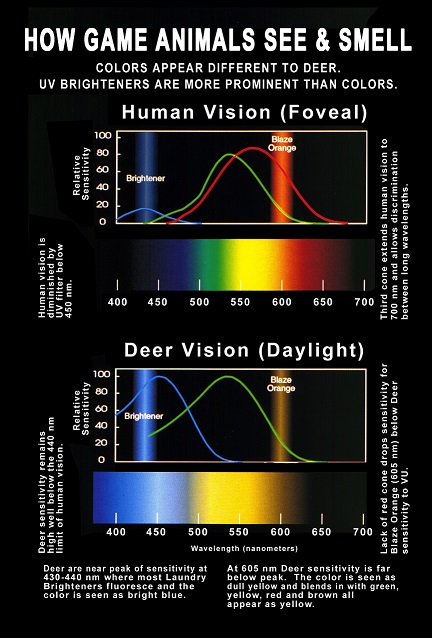
These graphs illustrate the difference between the Daylight (color) vision of the Human and the Whitetail deer. Each trace reveals the profile of sensitivity of a single class of receptor. Notice that the deer has only blue peaking and green peaking receptors while the human has a third receptor that is normally referred to as “red” because it gives us the ability to see red light. This third cone makes us far more sensitive to the longer wavelengths (such as blaze orange at 605 nanometers). Notice also that the sensitivities of our blue receptor and the short side of our green receptor are less than that of the deer. This is the result of our Ultraviolet (UV) Filter that is absent in the deer. It makes us unable to see UV and far less sensitive to all wavelengths below 500 nanometers. The color bars illustrate the full range of color and brightness that each would see if deer and human both observed the spectrum in equal brightness.
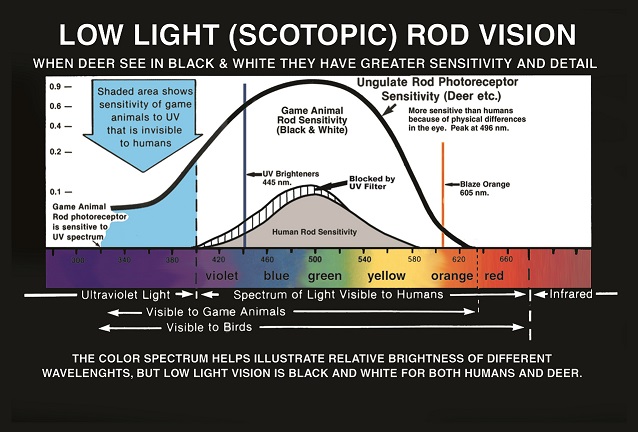
Scotopic or rod vision is the black/white/gray capability in low light conditions at the peak hunting hours when these animals are most active. While deer are clearly superior in low light at all wavelengths, the advantage is greatest at wavelengths where the deer’s sensitivity continues after human vision has ceased (Blocked by the UV Filter). This graph illustrates the extended capability of game animals and birds to see beyond our visible range. Note that at 400 nanometers (where human vision is fully blocked by our UV filter) the game animals have greater sensitivity than humans have for Blaze Orange. For ease of illustration, a logarithmic scale is used to compress the huge advantage in rod sensitivity of the deer.
Scotopic or rod vision is the black/white/gray capability in low light conditions at the peak hunting hours when these animals are most active. While deer are clearly superior in low light at all wavelengths, the advantage is greatest at wavelengths where the deer’s sensitivity continues after human vision has ceased (Blocked by the UV Filter). This graph illustrates the extended capability of game animals and birds to see beyond our visible range. Note that at 400 nanometers (where human vision is fully blocked by our UV filter) the game animals have greater sensitivity than humans have for Blaze Orange. For ease of illustration, a logarithmic scale is used to compress the huge advantage in rod sensitivity of the deer.
How Game Animals See & Smell by Kurt von Besser ATSKO/SNO-SEAL Inc.
FORWARD TO BOOK
It is a fact that deer do not see the world as we see it. But some people would rather you believe that the color or pattern of camouflage they make has the same appearance to a deer that it has to a human. How many pages of ads have asked “How many hunter’s do you see?” What “you see” makes absolutely no difference at all. It is what deer and other game see that is important, and their eyes are designed to see UV brighteners as a brilliant bright glow. Many camo manufacturers make their camouflage with UV brightening dyes in the fabric even though deer see bright camo easier than you see blaze orange. Eliminate those brighteners and you will see more Animals.
The pictures and the following points explain how important it is to avoid UV brighteners. This Book provides the scientific proof and technical detail you need to understand “How Game Animals See & Smell”.
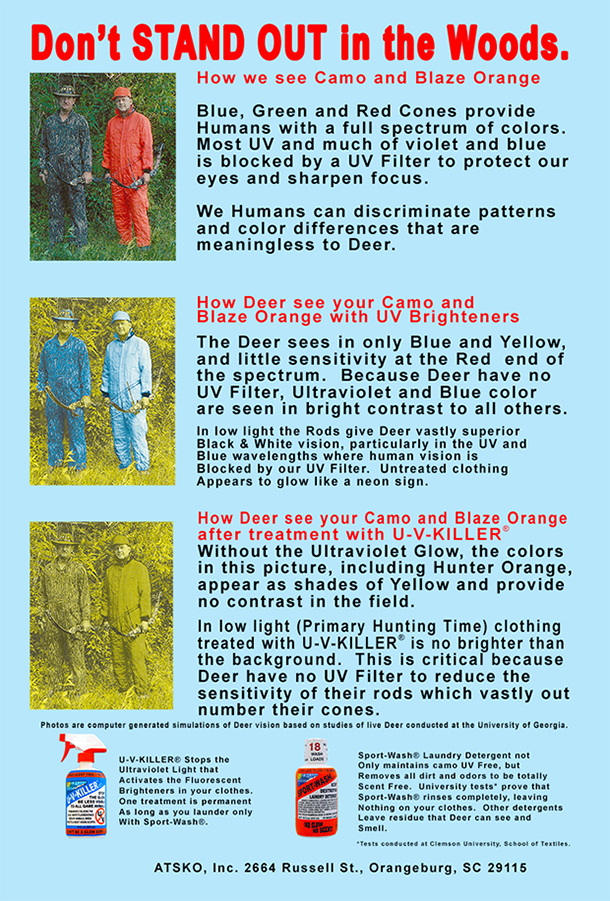
In low light and darkness, animals see in black and white and are tens of thousands of times more sensitive to ultraviolet and blue wavelengths than humans. After all, animals can run through the woods at night without bumping into trees. In daylight, deer see Ultraviolet and blue light as blue, but thousands of times brighter than we see it because the sensitivity of their blue cones is not reduced by the presence of a UV filter.
Instead of the way we see colors, deer see green, yellow, orange, red, and brown all as shades of yellow because deer have no red cones. (see back cover)
Birds have all the spectral vision capabilities of humans plus the blue and ultraviolet vision of deer. Plus many birds have additional cones with peak sensitivity in the UV wavelengths.
Ultraviolet brighteners gather energy from light over a wide range of wavelengths and reradiate that energy in a very powerful narrow band that corresponds almost exactly with the peak of sensitivity of the deer’s blue cones and their more numerous rods. This results in an unnaturally bright blue or white glow, brighter than the blue sky, or white snow.
Most camouflage, blaze orange, light colored street clothes, and laundry detergents contain UV brighteners.
To avoid brighteners, choose a camouflage that bears a Hang-Tag saying it was manufactured free of brighteners and wash only with SPORT-WASH® laundry detergent to keep it UV brightener free or new military camo.
Camouflage and blaze orange can be “Treated Permanently” with U-V-KILLER®, which absorbs the UV energy before it reaches the brighteners.
This is only the tip of the iceberg. After you have read the entire book you will understand how to be more successful in the field.
CONTENTS
WHAT ARE UV BRIGHTENERS? How they work and why they hurt your hunting success.
DEER VISION IN BRIGHT LIGHT (BLUE AND YELLOW) PHOTOPIC University of Georgia research on live Deer in 1992. Explanation of Color capabilities by Dr. Neitz. What this means to hunters.
DEER VISION IN LOW LIGHT (BLACK AND WHITE) SCOTOPIC Explanation of the Deer’s superior vision in low light and darkness by Jay Neitz Ph.D. University of Wisconsin.
PHYSICAL DIFFERENCES BETWEEN HUMAN EYE AND DEER EYE Structural differences and how they affect vision.
BIRD VISION Combining the best of human and deer vision.
BLAZE ORANGE How it is seen by deer. How treating it with U-V-Killer® can make you safe, legal, and successful.
THE SENSE OF SMELL The superior sensitivity of animals, and their ability to form images and associations with odors.
ODOR CONTROL PRODUCTS Avoiding covers, attractants, and other attempts to fool animals with better senses. What works and what doesn’t.
CARBON SUITS How to clean and maintain them and maximize their performance.
OUR PRODUCTS
WHAT ARE ULTRAVIOLET BRIGHTENERS They are called Blueing, Brightening dye, Optical Brightener, FWA (Fluorescent Whitening Agents), Color Safe Bleach, and Laundry Enhancers. They are various UV Dyes used to collect energy from a wide range of Ultraviolet and short blue wavelengths and reradiate that energy in a powerful peak at about 440 nanometers. (See graph on inside front cover.) Notice that 440 nm. light is almost invisible to humans while near maximum sensitivity of the deer.
There are about 200 compounds used and most are permanent. Fabrics like the poly/cotton blends, commonly used in camo, are almost always pre-brightened when manufactured. This is because the printing and colors will be brighter and more attractive if applied to bright fabric. Because it is easier and cheaper to brighten clothes than to clean them, all detergents (except SPORT-WASH®) contain Ultraviolet brighteners. Many water repellents especially factory-applied polymer types are applied with extenders that function as brighteners.
Deer are much more sensitive than humans to the shorter wavelengths of light. They have a blue cone with peak sensitivity at 455 nm, just 15 nm from the 440 nm peak of spectral power caused by the UV brighteners. This is earth shaking news to a 2 legged predator that can’t imagine the brightness of light he barely sees. This 440 nm light is seen as bright blue by the dichromatic eye of the deer. It occurs on garments of any color from camo to blaze orange if UV brighteners are present. In very low light the deer, like a human, switches to rod (black, white, and gray) vision and the 440 nm light caused by the UV brighteners is seen by the deer as a bright white.
Game animals quickly learn to respond to the glow of brighteners just as they would to the smell or sound of the hunter. If it glows, it’s a human; and the bigger the buck, the less chance you have of seeing him if you glow.
I have often observed that northern guides were very successful in stalking game animals. The one thing they all had in common was the wearing of woolen garments in plaids, browns and greens. They blended into the background because natural wool does not contain UV brighteners and therefore does not respond to UV light. Wash your Wool garments in SPORT-WASH® or have them Dry-Cleaned. (Woolite® now contains UV brighteners and must be avoided like all commercial detergents, softeners, and color safe bleach.)
You can observe, for yourself, the effect of UV brighteners on your own camo, if you have access to a fluorescent UV light. Simply hold your camo under the light and see if it glows. If it does, spray it with U-V-KILLER® and watch the UV brightness disappear. This is not magic, it’s technically simple, you are covering the brightening dye with a blocking dye, and if you have a UV light, you can watch it happen. You can buy a 350 BLB Fluorescent Light from Atsko or most home center stores. You can practice viewing different samples of white paper and cloth. Placing a drop of U-V-KILLER® on a swatch that glows will immediately darken it. Now observe this spot under ordinary light and you begin to understand how little we see of the brightener effect. Deer by contrast, are perfectly designed to see the effect of UV brighteners without the aid of an artificial light source.
DEER VISION IN BRIGHT LIGHT (PHOTOPIC COLOR VISION) North American white-tailed deer have been tested! The research was conducted from August 24 to 29, 1992, at the University of Georgia D. B. Warnell School of Forest Resources, in Athens, Georgia. Present were Dr. R. Larry Marchinton and Dr. Karl V. Miller of the University of Georgia with a staff of graduate students headed by Brian Murphy as research coordinator. The electroretinograph was administered by Dr. Jerry Jacobs and his assistant Jess Deegan of the University of California, assisting was Dr. Jay Neitz of the Medical College of Wisconsin. The Electroretinograph equipment, provided by Dr. Jacob’s lab, is the culmination of 12 years of refinements. Computer controlled light presentation and signal processing now enable scientists to accurately define the range of vision in animals.
Following is the abstract of what was presented to the Southeast Deer Study Group in February 1993.
PHOTOPIGMENTS OF WHITE-TAILED DEER Brian P. Murphy, Dr. Karl Miller, and Dr. Larry Marchinton, University of Georgia; Jess Deegan II, University of California; Dr. Jay Neitz, Medical College of Wisconsin; Dr. Gerald H. Jacobs, University of California.
All aspects of vision depend ultimately on the absorption of light by photo pigments. The retinas of white-tailed deer (Odocoileus virginianus), like those of other ungulates, contain a mixture of rod and cone photoreceptors. We have used a noninvasive electrophysiological technique to measure the spectral absorption properties of the photopigments contained in these receptors. In this procedure, electroretinogram (ERG) flicker photometry, light-evoked potentials were sensed by a contact-lens electrode positioned on the eye of an anesthetized deer. The eye was stimulated with a rapidly-pulsed, monochromatic light; variations in pulse rate, stimulus wavelength and adaptation state of the eye allowed preferential access to signals from different classes of photoreceptor. Recordings were obtained from nine white-tailed deer. Three classes of photopigment were detected. One of these is the photopigment contained in rods; it has a peak sensitivity of about 496 nm., a value greatly similar to that found for rod photopigments of other mammals. These measurements also reveal the presence of two classes of cone. One contains a photopigment maximally sensitive in the middle wavelengths (peak value of 537 nm); The other cone class has a sensitivity peak in the short wavelengths, at about 455 nm. In light of what is known about the relationships between photopigments and vision in other species, these results suggest two likely characteristics of cone-based (i.e., daylight) vision in deer: (1) deer should be relatively less sensitive to long wavelength lights than many other mammals (e.g., humans), and (2) white-tailed deer would be expected to have dichromatic color vision.
In addition to this study which used the ERG to detail the spectral sensitivity of the deer, there have been recent spectro radiometric studies of ambient light and blaze orange with and without U-V-KILLER® treatment. Following is an interpretation of the results of both of these studies by Dr. Jay Neitz, Medical College of Wisconsin.
PHOTORECEPTORS AND DAYLIGHT VISION OF THE DEER Vision is initiated when light is absorbed by photoreceptors of the retina, the light absorbing tissue that covers the back of the eye. The limits of vision depend on several factors, which include:
(1) The optical properties of the eye, i.e., the size of the eye, the size of the pupil, the refractive power of the eye’s optical elements.
(2) The properties of light absorbing filters through which light must pass before reaching the photoreceptors. In humans these include filters in the lens and in the central region of the retina that absorb strongly in the short wavelengths, blue, violet and ultraviolet.
(3) The light absorbing properties of the photoreceptors themselves, the number of different classes of photoreceptors and their distribution in the retina.
(4) The reflectivity of tissues that lie behind the photoreceptors. For example, many animals that are active in dim light have a reflective layer at the back of the eye that enhances sensitivity.
Some of these properties have been recently investigated for the eyes of whitetailed deer. A non-invasive procedure (harmless to the deer) was used on anesthetized deer to measure the sensitivity of the deer’s eyes to wavelengths of light across the spectrum.
Deer like all other mammals have two types of photoreceptor, rods and cones. The rods are responsible for vision in dim light and the cones are responsible for vision in daylight. The light absorbing properties of the rods in deer were found to be similar to those found in other mammals, including humans. Two classes of cone photoreceptor were detected in the deer. One most sensitive to short wavelength light (blue-violet); the other most sensitive to middle-wavelength light (green-yellow).
The lens of the human eye contains a yellow pigment that absorbs ultraviolet light almost completely; it absorbs strongly in the violet and into the blue spectral regions. In contrast, the transmission of short wavelength light is very high for the lens of many mammals that are active at dusk, dawn and at night. The recent experiments indicate that this is true for the deer. The relative sensitivity of deer eyes to short wavelengths (blue and violet) is high compared to that of humans, as expected because deer lack yellow pigment in their lens.
In humans, the very central region of the retina (the fovea) is specialized for high acuity vision. Among mammals, this specialization is found only in humans and other primates. Also unique to primates is an additional yellow pigment, the macular pigment that covers and thus screens the central region of the retina. Humans use the central region of the retina whenever we look directly at an object; it is this region that we depend on most heavily for vision. Thus, when comparing the daylight vision of deer to that of humans it makes sense to consider human foveal vision.
The recent experiments suggest important differences between the daylight vision of deer compared to that of humans:
(1) Humans have three classes of cone photoreceptors which are the basis of trichromatic (literally three-color) vision. In humans this three-receptor system confers excellent color vision. Humans can distinguish small differences in wavelength across the spectrum. In contrast, only two classes of cone photoreceptors were detected in deer. Deer can have no better than dichromatic (two-color) vision.
Thus, the color vision capacities of deer are, at best, limited compared to humans. The two classes of cones in deer allow for the ability to see color differences between short and long-wave lights, e.g., blue and yellow, however, they lack the photoreceptor basis for seeing differences in the color of objects that reflect middle-to-long wavelength light, e.g., yellow-green, green, yellow, orange, and red.
(2) Since humans have yellow pigments that screen out short-wavelength light, the relative sensitivity of deer to short wavelength light is much higher than the sensitivity of humans. This same difference would apply to low light conditions under which only rod photoreceptors operate.
(3) The three classes of cone photoreceptors in humans are each sensitive to a different region of the visible spectrum. Together these confer sensitivity to a wide band of wavelengths. The three classes of human cone photoreceptors can be termed red, green and blue cones. One of the two cone photoreceptors detected in deer is similar to the human blue cones; the other is similar to human green cones. Thus, compared to humans, deer effectively lack red cone photoreceptors. This suggests that deer should be relatively less sensitive to long-wavelength light (orange and especially red) than humans.
Human sensitivity is highest in the green-yellow region of the spectrum and, for equal intensities, these wavelengths are perceived as brightest. Humans are relatively insensitive throughout the short-wavelengths (blue and violet). Sensitivity also drops off rapidly in the very long wavelengths, e.g., we are relatively insensitive to deep reds. Humans can distinguish four basic colors; blue, green, yellow and red. We also distinguish dozens of intermediate colors, e.g., violet, blue-green, yellow-green, orange etc. Humans can make subtle color discriminations across the visible spectrum.
The region of highest sensitivity for the deer is at a shorter wavelength than that of humans. The relative sensitivity of deer to short-wavelength light is dramatically higher than human sensitivity to those wavelengths. For equal intensities, deer are expected to see short and middle-wavelengths as brightest. Because of the absence of red cones, the drop off in sensitivity at the long-wavelength end of the spectrum occurs at shorter wavelengths for deer. They are less sensitive in the spectral region that appears orange to humans and are virtually insensitive to deep reds. With only two classes of cone photoreceptors, deer can distinguish no more than two basic colors, one for the short wavelength end of the spectrum and another for the middle-to-long wavelength end of the spectrum. Animals with dichromatic color vision do not see an intermediate color in the spectral region between the two colors. That is, they do not see a color that appears bluish yellow. Instead they see the intermediate spectral region as colorless (gray).
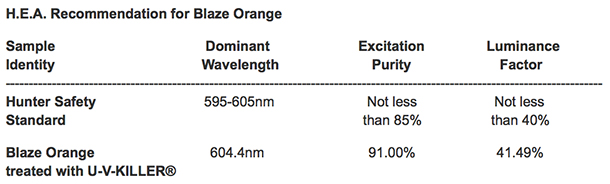
The issue of how deer see blaze orange is of considerable interest to hunters and those interested in hunter safety. Recent results lend insight into how deer may perceive blaze orange. Blaze orange is highly visible to humans because, for us, it is both intensely bright and intensely colored. The worst news for hunters would be if blaze orange was seen by deer as intensely colored and intensely bright as it is for humans. At the other extreme, perhaps the best news would be if blaze orange was not seen at all by the deer. Given what is known about deer vision neither of those extremes is likely to be true. The recommended specification of blaze orange requires a dominant wavelength between 595 and 605 nanometers.
Deer are expected to see this band of wavelength. However, the deer’s relative sensitivity to 605 nanometers is less than half the relative human sensitivity. Although 605 nanometers is expected to be seen by deer as colored, that color would not be different from long-wavelength lights (the ones we see as red, yellow and yellowish-green).
Wavelengths that deer are likely to be able to distinguish from 605 nanometers are the ones we see as violet, blue, blue-green, and pure green. A garment that emitted only an intense band of light at 605 nanometers would be less colored and less bright to deer than it is to humans. However, it is important to understand that such a garment would be far different from an ideal camouflage. It would still stand out as colored and/or bright against dark backgrounds, against bluish-greens, pure greens, browns, tans, and grays.
Finally, the issue of how deer see short-wavelength light has received considerable attention. Recent results also lend insight into this issue. “The difference between daylight human foveal vision and daylight deer vision is expected to be even more dramatic for short-wavelength light than it is for longwavelength light. Humans are very insensitive to wavelengths below 450 nanometers. For example, relative to other wavelengths, deer are about eight times more sensitive than humans to lights of wavelengths near 430-440 nm (such as those emitted by UV brighteners). Garments can reflect (or emit) considerable light in this spectral band. Because of the deer’s high relative sensitivity to short wavelength light, the presence of blue, violet and UV components would make a garment stand out as both bright and colored against natural backgrounds. Those same components could be barely noticeable to humans.” Dr. Jay Neitz
This information about color vision is also summarized by the graphs on the outside front cover. More examples of Dichromatic vision are found on Dr. Neitz’s website.
Significance of these findings to the hunter Much has been written lately about how UV brighteners effect a deer’s perception of camouflage, blaze orange, and other garments. In order to apply what has been learned about the visual systems of the deer we must define how UV brighteners effect the garment being seen. This is further complicated by the spectral composition of the ambient light in which the garment is viewed.
We can simplify the effects of variations in ambient light by simply assuming that, for the sake of a discussion about the effect of UV brighteners, we are talking about a time and place where Ultraviolet light is a high percentage of available light. In direct sun at high noon the longer wavelengths overwhelm our visual system completely and we see no effect from UV brighteners. As we move to dusk, dawn, deep overcast, or shade the absolute amount of UV and short blue light decreases, but the percentage share of total light contributed by UV increases greatly. We therefore confine discussion of UV brighteners to times and places where their effect is significant.
The garment’s color and other optical characteristics are also significant. Ignoring most variations again allows us to focus on the effects of UV brighteners. It should be noted, humans are very insensitive to UV and short blue wavelengths so the effects can only be observed (if at all) on white or light colored garments, unless a UV light source is used to enhance the effect. The deer, however, see these effects on almost any color. The background is also significant. Cones and Rods are classed by their wavelength of maximum sensitivity. Deer have cones sensitive to short (blue & UV) wavelengths and middle (green & yellow) wavelengths and no cones for long (red) wavelengths. Human cones are mostly long (red) wavelengths. We also have a good percentage of medium (green & yellow) wavelength cones, but fewer than 10% of our cones are the short (Blue & UV) variety. The sensitivity of our few blue cones is further suppressed by our UV filter. At low light our disadvantage in the short wavelengths is even greater because we have so few rods. Deer are simply able to see short wavelengths better than humans in all conditions.
The research also verified that “Deer are much less sensitive to longer wavelengths than humans”. This means that if a blaze orange vest had no UV brightener dyes and was purely 605 nm blaze orange, the deer would not see it as we do. (See back cover) They lack our red cone completely. They’re green cone peaks at 537 nm, almost 70 nm away. Dramatic as this difference in sensitivity is, it is only part of the story. From studies of colorblind humans who have the same two cones as deer, we know that their color vision is limited to shades of blue and yellow.
“White-tailed deer would be expected to have dichromatic color vision.” Human dichromats called protanopes also lack the red cone function. A human with one dichromatic eye (blue/green cones) and one trichromatic eye (blue/green/red cones) can tell us the difference in color perception. They see blue as blue and the rest of the spectrum from green to red as the color yellow, with their dichromatic eye. Therefore, if blaze orange or most green/brown camouflage is without UV brightener effect, Deer will see it as yellow. It will all blend in well in a world of green leaves, yellow grass, and brown trees, because they too are all yellow.”
Now consider what effect UV brighteners would have on these garments that appear yellow in a yellow world. Blue flags? Yes, especially on blue, white, light shades of gray, and other colors that have some blue content. Other colors will simply appear brighter and whiter much as intended for humans. In low light the problem is even greater.
SCOTOPIC (BLACK & WHITE) VISION Many subtle differences in physiology make the deer far more sensitive to dim light, especially shorter wavelengths. They switch to black and white rod vision as humans do but can detect light 1,000X below our threshold in the blue and UV wavelengths. The black and white (Rod) vision in Low Light where the cones cannot function is called Scotopic Vision. (See inside cover) The following letter from Dr. Neitz is based on conclusions from work done by researches predating the color research done at the University of Georgia in August of 1992.
The scientific report from Dr. Neitz summarized by the graph on the inside front cover overwhelmingly confirms our observations and explanation of the way in which game animals see. Game animals, birds, and insects have certainly evolved a wide range of visual capabilities to spot predators. One conclusion is obvious, UV brighteners are a real standout to game animals in the Wild. Your camo and exposed clothing must absorb rather than reflect UV light and not reradiate it in the short blue wavelengths. By now you must realize that the white-tailed deer is perfectly designed to see the glow of UV brighteners over a vast range of conditions. It is doubtful, whether the latest instruments can detect the UV glow as well as these awesome animals. If prehistoric man had been handicapped by present day UV brighteners, civilization would never have advanced thru hunting to begin agriculture.
PHYSICAL DIFFERENCES OF THE EYE There are many differences in the structure and wiring of the deer eye vs. the human eye. Some of these are more difficult to understand than the simple absence of red cones and UV filters. Major differences include:
RECEPTOR DISTRIBUTION AND LOCATION 10 times as many rods as cones in the deer vs. 30 times more cones than rods in the human. This difference alone suggest a 300 fold advantage for deer in low light. In the deer, the rods and cones are both found mainly in a horizontal band across the back of the eye called the Macula. In humans most of the Retina has few receptors except for one central depression called the Fovea. It is packed with cones; the Fovea actually excludes all rods to contain as many cones as possible. The impact on function is predictable, even if counter intuitive. Deer actually see more detail in low light than in bright light. Humans, having more cones, see sharper in bright light when the rods don’t function so we wrongly assume this is true for all animals. The concentration of cones in our Fovea gives us fantastic color and detail over a small field in bright light. This is ideal for a day hunter. Deer have no sweet spot but can see the entire horizon at once with greater detail in low light than in bright light. This is ideal for night grazing and avoiding predators.
DEER HAVE A REFLECTIVE TAPETUM This is what causes eye “Shine”. Humans do not. This reflective structure receives light that has passed thru the layer of photoreceptors (Rods and Cones) without being absorbed (used to signal the brain). The reflections provide the photons of light a second chance to be seen on their way out. An easy doubling in sensitivity, but at the cost of a loss of sharpness. The human Retina has a light absorbing backing to favor sharpness over sensitivity.
PHOTORECEPTOR WIRING Human photoreceptors are wired one receptor to one nerve. Deer photoreceptors are wired several receptors to each nerve. This hurts sharpness because a pulse to the brain cannot be traced to a single receptor. The brain only knows it came from one of several in an area. This is an ideal way to increase the animal’s sensitivity to the motion of a predator.
SLIT vs. PUPIL The deer’s eye opens 9 times as much area to gather available light. Like building a bigger telescope this causes proportional increase in sensitivity. The shape of the opening creates special capabilities.
The primate eye accommodates different levels of light by opening and closing a round aperture. This allows us to maintain sharpness of vision, in the small field seen by the Fovea, throughout a large range of light levels. We lose almost all peripheral vision but still see good detail in our straight-ahead binocular vision. This structure fails us seriously in very low light when vision is limited to rods. Indeed, when staring at a weak star it will disappear completely at center field because of the total lack of rods in our Fovea. Coupled with the UV filter it makes us unable to see in what we call darkness. Deer, by contrast, close their eye to a horizontal slit. This takes advantage of the horizontal Macula and side facing eyes to insure 320° horizontal vision over a wide range of light levels.
This horizontal slot along with the high concentration of rods allows the deer to see detail in significantly brighter light simply by partially closing his eyes. He still has 320° vision because of the horizontal slit. The opening and closing of our pupil takes precious seconds. The deer can optimize light entry instantaneously simply by moving his eyelids. This prevents loss of accommodation as he passes in and out of shadows. The deer can actually keep seeing with rods by choice. He can maintain rod vision thru the prime hunting hours of dawn and dusk, and under heavy cloud cover or forest canopy.
This raises interesting questions about deer freezing in lights. It suggests they should first shutter down the eyelids. Then we expect them to avoid the light so their rods can re-accommodate to darkness as the aperture closes to a horizontal slit. But we know they don’t even move their head to avoid the light, as we would, when a flashlight beam catches them. Is it possible that the beam is so well controlled within the eye that rods not directly in the beam can remain functional, while other rods are in the path of so much light that we see “eye shine” from the tapetum behind them. This is entirely possible while totally opposite to our common experience of becoming “night blinded” by looking at a flashlight for an instant. Perhaps the deer can continue to see good detail in other directions with rods that are not effected by our flashlight. Indeed, when he finally spooks he does not run blindly into the first tree. The deer doesn’t have to look with one eye to maintain dark adaptation on the other as military personal are trained to do. Within one eye the deer may enjoy the sharpness of rod vision in some directions while other rods are completely overpowered. Keep in mind that the brain easily adapts to take best possible advantage of physical structures. We suspect the structures of the deer’s eye are utilized to maximize advantage. In no case should we help them see us by wearing UV brighteners.
BIRD VISION Most Birds, with a few major exceptions, have little if any sense of smell, but they are amply compensated by superior visual acuity. First, they have all three-cone classes that humans possess for full color vision. Their acuity exceeds ours, and, having no UV filter, they are sensitive to all the UV and short Blue that the deer see. They may also have some rods for night vision like ours but theirs are unhindered by a UV filter. Many possess a 4th cone with peak sensitivity in the UV region and sensitive to below 300 nm. (A study conducted in 1997 presents behavioral confirmation of the UV capabilities that are suggested by physical structures and electroretinogram.) This 4th cone, combined with oil droplets in the eye, allows Birds to read scattering patterns to determine where the sun is on a cloudy day. Migrating birds may use this capability for navigation, and it certainly enables them to see the effects of UV brighteners. Except for blue and Ultraviolet, all Game Birds see colors quite similar to how we see them. Humans can match longer wavelength camo colors (green, yellow, orange, brown, and red) to the area hunted and birds would perceive the same measures of what is conspicuous and what blends in. A significant difference would occur, however, in the seeing of Ultraviolet and short blue. If UV brighteners are present the bird will see them (bright bluish white just as deer do) while we humans will be completely unaware of them. Duck, Dove, and Goose hunters will be more successful if UV brighteners are not present on their camo, blinds, or decoys.
FISH VISION In the late 80’s and early 90’s vision studies of fish found that, like birds, fish possess the “short” cone that enables them to see ultraviolet wavelengths. Fish that were found to have the UV cone included Guppies, Goldfish, and many Game Fish. Carp, Brown Trout, Yellow Perch, Salmonoids, Rudd, Roach, and Japanese Dace all possess the short (UV) cones along with the three cones for visible light that humans use. This is initially surprising because after just a few feet of depth most UV has been blocked by the water. We know that fish and marine creatures often make good use of camouflage to evade predators. This appears to conflict with the need to use plumage for attraction. The solution is to take advantage of the different rates at which water adsorbs (Blocks) short wavelengths, like UV and Blue, verses longer wavelengths like yellow, brown, orange, and red. Nature uses short wavelength colors to make dazzling displays of plumage variations to attract mates that are already pursued to close proximity. This is done using short wavelengths to avoid the danger of attracting distant predators. The art of camouflage is maintained in the long wavelengths that are seen for great distances. Fishing lures should certainly be designed to provide the appropriate UV clues that would help them to better match the baitfish they are trying to mimic. Fishermen should, like hunters, avoid UV brighteners in their outer clothing or they will be easily seen.
BEHAVIORAL TEST, THE FINAL PROOF The research on fish and birds is interesting because much of it is behavioral. Such tests are more complicated when performed on animals that can tolerate little control while testing, as is the case with deer. Behavioral tests can often be misinterpreted until the more basic tests have determined what capabilities are likely to be found. The most basic tests are often autopsies for specific structures. An example of this would be removing the lens material of different eyes to observe which have a yellow or orange tint to block UV, and which are clear. Researchers also count photoreceptors under a microscope to learn their distribution and abundance. The next class of test would be to verify the function of structures. Examples would be measurement of the transparency of lens material to different wavelengths with a spectrophotometer. The pigments in photo receptors can be exposed to varying wavelengths of light to determine the exact wavelength of maximum adsorption. With the flicker ERG we actually measure pulses of electricity generated by the eye of a living animal in response to light of various wavelengths. Structure and Function methods would leave room for doubters to question whether the brain is able to make use of the pulses that these structures provide. (Scientists know that using the information is the easy part – each and every brain must do this during its own development; the tough part is the thousands of generations of evolution required to perfect the structures necessary to produce the information). Behavioral experiments, such as Andrew T.D. Bennett, Cuthill, I. C., Partridge, Lunau, K. (1997) Ultraviolet plumage colors predict mate preferences in starlings. Proc. Natl. Acad. Sci. USA Vol 94,,pp. 8618-8621, actually demonstrate that the brain is putting the information to use by changing behavior. These bird and fish behavioral tests are as good as asking an animal if he sees something because they measure a change in the animal’s behavior in response to UV stimulus. Recent research has shown how Kestrals, tiny raptors, find mouse burrows by UV clues in mouse urine that are totally invisible to humans. Behaviors that depend upon seeing brighteners are the undisputed proof.
NEW MATERIAL ANNOUNCING BEHAVIORAL CONFIRMATION
These paragraphs in italics were added in July of 2014 and are not yet included in printed copies.
The properly designed and controlled behavioral test is the final answer. The quest begins with every primitive human’s desire to know what an animal can see. It starts with field observation that deer are active all night long without the vision limitations experienced by humans. Science begins feeding us crumbs of information by examination. We document that deer have rods, 2 classes of cones and a clear lens vs humans that have rods, 3 classes of cones and a yellow lens. In the next 40 years new techniques and instruments make it possible measure spectral absorbance of every structure in an eye and eventually even measure electrical pulses made by the eye in response to different colors of light.
In August of 1992 at the UGA, the most advanced of these techniques were applied for the first time to living White-tailed Deer. This work enabled scientists to predict exactly how well deer could see different colors. At this point, Atsko wrote the book HOW GAME ANIMALS SEE, to explain to hunters how differently deer see and what we must do to be able to see more animals. This was a courageous venture, because final behavioral proof was not yet available. In some cases actual vision as confirmed by behavioral tests can be a little different than what is predicted by the instruments. But Atsko was willing to risk apology for minor errors in order to bring hunters the information and products they needed to be more successful.
In 2012, again at the University of Georgia, Warnell School of Forest Resources in Athens, BEHAVIORAL tests were successfully done with white-tailed deer. It took a couple more years until it was published in the Wildlife Society bulletin (Behavioral measure of the light-adapted visual sensitivity of white-tailed deer: Bradley S. Cohen1,*, David A. Osborn1, George R. Gallagher2, Robert J. Warren1 and Karl V. Miller1, Article first published online: 16 MAY 2014, DOI: 10.1002/wsb.438). The abstract is on the Atsko website and the entire study can be found at Wiley Online Library http://onlinelibrary.wiley.com/doi/10.1002/wsb.438/abstract.
The suspense is over. after 20 years, the behavioral tests confirm the spectral sensitivity predicted by the measurements of Neitz and Jacobs. There is no need to repeat the findings here as they are exactly as explained in this book, currently called HOW GAME ANIMALS SEE AND SMELL.
BLAZE ORANGE One of the most exciting findings of this work is that, free of UV brightness from 450 nm down, blaze orange is an excellent choice of color for low visibility to deer. With effective hunter education, the use and therefore effectiveness of blaze orange could be dramatically improved. We hope that eventually all hunter orange will be made free of emission peaks below 450 nm. U-V-KILLER® treated blaze orange does not spook deer, and it remains just as visible to humans as untreated blaze orange.
With U-V-KILLER® on your Blaze Orange you are safe and legal.
Meeting this recommendation is only half the story, it doesn’t specify whether or not there is another fluorescent peak that only the animals can see. All major brands of Blaze Orange appear bright blue to game animals because of energy absorbed in the UV and short blue portion of the spectrum and reradiated in a powerful peak below 440 nm.
U-V-KILLER® stops all the UV reflection and fluorescence on all your clothing, Blaze Orange or Camo, and stops you from glowing in daylight, at dawn and at dusk, in deep shade, and at night. You blend into their world. High contrast blue is replaced by a range of yellows that match the appearance of their world. You will see more animals because they will fail to see you.
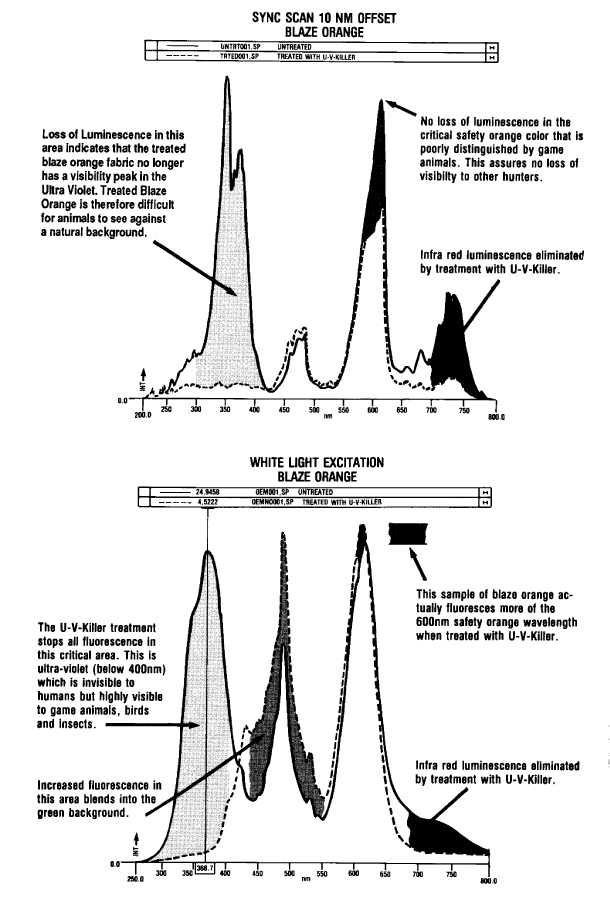
This graph is obtained from a Perkin Elmer LS50 Luminescence Spectrometer by exciting one small bandwidth at a time. It demonstrates that treatment with U-V-KILLER® eliminates the emission of luminescence (resulting from excitation at 10-nm lower wavelength) in the UV and Near IR portions of the spectrum with no loss of luminescence in the human visible range, particularly the important 605 nm Blaze Orange Peak.
WHITE LIGHT EXCITATION BLAZE ORANGE This graph is also from the Perkin Elmer LS50. The graph illustrates the measured luminescence spectrum when the blaze orange sample is excited by the full spectrum from a Xenon lamp source. Notice that the 369 nm peak exhibited by the untreated sample is completely invisible to humans but falls in the area of UV that is strongly-visible to game animals. This peak is totally eliminated in the treated sample. The excitation energy is instead released by the treated sample at two peaks in the longer visible wavelengths not easily distinguished by game animals. The 605 nm peak vital to the effectiveness of Blaze Orange to Human eyes is actually increased by treatment with U-V-KILLER®.
These measurements and actual observations in the field have proven that a hunter in blaze orange that has been treated with U-V-KILLER® is more visible to other hunters but is no longer easily seen by game animals and birds. Birds will still see the orange as orange because they have red cones like we do, but the bright blue wavelengths will be eliminated. The U-V-KILLER® treatment allows safer hunting and more successful hunting.
U-V-KILLER® is very effective on Blaze Orange. Humans are unable to observe this effect without a UV light source because our eyes are overpowered by the bright Orange to which we are so sensitive. Blaze Orange has been chosen by governments as the international safety color because it is the one color that we humans see the best against most backgrounds. Blaze Orange falls into the spectrum at 605 nm which is near the peak of sensitivity of our long cone. It and red are also the only colors to which our eyes are more sensitive than the deer’s (a graph of the ungulates sensitivity to the light spectrum is on the front cover). Blaze Orange gathers energy in the Green and Yellow portion of the spectrum and releases it in a powerful narrow peak at about 605 nm. (Near our peak sensitivity but almost invisible to deer). This brightness is the same effect the UV brightening dye has on our clothing when seen by the deer. (Remember the UV brighteners gather UV and short blue energy and reradiate it in a powerful peak near 440 nm.). The deer sees this wavelength as a bright glowing blue. This brilliant blue color is out of place in nature and stands out just as much to the animals as Blaze Orange does to our eye. While we humans are more sensitive to the reds and oranges in the longer wavelengths, the animals are more sensitive to the shorter wavelengths of light. The vision and environment of man are a perfect combination for seeing International Orange, just as the vision and environment of the deer is ideal for detecting UV brighteners.
In low light conditions, the effect of Blaze Orange is easy to understand, when comparing the dark-adapted eyes of humans and animals. Both are seeing only shades of gray (rod dominated function) but the game animals eyes are thousands of times more sensitive to the available light source. Blaze Orange will appear as a shade of gray to animals like the deer only if there are no Ultraviolet brighteners present on the Blaze Orange clothing. But UV brighteners are always present in the Blaze Orange pigments so the color seen by the deer will be a bright white glowing color, as bright and as out of place in nature as Blaze Orange is to you on a bright sunlit day. This situation occurs at night, at dawn and dusk, and in deep shaded forests on cloudy days; whenever the available light allows the eye of the deer to shift to rod dominated (scotopic) vision.
Animals like the deer prefer to function in lower light for superior vision. They see better in low light because their eye is rich in rods and deficient in cones. It is not often that we observe any game animals actively feeding and moving about in bright sunlight. They prefer shaded areas and cloudy overcast days. We humans are the opposite, we are more comfortable using our cones, (daylight vision) as we have few rods and none at all in the fovea, the area in the eye responsible for our sharpest vision. Deer will always try to use rod vision and this maximizes their sensitivity to brighteners in blaze orange.
Daylight vision of Blaze Orange is more complex. Ungulates like the deer have two cones (in limited concentration). This provides limited dichromatic color vision similar to a human with protanopia, red-green color blindness. They perceive blues and yellows but are unable to distinguish green, yellow, orange, red, tan, brown, and gray from different shades and intensities of yellow. In simple terms deer see their entire world, in full daylight, as shades of yellows, except for a blue sky, blue water, and a few blue flower petals. Even Blaze Orange would be just another yellow if you could stop the effect of the Ultraviolet Brightening Dye. The UV brighteners cause a very powerful stimulation to the deer’s blue cones, which, when added to the stimulation of the yellow cones results in their seeing a BRIGHT BLUE-WHITE. It stands out against their natural world as a powerful signal, or warning just as the Blaze Orange does to the human eye.
When you treat your Blaze Orange garments with U-V-KILLER® you stop the fluorescence of the UV light. You cannot see the effect because the Blaze Orange overpowers the human eye. Your Blaze Orange is still protecting you from other humans but blends into the deer’s yellow landscape (see back cover).
U-V-KILLER® It does no good to treat only part of or some of your garments. Everything you are wearing must be treated. Hats, gloves, face masks, socks, etc. Otherwise the one brightly glowing item will give you away. A very important point to remember is that if you wash your U-V-KILLER® treated garments in SPORT-WASH®, the U-V-KILLER® treatment will last for years, but if you wash your treated garment in another detergent you will again dye the garment with UV brighteners. You will then have to retreat the garment with U-V-KILLER®.
It makes no difference whether you are a beginner or the most successful hunter in the woods. When your clothes stop glowing you are going to be more successful and have more opportunities.
In order to be able to treat everything a hunter takes into the woods, we have a product for blocking UV reflection on bare metal, wood, plastic, and painted surfaces called U-V-SHIELD®. It may also be brushed on hard fabric like snake leggings and treats items like backpack frames, tree stands, arrows, quivers, duck decoys, etc.
Complete instructions on how to apply U-V-KILLER® and U-V-SHIELD® are included with the product and should be read thoroughly before using. Additional tips to optimize application and frequently asked questions are available at the articles section on the website.
The first time I used U-V-KILLER® on my Camo I was astounded by my success. While having hunted for years, I had never considered myself an expert. I lack patience, am always fidgeting on my stand and move too fast while stalking, but that season was an eye opener. I took a 140 pt. Whitetail buck with a rifle, 5 bucks, (two in Michigan, 3 in South Carolina) and one doe and 3 javelinas with the bow. No, I did not spend months hunting, the fact is that I had less time that year and only had 5 days in Michigan, 4 days in Texas, and 8 weekends in South Carolina. I actually saw more deer in my time afield that year than I had seen in the preceding 5 years. I was also able to get much closer to the deer I arrowed than ever before, and believe me I need to get within 25 yards.
The most astounding result of the treatment of my camo with U-V-KILLER® has been how much movement I have been able to get away with. We have all experienced how our eye catches or is attracted to anything that moves. When our head is still, and we are looking out across an opening, we instantly see a bird flitter from one seed stalk to another at 200 yards. Game animals are able to detect movement even better than we are. We can catch, out of the corner of our eye, movement in our peripheral vision; though we are unable to identify what moved until we turn our eye or head to focus on the subject. This is because we humans have a narrow field of vision, about 3 degrees, on which we are able to focus sharply, and our peripheral field of vision is approximately 180 degrees.
Deer have a much broader field of vision on which they are able to focus sharply, and their peripheral field of vision in which they can detect movement is over 300 degrees. This physical superiority gives the deer not only an advantage in detecting movement over a much wider field of vision but they are able to immediately focus in on and identify objects in a wider field of vision.
We have all had the experience of having a deer run off when we tried to stand up or raise our rifle or bow. Imagine how easy it was for the deer to see you move when your camo is as bright and reflective as blaze orange is to our eyes. Camo treated with
U-V-KILLER® is not bright and your camo blends in with the natural background. You are harder to see when you move, and if you move very slowly, you have an excellent chance of getting away with it. I was able to slowly draw on two deer at 25 yards while they were looking in my direction.
If you are an average deer hunter you are approximately 12% successful in harvesting a deer every year. With all of the modern weapons at our disposal, scents, and computer designed camo patterns, plus the fact that there are many more deer today, something is very wrong. An Indian of equal success would have starved to death. However the Indian, like the American pioneer, had something more going for him. There were no UV brighteners in his clothing. He did not glow, his garments were made of natural materials that were never dyed or washed with UV brighteners.
We have all heard the old saying that fishing lures are designed to “CATCH FISHERMEN”. Apparently a lot of the New Camo is only designed to “BAG HUNTERS”. Why would manufacturers allow UV brighteners in their Camo after all that has been learned about deer’s sensitivity to short wavelength light? Two reasons: First: It requires Time and Money to make camo Free of UV brighteners. They have to special order fabric free of UV brighteners. Second: It’s a proven fact that clothing with UV brighteners looks more attractive to human eyes in the store even though it spooks game in the field.
The US Government refuses to buy camouflage that contains UV brighteners and you should too!
THE SENSE OF SMELL Odor control is a major concern for hunters and fishermen. But until recently, most commercial and home odor control products have been useless for hunters. Available products have focused on making things smell “Good” rather than odorless. Research has centered on eliminating bad odors by creating a new odor that was not objectionable. Clothes, carpets, commodes and companions are all made to smell good, clean or fresh but never odorless. The cover scent is just stronger to humans than the objectionable odor it is blocking out. Many hunting and fishing odor control products use the same method. They try to block the human odor with cover scents like apples, skunks, fox and buck or doe urines.
We cannot tell you what animals smell. We know that deer are 10 thousand times more sensitive to odor than humans. A large portion of their brain is devoted to olfaction (the ability to smell) and scientists say deer are able to recognize six different odors at the same time. Certainly their marking of territory and other behaviors indicate that they readily smell things of which we are unaware.
We know they can tell the difference between an apple from North Carolina and one from Pennsylvania. This suggests that cover, attractants, and other artificial scents are readily recognized as foreign and function only through the inquisitive nature of animals. Trying to fool a deer’s nose is as futile as a child trying to trick Einstein with a riddle in relative physics. Fish may have even a more highly developed sense of smell. Sharks have shown their ability to detect a few parts per billion of blood in water at a distance of several miles. Salmon find their spawning streams by odor at great distances. Bass following a lure, attracted by its motion or vibration, turn away when they smell a contaminating odor. So how can a cover scent work? It can’t. Our SPORT-WASH® laundry detergent and SPORT-WASH® HAIR & BODY SOAP both rinse completely leaving no residue. The only thing a deer can’t smell is nothing.
Our approach is to simply reduce the odors of the hunter and fisherman to the lowest possible level without introducing any new odor. Having no odor means no detection by game or fish.
Other products that attempt to use this strategy do not have the technology to do the job. Their main ingredient is baking soda and/or washing soda with one or more antimicrobials added so nothing grows in the bottle. Baking soda raises skin pH to slow the growth of the bacteria that cause body odor but despite its reputation in the refrigerator it actually absorbs very little odor before it reaches equilibrium and releases odor molecules as fast as it reacts to new ones. Carbonates prefer water to organics and will actually release previously absorbed odors when wet to absorb more water. These products are only partially effective at best and are a poor value for the few cents worth of ingredients in deionized water.
In order to study and judge the effectiveness of different materials for odor control we had to create standard smells and develop a rating scale. Then we perfected test methods that gave consistent and reproducible results. The most sensitive observers were young non-smokers who favor a bland diet.
We tested wet and dry systems against a wide range of common odors. We found two ways to eliminate odor without introducing a new odor. The first method is by oxidation and the product is N-O-DOR® the liquid spray. The second method is selective adsorption and the product is N-O-DOR® II the powder.
N-O-DOR® & N-O-DOR® II are not fully compatible. Clothes that are heavily powdered with N-O-DOR® II will deactivate N-O-DOR® liquid. There are applications where either system could be used. However, some problems are better suited to the liquid application and others are best handled by the powder.
What is N-O-DOR® the liquid? It is an oxidizer, a new application of natures own process for destroying organic waste. You are familiar with how chlorine destroys odor and bacteria. Chlorine is an oxidizer. Oxidizers combine with organic compounds and change them to non-volatile salts. The change is permanent and they no longer smell. The problem with chlorine is that it has its own odor. You recognize the smell of chlorine when you are close to a spa or swimming pool, sometimes you can smell it in drinking water. We found a new oxidizer that was developed for the food industry. It has no odor of its own, but like chlorine permanently destroys all odor caused by organic compounds and is safe for you to use on your skin, hair, clothing, carpeting, and pets. Other products instruct you to only spray them on your clothing as they can injure your skin.
N-O-DOR® does not eliminate the need for washing your clothes & body. Our body odor is the result of accumulating waste products from bacteria that live on the skin. Heavy accumulations must be washed away from our clothing and skin. This is done with SPORT-WASH® unscented, non-brightening residue-free laundry detergent and SPORT-WASH® unscented Hair & Body Soap. After most of the organic debris has been washed away, N-O-DOR® provides a way to remove every trace of odor from your clothes & body while in the field. By chemical reaction, N-O-DOR® transforms new organic odor sources into nonvolatile salt. This Oxidation-Reduction process permanently eliminates all odor and the germs that cause odors. As more organic material is generated N-O-DOR® continues to oxidize it until it all dries away. Spraying your body from head to toe deodorizes you so completely you feel as refreshed as if you had taken a shower. Triple action: Oxidizing the organic material that odor causing bacteria feed upon, oxidizing the bacteria, and oxidizing any odorous products created by the bacteria.
Ideally, the hunter should begin each day with a shower using SPORT-WASH® unscented Hair & Body Soap. When this is not possible one should spray N-O-DOR® liberally ON THE SKIN AND THE HAIR. Lightly towel off excess liquid before dressing in clean clothes. If clean clothing is not available be sure to spray clothing with N-O-DOR®. As the day progresses and perspiration persists, additional N-O-DOR® can be applied to the skin and clothing as needed. With N-O-DOR® you are able to remain scent free all day. Nature has always cleaned up her spent organic debris by oxidation. Now, thanks to the experts at Atsko, you can be odor-free and a more successful hunter.
N-O-DOR® will also destroy odors in your car, home or wherever a problem exists.
N-O-DOR® II the powder, is a blend of ABSCENTS® crystals in a Body Powder. ABSCENTS® crystals are a molecular sieve of aluminosilicate composition, in which the crystal framework of aluminum and silica atoms forms a three dimensional network of spherical cavities having a honey comb like structure.
Now lets look at actual applications and determine when each form of N-O-DOR® is appropriate. First in order of use is any preparation that can be done in advance of your trip. Most important is deodorizing the things that cannot be laundered with
SPORT-WASH®. Boots should be powdered liberally with N-O-DOR® II. If dry and not used in daily wear, apply powder two weeks before hunting and wrap in plastic. If you must hunt in boots you wear everyday, they should be powdered every second day and old powder should be wiped out each time. The washables are easy, simply launder them in SPORT-WASH®. Store in plastic bags containing local flora from a recent scouting trip or a shake of N-O-DOR® II the powder. Leaves or earth from the wrong location can be as out of place as a commercial cover scent. If in doubt, the best odor is N-O-DOR®.
The day of the hunt: If possible, shave and shower with SPORT-WASH® Hair & Body Soap. It’s scent free and cleanses so completely that it takes hours for odor causing bacteria to reappear. Be sure to do a thorough job on hair, feet and sweat areas. If a shower is not possible, spray your entire body with N-O-DOR® liquid. This is as effective as showering and can be repeated in the field.
As you dress: If it will remain cold all day dry yourself completely and apply N-O-DOR® II (powder) to critical areas of your Body, Clothes, and Boots. If you will be perspiring, dampen your body with N-O-DOR® liquid as you dress (except Boots). Carry your outermost layer of clothes in a plastic bag if you will be riding in a vehicle.
Arriving at your hunting Area: Dress outside your vehicle. For cold weather, use powder inside as you finish dressing. Warmer weather, spray your inner clothing lightly with N-O-DOR® liquid before dressing. In all weather the sleeves, collar, cuffs, and entire outer layer should be sprayed with N-O-DOR® liquid. Spray the outside and bottoms of your Boots so you don’t leave a scent trail.
Arriving on stand: You can repeat spraying or powdering especially around sweat areas as necessary during the day. Don’t overlook gloves, hat, release triggers, and other things you will be handling. Be careful not to get N-O-DOR® II powder on lenses or coated optics. It contains superfine crystals that could scratch glass, plastic, and coatings. Apply extra liquid or powder to any stains or spills that may have occurred since you last washed your clothing in SPORT-WASH®. Gasoline odor is particularly difficult to control due to the benzene rings. Wash gas spills in SPORT-WASH® and treat with N-O-DOR® spray.
Deer and other game can easily associate two or more odors just as we form visual associations. A human male watching a red convertible driven by a young blonde female will have no problem remembering the girl next time he spots the car a quarter mile away. Similarly, a Buck associates a popular cover scent with you or another human that has done a poor job of odor control or perhaps is identified by a bright UV Glow. The next time he smells that cover scent he knows a human is in the area even if he cannot see him or smell his human odors.
ATTENTION FISHERMEN Fish can detect an odor with as little as a few parts per billion in water from miles away. Fishermen must recognize that spraying their hands and lures with N-O-DOR® is a critical part of a perfect presentation. N-O-DOR® works faster and better than any product on the market and leaves no residue on the lure or fisherman’s hands.
GETTING MAXIMUM PERFORMANCE FROM CARBON SUITS The recent popularity of Carbon Suits has raised questions about their capabilities, limitations and care. Carbon Suits function by adsorbing odors in the crevices of activated carbon. The good news is that activated carbon has a tremendous capacity to adsorb odors, and still works the same in an outfit that has been treated with U-V-KILLER® There are many compromises and limitations but the bottom line is that when designed and used properly, the carbon suit can reduce the amount of escaping odors.
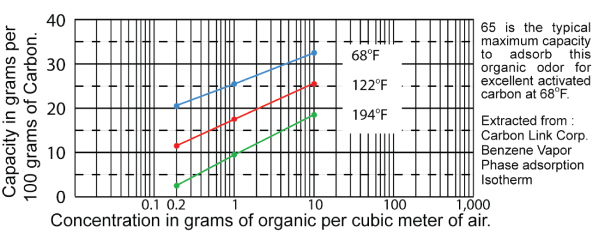
Carbon does not destroy odors, it holds them. Carbon has a big but limited capacity and when filled it can adsorb no more. It reaches an equilibrium where it is releasing odor as fast as it is adsorbing. When it has reached this point of fullness it will release odor if warmed or moistened because some odors will be replaced by water vapor and the total capacity actually decreases as temperature increases..
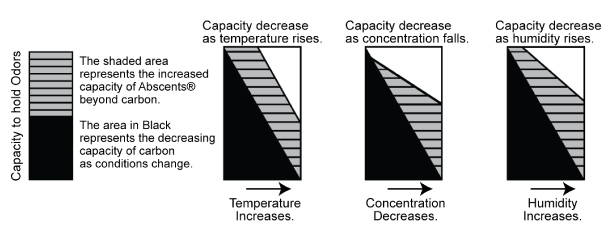
Capacity decreases as ambient concentration decreases. Capacity decreases as temperature rises. Capacity decreases as ambient concentration of water vapor or other organics increases.
For simplicity consider only the vertical bar where the concentration of organics is 1 gram per cubic meter of air. As you move from 68o to 122o to 194o the equilibrium capacity of 100 grams of carbon drops from 25 to 17 to 9 grams. Now move to .2 grams of organics per cubic meter of air and notice how much less the capacity is. When levels are extremely low, carbon is not nearly as effective as a deer’s nose.
No one can determine the capacity of a carbon suit by looking at it. Exposure, history, temperatures, different odors, different carbons, amount of carbon, time to reach equilibrium, humidity, closeness of carbon layer to body, activity level are all variables that defy quantification. A visual analogy helps provide a feel for how the different variables effect capacity.
Think of an odor-laden suit as a heaping full bucket of Ping-Pong balls. Add more balls and they just fall off, adding water will float more out and boiling the water, shaking it violently, or blasting it with air will blow out more balls. If you want to adsorb more odors you must be sure you have lots of extra room in the carbon. To maximize the capacity of the carbon suit you must keep it clean and sealed up where odors cannot reach it until you are ready to wear it. Going back to the bucket and Ping-Pong ball analogy, you want to empty the bucket and put it into a box so that no more balls can fall into it.
Your odor is one of thousands of organics and the carbon is not real fussy about which ones it holds. Let’s say ping pong balls come in 100 colors but human odor is always Hot Pink. If the rain of ping pong balls is only 5 percent Hot Pink (human Odor) most of the capacity of our bucket is actually wasted holding and releasing other odors. Some of these may be even more alarming to the deer.
To clean and care for your carbon suit, wash it in SPORT-WASH®, dry it, and heat it. SPORT-WASH® is superior because it functions by surfactency, it attaches to organic molecules on one end while attached to water on the other. This allows it to grab the odor molecule on one end and pull it from the carbon as the water carries it away. More importantly, it leaves no trace of its own organic compounds behind. Instead it rinses completely leaving nothing to occupy odor-holding sites in the carbon. SPORT-WASH® has been laboratory tested at Clemson University and proven to rinse completely leaving no residue. Drying on a line outside will minimize wear and tear and house odors, and prepare the suit for heating.
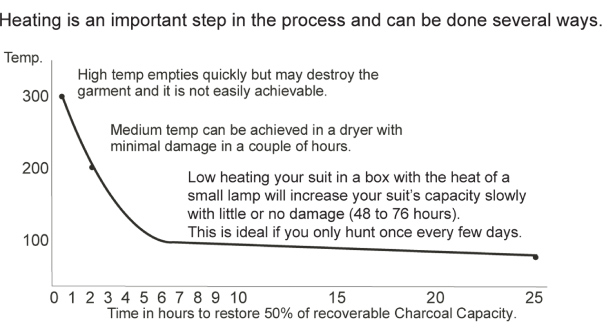
Now we need to dry and heat the fabric. Remember water decreases how many Ping-Pong balls the bucket will hold. The clothes dryer or hanging in a breeze can remove the water. Heating brings the suit to equilibrium with less organics in it so that when it cools down, it has excess capacity. The Ping-Pong balls are bouncing around in the bucket. When you let them settle (cool) you will find there’s room for more.
The odor molecules are adsorbed by becoming caught in the crevices and fissures of the charcoal. Heat adds energy (velocity) to the odor molecules so that they are harder to capture and more likely to jiggle free and escape. This is why the capacity to hold odors decreases as the temperature increases. This heating is often referred to as reactivation, but it is nothing like the original activation process. Activated Charcoal has been heated to 1,100o F with oxygen excluded by steam or CO2. The capacity that can be restored by heating a finished garment is only a small fraction of the original capacity of newly activated carbon. When you receive a new hunting suit, it is already at equilibrium with its environment and must be heated and sealed in a bag until use.
A very high heat (400o-700o F) will rapidly dislodge and vaporize molecules whose boiling point is below the purging temperature. Unfortunately, the high Temperature will rapidly destroy the whole garment so this is out of the question.
Home clothes dryers reach 180o-200o F. Most fabrics can handle this heat and will sustain only slight damage in two hours of tumbling.
If your hunting schedule allows it, a low heat will restore some capacity in a few days with absolutely no damage.
Proper storage will maintain the capacity you have restored.
You can actually increase your suit’s capacity while you store it. Use an odorless barrier bag with N-O-DOR® II powder, a more powerful absorber than carbon. It scavenges odor from within the bag and even draws down some of the odors remaining in the charcoal suit until it is ready to use. Reseal it into the bag after each use until you have reached 8-24 hours of use before washing it again. Do not wear your carbon suit except in the woods and always keep it in a sealed bag when not in use. There is odor everywhere; it’s raining Ping-Pong balls. As soon as you stop shaking the bucket (letting the suit cool) it will fill up. You must cover it or put it in a box to keep it empty. You must seal your hot suit into an airtight bag.To understand how this is possible we must compare how temperature, humidity, and concentration effect carbon and N-O-DOR® II powder.
The capacity of carbon to hold odor decreases as temperature rises. Its capacity to hold odor increases as the concentration of odor increases but falls off badly at low concentrations and also falls off as humidity increases. Unfortunately, as conditions change, the charcoal suit can become very ineffective, and can even be working against you. These shortcomings can be overcome by supplementing the charcoal suit with N-O-DOR® II powder, which contains Abscents® crystals.
In all cases N-O-DOR® II powder surpasses carbon as conditions change from ideal towards real world hunting conditions.
N-O-DOR® II powder has a strong affinity for organic odors. It takes more energy and therefore more heat to free the odor molecules from the N-O-DOR® II powder. We don’t even try to remove organic from N-O-DOR® II, we simply wash it away and replace it.When carbon reaches its equilibrium capacity for a given temperature and cannot hold any more odors, N-O-DOR® II powder will continue to work.
N-O-DOR® II powder remains effective at much lower concentrations. Because charcoal has only a passive hold on odor, the molecules simply drift in and back out when the external concentration is very low. This is not much of an issue if you smell really bad, but if you’re doing everything right and have very little odor, the carbon won’t help much at all. N-O-DOR® II powder, however, will not release odors just because their concentration is low. It can scavenge odors out of a carbon suit in a sealed bag, actually increasing the available capacity. This is an excellent way to maintain the suit between washings or heating.
Increasing humidity (perspiration) reduces the capacity of charcoal because it can adsorb water, which uses up capacity. N-O-DOR® II powder suffers far less reduction of capacity by humidity because it is extremely hydrophobic and therefore does not waste any capacity adsorbing water vapor.
N-O-DOR® II powder has proven itself in hunter’s boots for many years and is the perfect product for maximizing the effectiveness of carbon suits. Simply sprinkle a tablespoon of N-O-DOR® II powder into your storage bag before inserting a freshly heated suit. Heavy Duty zipper close Barrier Bags are available at atsko.com. Each time the suit is heated, remove old powder from the bag with a damp cloth and sprinkle in another tablespoon (½ oz.) of new powder.
If your suit is incomplete, (No socks, or gloves, or hat) consider powdering an ordinary garment with N-O-DOR® II powder as you dress. Sealed N-O-DOR® II powder remains at maximum capacity in its closed bottle, but begins adsorbing as soon as it is out in the air. Unlike Carbon, used N-O-DOR® II powder can simply be washed away after hunting, so you don’t have to worry about trying to restore some precious little percentage of its capacity. After use, washing and drying, apply fresh N-O-DOR® II powder and store it in the sealed bag with your carbon suit till the next time you wear it.
A carbon suit is a big investment and it’s very difficult to measure its effectiveness in the field. Without proper care and use it can actually be working against you. You must understand carbon’s limitations and maximize its capabilities using SPORT-WASH® and N-O-DOR® II powder.
OUR PRODUCTS ARE MADE IN THE USA
SNO-SEAL®Item #1330 The Original Beeswax Waterproofing protects leather from rain, sun, snow, and salt. Enjoy dry feet all year. Waterproofs, preserves, and restores leather. Allows leather to breathe. Will not damage glue seams, stitching, or welts. Sno-Seal® is the longest lasting waterproofing you can use. Now available in Black and Brown.
SPORT-WASH® Item #1338 Total care for all sporting wear destroys odors and eliminates residue that can hold new odors. Maximize performance of all high-tech fabric and insulation, restore performance of cotton, wool, silk, Gore-Tex® fabric, down, Thinsolate®, microfibers, polyethylene, polypropylene, nylon, polyester, acrylic, and blends, whether fleeced, coated, laminated, or treated. Restores Factory applied waterproofing (DWR) wicking, breathability, rapid-dry features and insulation. Scent free detergent is safe for all washables yet removes odors and stains including grass, blood, and oil. Contains no UV brighteners. Makes high-tech fibers and treatments work better by getting them really clean with no residues. Biodegradable and phosphate free. Concentrated-use only 1 oz. per Wash-Load.
SPORT-WASH® HAIR & BODY SOAP 4 oz. tube Item #1345, 16 oz. bottle #1345B Sport-Wash® Hair & Body Soap is scent free and rinses completely. It removes bacteria, odor and residues of other soaps. Leaves nothing to alert game, attract insects, or irritate skin.
SILICONE WATER-GUARD® Spray Item #1336 Heavy duty silicone water repellent achieves maximum effectiveness in a single treatment. Restores and replaces factory waterproofing on silicone impregnated leather boots. Waterproofs backpacks, tents, duffels, clothing, etc. Also available in one gallon container.
SILICONE WATER-GUARD® EXTREME Spray Item #1336X Maximum water repellency plus an invisible coating that resists UV damage, odor and discoloration caused by mold, mildew, fungi and algae. Choose for continuous outdoor exposure. Protects everything from artificial flowers to genuine rock. Also available in one gallon container.
SILICONE WATER-GUARD® ARROW TREATMENT Item #1337AT Waterproofs all feather fletching. Absorbed moisture changes the weight and flight of arrows. SILICONE WATER-GUARD® ARROW TREATMENT protects feather fletching from water and weight gain.
PERMANENT WATER-GUARD® Item #1357 Restore or apply new durable water repellent (DWR) to washable fabrics. Non flammable, No Solvents, No VOC’s, Still beads water after 25 washings in SPORT-WASH® or SENSI-CLEAN®. Water beads up, runs off, leaving fabric dry & breathable. Dries odor free. Leaves fabric soft and quiet. Non-yellowing. PERMANENT WATER-GUARD® is a fluoropolymer surface treatment applied in a water system without solvents, silicone, waxes, or any other extenders. PERMANENT WATER-GUARD® is the most effective and durable water repellent you can apply. It is compatible with all washable fabrics and performs best when heat activated with an iron or clothes dryer. When applied according to directions on fabric that can be washed and ironed, PERMANENT WATER-GUARD® will exceed the performance of factory applied water repellents. Item #1356 17 fl. oz. Spray bottle for natural absorbent fabrics Item # 1357 10 oz. Aerosol can for synthetic fabrics.
WELT-SEAL® Item #1339 2 fl oz. Squeeze tube with applicator tip. A nitrile rubber coating which seals, protects, and waterproofs the welt and stitching of work and sport boots. Stops leaks at thread holes while protecting stitching from abrasion, cuts, chemicals, fuel, and sparks.
PRO-TECH-SKIN® Item #1352 4 fl. Oz. Jar. Heavy-duty protection for hard-working skin. Pro-Tech-Skin® has no perfume, protein, or vitamin or other fad ingredients. We do not claim that PRO-TECH-SKIN® heals your skin. However, by protecting it from further damage and retaining natural moisture, it will enable your skin to heal itself. Your hands will look and feel healthier immediately and continue to improve as natural healing occurs.
N-O-DOR® OXIDIZER LIQUID SPRAY Item #13496 N-O-DOR® spray deodorizes clothing, hair, skin, and all wetable surfaces quickly and safely by permanently oxidizing the organic molecules creating new odorless, nonvolatile compounds. N-O-DOR® does not cover, absorb, or mask odors, but totally destroys them. The unique packaging assures absolute freshness with economy and ease of use. With N-O-DOR®, you are able to remain scent free all day.
N-O-DOR® ODOR OXIDIZER Item #13492 Twin Pack New pre filled system. Just add the activator. The freshest, most powerful odor control system. Twin pack (2 ea. – 8 oz. bottles). Activate one now, save one for your next trip. Refill with Item #13494
N-O-DOR® ODOR OXIDIZER Item #13496 New larger size trigger spray totally fresh because you add the enclosed activator. Refill with item #13494
N-O-DOR® II THE POWDER Item #1347 8 oz. Bottle Improves the performance of Carbon Suits. A mixture of Abscents® crystals which adsorbs every trace of odor and Baking Soda to slow the creation of new odor by increasing pH. This powder performs wet or dry and washes away easily when done. Ideal to deodorize your daily wear boots for hunting, or maximize the capacity of your carbon suit in sealed zipper bag item #1347B.
U-V-KILLER® Item #1341 18-oz. spray bottle. Blocks Ultraviolet light reflection and luminescence. For all fabric, camo, and blaze orange. One bottle will treat two sets of hunting clothes. Stop the Glow so you will see more animals.
U-V-BOWSTRING WAX Item #1344 1.4 oz. Tube 100% beeswax with Ultraviolet absorbent dye. For all synthetic and natural bowstrings. Lasts longer than synthetic waxes.
U-V-SHIELD® Item#1343 8 oz. Jar A durable outdoor clear coat with Ultraviolet absorbent dye. For all painted surfaces, metal, wood, and plastic. Tree-stands, decoys, archery equipment, etc.
U-V-KILLER® TREATED BLAZE ORANGE VEST Item #1000 Allows you to be safe, legal, and invisible to animals. Extremely fade resistant. One size fits all.
U-V-KILLER® CAMO VEST Item #1009 Seen as camouflage by Deer and 100% solid orange by humans. Viewed by Humans, the U-V-Killer® Camo Vest appears to be identical to ordinary Blaze Orange. You are safe and legal but U-V-Killer® Camo Vest won’t spook animals. Viewed by Deer, the U-V-Killer® Camo Vest is a dull yellow and brown camouflage that matches and blends into their world.
UV FLASHLIGHT Item FLLT (6” fluorescent 350 BLB) Enables humans to determine if brighteners are present in camo, blaze orange, etc. Don’t guess! Check all your clothing and gear with this 350 BLB Ultraviolet light source. (imported).
GLOW TEST KIT Item #13413 With the Ultraviolet Brightener Detection Kit you can check your old camouflage/Blaze Orange clothing and check all new camouflage before buying so you will not be GLOWING in the woods. Detection Kit contains our custom made 370-390 nanometers LED Black Light, a copy of our DVD “Whitetail Sight and Scent Strategies” and the book “How Game Animals See & Smell”.
RAPID-ROD® Item #1100 Folds to fit in your shirt pocket. Rapid-Rod® will keep your barrel clear and safe. Opens in seconds to a rigid cleaning rod. No loose pieces. Weighs only 2 ounces. Fits rifles from .22 cal. and up with 26” barrel Fits shotguns from 20 gauge and up with 30” barrel. Obstructions such as mud, snow, dirt, ice, shotgun wadding, shell casings or a bullet can and do get lodged in chambers and barrels. This dangerous and frustrating situation renders your weapon useless until cleared. Rapid-Rod will quickly, quietly, and safely clear all obstructions and save your day in the field. Why would anyone go to the field without it?
U-V-BLOCK® Item #2344 17-fl. oz Spray bottle. Sun protection. Permanent fabric treatment. You can now apply UV protection to white or light colored (cool) clothing instead of skin. Eliminate the repeated chemical exposure and cost of applying sunscreen to the skin. U-V-Block® treats any fabric. On many fabrics U-V-Block® will achieve UPF 50+, the highest rating allowed by ASTM fabric labeling standard, in just one application. For Fishing Hats, shirts, etc. Also 1-Qt size for outdoor furniture, boat covers, awnings and umbrellas, to protect them from the sun’s harmful UV Rays, and make them last 4 times longer.
N-O-DOR® PET SHAMPOO Item #1396 16 fl. Oz. Bottle The best unscented, free-rinsing pet shampoo on the market today. Safe and economical for regular use. The clear liquid produces a rich lather that leaves your pet’s coat and skin so clean it delays the re-growth of odor causing bacteria but contains no harmful residue to attract insects, or cause skin irritation. With N-O-DOR® Pet Shampoo you can enjoy having a clean pet without making him endure the smell of perfume or medication. No scent, no medication, no residue, and no irritation.
UV Color and Vision References
Popular Publications
CLANCY, UV The Invisible Factor. Petersen’s Bowhunting. August 1990 pp 46-50.
GOOCH, BOB. Blaze in the Woods. OUTDOOR LIFE November 1992 pp 90-102.
MANDILE, TONY. Now they see you…Now they don’t. OUTDOOR LIFE July 1990 pp 81-90.
Charles J. Alsheimer The Role of Color Vision in Whitetails. Deer & Deer Hunting December 1999 pp 20-28
ROBB, BOB The Question of COLOR. Whitetail Journal October 2000 pp 53-56
JACOBS, GERALD H., The Distribution and Nature of Colour Vision among the Mammals Department of Psychology, University of California, Santa Barnara 1 March 1993.
LYTHGOE, J. N., The Ecology Of Vision. Clarendon Press, Oxford, 1979.
RODIECK, R. W., The Vertebrate Retina Principles Of Structure And Function. W. H. FREEMAN & CO.
SINCLAIR, S., Foreword by DEAN YEAGER, PHD., How Animals See, Other Visions of Our World. Facts On File Publications, New York.
WALD, G., Edited by Richard Jung, Life & Light Handbook of Sensory Physiology Volume VII/3 Central Processing of Visual Information. Springer-Verlag, New York, 1973.
IVOSEVIC, S. W., Birder Camouflage on disguising appearance, movements, and location while watching or photographing birds. Stanley W. Ivosevic, Castle Hayne, 2000.
Juried Scientific Publications
ANDERSSON, M. (1996) Sexual Selection (Princeton Univ. Press, Princeton, NJ).
ANDERSSON, S. (1996) Proc. R. Soc. London Ser. B263, 843-848.
AGUIRRE, G .(1978). Retinal degenerations in the dog, I: Rod dysplasia. Experimental Eye Research 26, 233-253.
AGUIRRE, G., ALLIGOOD, J, O’BRIEN, P. & BUYKMIHCI, N. (1982). Pathogenesis of progressive rod-cone degeneration in minature poodles. Investigative Ophthalmology and Visual Science 23, 610-630.
AHNELT, P. K. (1985). Characterization of the color-related receptor mosaic in the ground squirrel retina. Vision Research 25, 1557-1567.
ALEXANDER, G. & STEVENS, G. (1979). Discrimination of colours and gray shades by Merino ewes: tests using coloured lambs. Applied Animal Ethology 5, 215-231.
ALI, M. A. & KLYNES, M. A. (1985). Vision in Vertebrates. Plenum Press, New York.
ALPERN, M., LEE, G. B., MAASEIDVAAG, F. &- MILLER, S. S. (1971). Colour vision in blue-cone monochromacy. Journal of Physiology 212, 211-23 3.
BAILEY, W. J., SLICHTOM, J. I,. & GOODMAN, M. (1992). Rejection of the ‘Flying Primate’ hypothesis by phylogenetic evidence from the y-globin gene. Science 256, 86-89.
BARLOW, H. B. (1982). What causes trichromacy? A theoretical analysis using comb-filtered spectra. Vision Research 22, 63S-643.
BAUCHEMIN M. L: The fine structure of the pig’s retina. Albrecht von Graefes Arch Klin Exp Ophthalmol 190:27-45, 1974.
BAYLOR, D. A., NUNN, B. J. & SCHNAPF, J. I,. (1984). The photocurrent, noise and spectral sensitivity of rods of the monkey. Macaca fascicularis. Journal of Physiology 357, 575-607.
BAYLOR, D. A., NUNN, B. J. & SCHNAPF, J. I,. (1987). Spectral sensitivity of cones of the monkey Macaca fascicularis. Journal Of Physiology 390, 145-160.
BENNETT, A. T. D. & CUTHILL, I. C. (1994) Vision Res.34, 1471-1478
BENNETT, A. T. D., CUTHILL, I. C. & NORRIS, K. J. (1994) Am. Nat.144, 848-860
BENNETT., A. T. D., CUTHILL, I. C., PARTRIDGE, J.C.& MAIER, E. J. (1996) Nature (London)380, 433-435
BENNETT., A. T. D., CUTHILL, I. C., PARTRIDGE, LUNAU, K. (1997) Ultraviolet plumage colors predict mate preferences in starlings. Proc. Natl. Acad. Sci. USA Vol 94,,pp. 8618-8621
BIRCH, D. & JACOBS, G. H. (1975). Behavioral measurements of rat spectral sensitivity. Vision Research 15, 687-691.
BLACKWELL, H. R. & BLACKWELL, 0. M. (1961). Rod and cone receptor mechanisms in typical and atypical congenital achromatopsia. Vision Research 1, 62-107.
BLAKESLEE, B. & JACOBS, G. H. (1982). Color vision in the spider monkey (Ateles). Folia Primatologica 38, 86-98.
BLAKESLEE, B. & JACOBS, G. H. (1985). Color vision in the ring-tailed lemur (Lemur catta). Brain, Behavior and Evolution 26, 154-166.
BLAKESLEE, B., JACOBS, G. H. & NEITZ, J. (1988). Spectral mechanisms in the tree squirrel retina. Journal of Comparative Physiology A 162, 773-780.
BOWMAKER, J. K. Trends Neurosci., 196, 1980.
BOWMAKER, J. K. (1984). Microspectrophotometry of vertebrate photoreceptors. Vision Research 24, 1641-1650.
BOWMAKER, J. K. (I 991a). Visual pigments, oil droplets and photopigments. In The Perception of Colour (ed. P. Gouras), pp. 108-127. CRC Press, Boca Raton.
BOWMAKER, J. K. (1991b). Visual pigments and colour vision. In From Pigments to Perception : Advances in Understanding Visual Processes (ed. A. Valberg and B. B. Lee), pp. 1-9. Plenum Press, New York.
BOWMAKER, J. K. (1991c). The evolution of vertebrate Visual pigments and photoreceptors. In Evolution of the Eye and Visual System led. J. R. Cronly-Dillon and R, L. Gregory), pp. 63-81. CRC Press, Boca Raton.
BOWMAKER, J. K., ASTELL, S., HUNT, D. M. & MOLLON, J. D. (1991). Photosensitive and photostabile pigments in the retinae of Old World monkeys. Journal of Experimental Biology 156, 1-19.
BOWMAKER, J. K., DARTNALL, J. A., LYTHGOE, J. N. & MOLLON, J. D. (1970). The visual pigments of rods and cones in the rhesus monkey, Macaca mulatta. Journal of Physiology 274, 329-348.
BOWMAKER, J. K., DARTNALL, H. J. A. & MOLLON, J. D. (1980). Microspectrophotometric determination of four classes of photoreceptor in an Old World primate, Macaca fascicularis. Journal of Physiology 298, 131-143.
BOWMAKER, J. K., JACOBS, G. H. & MOLLON, J. D. (1987). Polymorphism of photopigments in the squirrel monkey: A sixth phenotype. Proceedings of the Royal Society of London B231, 383-390.
BOWMAKER, J. K., JACOBS, G. H., SPIEGELHALTER, D. J. & MOLLON, J. D. (1985). Two types of trichromatic squirrel monkey share a pigment in the red-green spectral region. Vision Research 25, 1937-1946.
BOYNTON, R. M. ‘Human Color Vision’. Holt-Rinehart-Winston, New York, 1979.
BRINDLEY, G. S. (1970). Physiology of the Retina and Visual Pathway.), 2nd edn. Williams & Wilkins, Baltimore.
BURKHARDT, D. (1982). Birds, berries and UV. Naturwissenschaften 69, 153-157.
BURKHARDT, D. (1983). Wavelength perception and colour vision. Symposia of the Society for Experimental Biology 36, 371-397.
BURKHARDT, D. & FINGER, E. (1991). Black, white, and UV: how birds see birds. Naturwissenschaften 78, 279-280.
BURN, D. M. (ed.) (1991). The Encyclopedia of the Animal World. Peerage Books, London.
BUSCH, H. & DUCKER, G. (1987). Das visuelle Leistungsvermogen der Seebaren (Arctocephalus pusillus und Arctocephalus australis). Zoologischer Anzeiger 219, 197-224.
CAMPENHAUSEN, C. von. (1986). Photoreceptors, lightness constancy and color vision. Naturwissenschaften 73, 674-675.
CHAUSSEIL, M. (1992). Evidence for color vision in procyonides: Comparison between diunal coatis (Nasua) and nocturnal kinkajous (Potos flavus). Animal Learning and Behavior 20, 259-265.
CICERONE, C. M. (1976). Cones survive rods in the light-damaged eye of the albino rat. Science 194, 1183-1185.
CICERONE, C. M. & NERGER, J. L (1980). The relative numbers of long-wavelength-sensitive to middle-wavelength-sensitive cones in the human fovea centralism Vision Research 29, 115-128.
COCKAYNE, E. A. (1924). The Distribution of Fluorescent Pigments in the Lepidoptera. Trans. Entom. Soc. London, 1924,pp. 1-19.
COILE, D. C. (1982). Adetermination of critical flicker fusion as a function of light intensity in dogs using conditioned supression. Unpublished Masters Thesis, Florida State Univ.
COHEN, A. I. (1972). Rods and cones. In Physiology of Photoreceptor Organs (ed. M. G. F. Fuortes), pp. 63-110. Springer Verlag, Berlin.
CORBET, G. H. & HILL, J. E. (1991). A World List of Mammalian Species, 3rd edn. Oxford University Press, Oxford.
CRESCITELLI, F. (1963). Obituary: Gordon Lynn Walls. Vision Research 3, 1-7.
CRESCITELLI, F. & POLLOCK, J. D. (1972). Dichromacy in the antelope ground squirrel. Vision Research 12, 1553-1586.
CROCKER, R. A., RINGO, J., WOLBARSHT, M. L. & WAGNER, H. G. (1980). Cone contributions to cat retinal ganglion cells receptive fields. Journal of General Physiology 76, 763-768.
CRONIN, T. W. & MARSHALL, N. J. (1989). A retina with at least ten spectral types of photoreceptors in a mantis shrimp. Nature 339, 137-140.
CURCIO, C. A., ALLEN, K. A., SLOAN, K. R., LEREA, C. L., HURLEY, J. B., KLOCK, I. B. & MILAM, A. H. (1991). Distribution and morphology of human cone photoreceptors stained with anti-blue opsin. Journal of Comparative Neurology 312, 610-624.
DALRYMPLE, B. W.: When can your quarry see you? Outdoor Life 156:61, 1975.
DARTNALL, H. J. A., ARDEN, G. B., IKEDA, H., LUCK, C. P., ROSENBERG, C. M., PEDLER, H. & TANSLEY, K. (1965). Anatomical, electrophysiological and pigmentary aspects of vision in the bush baby: an interpretative study. Vision Research 5, 399-424.
DARTNALL, H. J. A. & LYTHGOE, J. N. (1965). The spectral clustering of visual pigments. Vision Research 5, 81-100.
DARWIN, C. (1871) The Descent of Man and Selection in Relation to Sex (Murray, London).
DAW, N. W. & PEARLMAN, A. L. (1969). Cat colour vision: one cone process or several. Journal of Physiology 201, 745-764.
DAW, N. W. & PEARLMAN, A. L. (1970). Cat colour vision: Evidence for more than one cone process. Journal of Physiology 211, 125-137.
DAWIS, S. M. (1981). Polynomial expressions of pigment nomograms. Vision Research 21, 1427-1430.
DAWSON, W. W, (1980). The cetacean eye. In Cetacean Behavior: Mechanisms and Functions (ed. L. M. Herman), PP. 53-100. John Wiley, New York.
DEEGAN II, J. F. & JACOBS, G. H. (1993). On the identity of the cone types of the rat retina. Experimental Eye Research 56, 375-377.
DERRINGTON, A. M., KRAUSKOPF, J. & LENNIE, P. (1984). Chromatic mechanisms in lateral geniculate nucleus of macaque. .Journal of Physiology 357, 219-240.
DE VALOIS, R. L. & DE VALOIS, K. K. (1988). Spatial Vision. Oxford University Press, New York.
DE VALOIS, R. L. & JACOBS, G. H. (1984). Neural mechanisms of color vision. In Handbook of physiology. Section r. Volume III. Sensory Processes (ed. I. Darian-Smith), PP. 425-456. Williams & Wilkins, Baltimore.
DE VALOIS, R. L., MORGAN, H. C., POLSON, M. C., MEAD, W. R. & HULL, E. M. (1974). Psychophysical studies of monkey vision. I. Macaque luminosity and colour vision tests. Vision Research 14, 53-67.
DODT, E. (1967). Purkinje shift in the rod eye of the bush baby, Galago crassicaudatus. Vision Research 7, 509-517.
DUBIN, M. W. & TURNER, L. (1977). Anatomy of the retina of the mink (Mustela vison). Journal of Comparativ Neurology T,73, 275-288.
DUCKER, G. (1964). Colour-vision in mammals. Journal of the Bombay Natural History Society 61, 572-586.
EBREY, T. G. & HONIG,B. (1977). New wavelength-dependent visual pigment nomograms. Vision Research 17, 147-151.
EENS, M., PINXTEN, R. & VERHEYEN, R. F. (1991) Behaviorll6, 210-238
ELTRINGHAM, H. (1919). Butterfly Vision. Trans. Entom. Soc.London, 1919, pp. 1-49, 5 pls.
ENDLER, J. A. & THERY, M. (1996) Am. Nat.148, 421-452
ENDLER, J. A. (1987) Anim. Behav.35, 1376-1385
ENDLER, J. A. (1990) Biol. J. Linn. Soc. Lond.41, 315-352.
ENDLER, J. A. (1991) Vision Res.31, 587-608[Medline].
ENDLER, J. A. (1992). Signals, signal conditions, and the direction of evolution. American Naturalist 139, S125-S153.
ENGQVIST, A. & RICHARD, A. (1991). Diet as a possible determinant of cathemeral activity patterns in primates. Folia Primatologica 57, 169-172.
ESKEW JR., R. T. & BOYNTON, R. M. (1987). Effects of field area and configuration on chromatic and border discrimination. Vision Research 27, 1835-1844.
FEARE, C. (1984) The Starling (Oxford Univ. Press, Oxford)-.
FELDMAN, J. L. & PHILLIPS, C. J. (1984). Comparative retinal pigment epithelium and photoreceptor ultrastructure in nocturnal and fossorial rodents: the eastern woodrat, Neotoma floridana and the plains pocket gopher, Geomys bursarius. Journal of Mammalogy 65, 231-245.
FRIEDMAN, H. (1967). Colour vision in the Virginia opossum. Nature 213, 835-836.
FRYXELL, K. J. & MEYEROWITZ, E. M. (1991). The evolution of rhodopsins and neurotransmitter receptors. Journal of Molecular Evolution 33, 367-378.
GILBERT JR., B. J. & ARAVE, C. W. (1986). Ability of cattle to distinguish among different wavelengths of light. Journal of Dairy Science 69, 825-832.
GOLDSMITH, T. H. (1986). Interpreting trans-retinal recordings of spectral sensitivity. Journal of Comparative Physiology A159, 481-487.
GOLDSMITH, T. H. (1990). Optimization, constraint, and history in the evolution of eyes. Quarterly Review of Biology 65, 281-322.
GOVARDOVSKII, V. I., ROHLICH, P,, SZEL, A. & KHOKHLOVA, T. V. (1992). Cones in the retina of the Mongolian gerbil, Meriones unguiculatus: an immunocytochemical and electrophysiological study. Vision Research 32, 10-28.
GRAUR, D., HIDI, W. A. & LI, W.-H. (1991). Is the guinea pig a rodent? Nature 351, 649-652.
GRETHER, W. F. (1939). Color vision and color blindness in monkeys. Comparative Psychology Monographs 29, 1-38.
GRETHER, W. F. (1940). A comparison of human and chimpanzee hue discrimination curves. Journal of Experimental Psychology 26, 394-403,
GRIEBEL, U. & SCHMID, A. (1992). Colour vision in the California sea lion (Zalophus californianus). Vision Research 32, 477-482.
GRIFFITHS, M. (1978). The Biology of Monotremes, Academic Press, New York.
GUENTHER, E. & ZRENNER, E. (1990). Analysis of the photopic spectral sensitivity of the cat reveals three cone mechanisms. Investigative Ophthalmology and Visual Science Supplement 31, 260.
HARWERTH, R. S. & SPERLING, H. G. (1971). Prolonged color blindness induced by intense spectral lights in rhesus monkeys. Science 174,520-523.
HAMILTON, W. D. & ZUK, M. (1982) Science2l8, 384-387 [Medline].
HAMILTON, W. D. (1990) Am. Zool.30, 341-352
HAO, Y., SOREF, C. M, GERKE JR., C. G. & WONG, F. (1992). The visual pigment gene family and the distribution of photoreceptors in the pig retina. Investigative Ophthalmology and Visual Science 33, 1004.
HAROSI, F. (1987). Cynomologous and rhesus monkey visual pigment. Journal of General Physiology 80, 717-743.
HARWERTH, R. S. & SMITH 111, E. I,. (1985). The rhesus monkey as a model for normal vision of humans. American Journal of Optometry and Physiological Optics 62, 633-641.
HAWRYSHYN, C. W. (1982). Studies of animal color vision: comments on some important theoretical considerations. Canadian Journal of Zoology 60, 2968-2970.
HELMS, C. W. & DRURY, W. H. (1960) Bird Band.31, 1-40
HESS, R. F., MULLEN, K. T., SHARPE, I,. T. & ZRENNER, E. (1989). The photoreceptors in atypical achromatopsia. Journal of Physiology 417, 123-149.
HOPE, G. M. & BHATNAGAR, K. P. (1979). Electrical response of bat retina to spectral stimulation: comparison of four microchiropterian species. Experientia 35, 1189-1191.
HUNT, D. M., WILLIAM, A. J., BOWMAKER, J. K. & MOLLON, J. D. (1993). Structure and evolution of the polymomorphic photopigment gene of the marmoset. Vision Research 33, 147-154.
HUNT, S., CUTHILL, I. C., SWADDLE, J. P. BENNETT, A. T. D. (1997) Anim. Behav., in press.
HURVICH, L. M. & JAMESON, D. (1974). On the measurement of dichromatic neutral points. Acta Chromatica 2,207-216.
HURVICH, L. M. ‘Color Vision’.Sinauer, Sunderland, Mass., 1981.
IMMEL JR., J. H. (1981). The tree shrew retina: photoreceptors and retinal pigment epithelium. Doctoral Dissertation. University of California, Santa Barbara.
JACOBS, G. H. (1977). Visual capacities of the owl monkey (Aotus trivirgatus). 1. Spectral sensitivity and color vision. Vision Research 17, 811-820.
JACOBS, G. H. (1978). Spectral sensitivity and colour vision in the ground-dwelling sciurids: results from golden-mantled ground squirrels and comparisons for five species. Animal Behaviour 26, 409-421.
JACOBS, G. H. (1981). Comparative Color Vision. Academic Press, New York.
JACOBS, G. H. (1983). Colour Vision In Animals.Endeavor, New Series, Volume 7, No.3, 1983.Pergamon Press.Printed Great Britain.
JACOBS, G. H. (1984). Within-species variations in visual capacity among squirrel monkey (Sairmiri sciureus): color vision. Vision Research 24, 1267-1277.
JACOBS, G. H. (1990 a). Duplicity theory and ground squirrels: Linkages between photoreceptors and visual function. Visual Neuroscience 5, 311-318.
JACOBS, G. H. (1990 b). Evolution of mechanisms for color vision. SPIE Proceedings 1250, 287-292.
JACOBS, G. H. (1990 c). Discrimination of luminance and chromaticity differences by dichromatic and trichromatic monkeys. Vision Research 30, 387-397.
JACOBS, G. H. ‘Variations in Color Vision Among Nonhuman Primates in Colour Vision: Physiology and Psychophysics (eds.J. D.Mollon and L.T.Sharpe). Academic,London, in press.
JACOBS, GERALD H. (1991) Retinal Receptors in Rodents maximally sensitive to ultroviolet light. NATURE pp 655
JACOBS, G. H. (1992a). Data and interpretation in comparative color vision. The Behavioral and Brain Sciences 15, 40-41.
JACOBS, G. H. (1992b). Ultraviolet vision in vertebrates. American Zoologist 32, 544-554.
JACOBS, G. H. (1993). Color-vision polymorphisms in New World monkeys: Implications for the evolution of primate trichromacy,. In New World Primates: Ecology, Evolution and Behavior (ed. W. G. Kinzey) (In the Press.) Aldine de Gruyter, New York.
JACOBS, G. H. & BLAKESLEE, B. (1984). Individual variations in color vision among squirrel monkeys (Saimiri sciureus) of different geographical origin. Journal of Comparative Psychology 98, 347-357.
JACOBS, G. H., BLAKESLEE, B. & TOOTELL, R. B. H. (1981). Color discrimination tests on fibers in ground squirrel optic nerve. Journal of Neurophysiology 45, 903-914.
JACOBS, G .H. & NEITZ ,J. (1986). Spectral mechanisms and color vision in the tree shrew (Tupaia belangeri). Vision Research 26, 291-298.
JACOBS, G. H., BOWMAKER, J. K. & MOLLON, J. D. (1981). Behavioural and microspectrophotometric measurements of color vision in monkeys. Nature 282, 541-543.
JACOBS, G. H. & DEEGAN II, J. F. (1992). Cone photopigments in nocturnal and diumal procyonids. Journal of Comparative Physiology A 171, 351-358.
JACOBS, G. H. & DEEGAN II, J. F. (1993). Photopigments underlying color vision in ringtail lemurs (Lemur catta) and brown lemurs (Eulemur fulvus). American Journal of Primatology (In the Press.)
JACOBS, G. H., DEEGAN II, J. F., CROCNALE, M. A. & FENWICK, J. A. (1993). Photopigments of dogs and foxes and their implications for canid vision. Visual Neuroscience 10, 173-180.
JACOBS, G. H., DEEGAN II, J. F., J. NEITZ, B.P. MURPHY, K.V. MILLER, R.L. MARCHINTON (1994) “Electrophysiological measurements of spectral mechanisms in the retinas of two cervids: white-tailed deer (Odocoileus virginianus) and tallow deer (Dama dama).” Journal of Comparative Physiology, A 174:551 557.
JACOBS, G. H., DEEGAN, II, J. F., NEITZ, J., CROGNALE, M. A. & NEITZ, M. (1993). Photopignients and color vision in the nocturnal monkey. Aotus. Vision Research (In the Press.).
JACOBS, G. H. & HARWERTH, R. S. (1989). Color vision variations in Old and New World primates. American Journal of Primatology 18, 35-44.
JACOBS, G. H.& NEITZ, J. (1985). Spectral positioning of mammalian cone pigments. Journal of the Optical Society of America A 2, P23.
JACOBS, G. H. & NEITZ, J. (1986a). Spectral mechanisms and color vision in the tree shrew (Tripaia belatigeri). Vision Research 26, 291-298.
JACOBS, G. H. & NEITZ, J. (1986b). Spectral sensitivitv of cat cones to rapid flicker. Experimental Brain Research 62, 446-448.
JACOBS, G. H. & NEITZ, J. (1987). Polymorphism of the middle wavelength cone in two species of South American monkey: Cebus apella and Callicabus molloch. Vision Research 27, 1263-1268.
JACOBS, G. H. & NEITZ, J. (1987) Inheritance of color vision in a New World monkey (Saimiri sciureus). Proceedings of the National Academy of Sciences USA 84, 2545-2549.
JACOBS, G. H. & NEITZ, J. (1989). Cone monochromacy and a reversed Purkinje shift in the gerbil. Experientia 45, 317-319.
JACOBS, G. H., NEITZ, J. & CROGNALE, M. (1985). Spectral sensitivity of ground squirrel cones measured with ERG flicker photometrv. Journal of Comparative Physiology A 156, 503-509.
JACOBS, G. H., NEITZ, J. & CROGNALE, M. (1987). Color vision polymorphism and its photopigment basis in a callitrichid monkey (Saguintus fuscicollis). Vision Research 27, 2089-2100.
JACOBS, G. H., NEITZ, J., CROGNALE, M. A. & BRAMMEFR, G. L. (1991). Spectral sensitivity of vervet monkeys (Cerocopithectis aethiops sabaetis) and the issue of catarrhine trichromacy. American Journal of Primatology 23, 185-195.
JACOBS, G. H., NEITZ, J. & DEEGAN II, J. F. (1991). Retinal receptors in rodents maximally sensitive to ultraviolet light. Nature 353, 655 -656.
JACOBS, G. H. & SILVERMAN, M. S. (1976). Electrophysiological evidence for rod and cone-based vision in the nocturnal flying squirrel. Journal of Comparative Physiology 109, 1-16.
JANIS, C. M. & DAMUTH, J. (1990). Mammals. In Evolutionary Trends led. K. J. McNamara), pp. 301-345. Belhaven Press, London.
JOSHI, D. & CHANDRASHEKARAN, M. K. (1985). Spectral sensitivity of the photoreceptors responsible for phase shifting the circadian rhythm of activity in the bat, Hipposideros speoris. Journal of Comparative Physiology A156, 189-198.
KALMUS, H. (1983). Kinds and intensity of selection at the colour vision loci. In Colour Vision Physiology and Psychophysics (ed. J. D. Mollon and L. T. Sharpe), PP. 51-55. Academic Press, London.
KAUFMAN, J. H. (1982). Raccoon and allies. In Wild mammals of North America led. J. A. Chapman and G. A. Feldhamer), PP. 567-585. Johns Hopkins University Press, Baltimore.
KING-SMITH, P.E. & CARDEN, D. (1976). Luminance and opponent color contributions to visual detection and adaption and to mtemporal and spatial integration. Journal of the Optical Society of America 66, 709-717.
KOLB, H. & WANG, H. (1985). The distribution of photoreceptors, dopaminergic amacrine cells and ganglion cells in the retina of the North American opossum (Didelphis virginiana). Vision Research 25, 1207-1221.
KRAFT, T. W. (1988). Photocurrents of cone photoreceptors of the golden-mantled ground squirrel. Journal of Physiology 404, 190-213.
KRASTEL, H. & MORELAND, J. D. (1991). Colour vision deficiencies in ophthalmic diseases. In Inherited and Acquired Colour Vision Deficiencies (ed. D. H. Foster), pp. 115-172. Macmillan, London.
LAND, M. F. & FERNALD, R. D. (1992). The evolution of eyes. Annual Review of Neuroscience 15, 1-29.
LENNIE, P. & D’ZRIURA, M. (1988). Mechanisms of color vision. CRC Critical Reviews in Neurobiology 3, 333-400.
LEVINE, J. S. & Mac.NICH0L Jr., E. F. (1979). Visual pigments in teIeost fishes: effects of habitat, microhabitat and behavior on visual system evolution. Sensory Processes 3, 95-130.
LEVINE, J. S. & MacNICHOL JR., E. F. (1985). Microspectrophotometry of primate photoreceptors: art, artifact, and analysis. In The Visual System (ed. A. Fein and J. S. Levine), PP. 73-88. Liss, New York.
LONG, K. 0. & FISHER, S. K. (1983 a). The distribution of photoreceptors and ganglion cells in the California ground squirrel (Spermophilus beechevi). Journal of Comparative Neurology 221, 329-340.
LONG, K. 0. & FISHER, S. K. (1983b). Procion and lucifer staining of ground squirrel photoreceptors. Investigative Ophthalmology and Visual Science Supplement 24, 259.
LOOP, M. S., MILLICAN, C. L. & THOMAS, S. R. (1987). Photopic spectral sensitivity of the cat. Journal of Physiology 382, 537-553.
LUCK, C. P. (1965). Comparative morphology of the eyes of certain African suiformes. Vision Research 5, 283-297.
LUCKIESH, M.(1930). Artificial Sunlight. Van Nostrand. New York.
LUTZ, F.E. (1933). “Invisible” Colors of Flowers and Butter-flies.Journ. American Mus. Nat. Hist., vol.33, pp. 565-576, 21 figs.
LYTHGOE, J. N. (1988). Light and vision in aquatic environments. In Sensory Biology of Aquatic Animals. (ed. J. Atema, R. R. Fay, A. N. Popper & W. N. Tavolga), PP. 57-82. Springer-Verlag, Berlin.
LYTHGOE, J. N. & PARTRIDGE, J. C. (1989). Visual pigments and the acquisition of visual information. Journal of Experimental Biology 146, 1-20.
LYTHGOE, J. N. & PARTRIDGE, J. C. (1991). The modelling of optimal visual pigments of dichromatic teleosts in green coastal waters. Vision Research 31, 361-371.
MARTIN, R. D. (1990). Primate Origins and Evolution. Princeton University Press, Princeton.
MASON, W.T., FAGER, R.S., ABRAHAMSON, E.W. (1973). Ultrastructure of the receptor and epithelial layers of the bovine retina. J Anat 115: 289-308,1973.
MASSOF, R.W. & BAILEY, J.E. (1976). Achromatic points in protanopes and deuteranopes. Vision Research 16, 53-57.
MATTHEWS, L. H. (1969). The Life of Mammals, vol. 1. Weidenfeld and Nicolson, London.
MENZEL, R. (1979). Spectral sensitivity and color vision in invertebrates. In Handbook of Sensory, Physiology, vol. VII/6A (ed. H. Autrum), PP. 503-580. Springer-Verlag, Berlin.
MENZEL, R. & BACKHAUS, W., (1901). Colour vision in insects. In The Perception of Colony (ed. P. Gouras), pp. 262-203. CRC Press, Boca Raton.
MERBS, S. I,. & NATHANS, J. (1992). Absorption spectra of the hybrid pigments responsible for anomalous color vision. Science 258, 464-466.
MILLER, W. H. & SNYDER, A. W. (1977). The tiered vertebrate retina, Vision Research 17, 239-255.
MILINSKI, M. & BAKKER, T. C. M. (1990) Nature (London)344, 330-333
MOLLON, J. D. (1988). On the origins of polymorphisms. In Frontiers of Visual Science (ed. Committee on Vision, National Research Council), pp. 160 -168. National Academy Press, Washington.
MOLLON, J. D. (1991). Uses and evolutionary origins of primate colour vision. In Evolution of the Eye and Visual System led. J. R. Cronly-Dillon and R. L. Gregory), PP. 306-319. CRC Press, Boca Raton.
MOLLON, J.D., BOWMAKER, J.K., DARTNALL ,H. J. A. & BIRD ,A.C. (1984). Microspectrophotometric and psychophysical results for the same deuteranopic observer. Documenta Ophthalmologica Proceedings Series 39, 303-310.
MOLLON, J. D., BOWMAKER, J. K. & JACOBS, G. H. (1984). Variations in colour vision in a New World primate can be explained by polymorphism of retinal photopigments. Proceedings of the Royal Society of London B222, 373-399.
MOLLON, J. D. & JORDAN, G. (1988/1989). Eine evolutionare Interpretation des menschlichen Farbensehens. Die Farbe 35/36, 139-170.
MONTAG, E. S. & BOYNTON, R. M. (1987). Rod influence on dichromatic surface color perception. Vision Research 27, 2153-2162.
MORGAN, M. J., ADAM, A. & MOLLON, J. D. (1992). Dichromats detect colour-camouflaged objects that are not detected by trichromats. Proceedings of the Royal Society of London B 248, 291-295.
MULLEN, K. T. (1985). The contrast sensitivity of human colour vision to red-green and blue-yellow chromatic gratings. Journal of Physiology 359, 381-409.
MULLER, B. & PEICHL, I,. (1989). Topography of cones and rods in the tree shew retina. Journal of Comparative Neurology 282, 581-594.
MUNKENBECK, N. W. (1982). Color vision in sheep. Journal of Animal Sciences SS, 129.
MUNZ, F. W. & McFARLAND, W. N. (1973). The significance of spectral position in the rhodopsins of tropical marine fishes. Vision Research 13, 1829-1874.
NAGY, A. L. (1980). Large-field substitution Rayleigh matches of dichromats. Journal of the Optical Society of America 70, 778-784.
NAGY, A. L., MacLEOD, D. I. A., HEYNEMAN, N. E. & EISNER, A. (1981). Four cone pigments in women heterozygous for color deficiency. Journal of the Optical Society of America 71, 719-722.
NAASH, M. L., AL-UBAIDI, M. & BAEHR, W. (1992). Characterization of cDNA clones encoding the mouse retina blue pigment. Investigative Ophthalmology and Visual Science Supplement 33, 1004.
NATHANS, J. (1987). Molecular biology of visual pigments. Annual Review of Neuroscience 10, 163-194.
NATHANS, J., THOMAS, D. & HOONESS, D. S. (1986). Molecular genetics of human color vision: the genes encoding blue, green and red pigments, Science 232, 193-202.
NATHANS, J., MERBS, S. L., SUNG, C. H., WEITZ, C. J. & WANG, Y. (1992). Molecular genetics of human visual pigments. Annual Review of Genetics 26, 403-424.
NEITZ, J. & JACOBS, G. H. (1984). Electroretinogram measurements of cone spectral sensitivity in dichromatic monkeys. Journal of the Optical Society, of America A I, 1175-1180.
NEITZ, J. & JACOBS, G. H. (1986). Reexamination of spectral mechanisms in the rat (Rattus norvegicus). Journal of Comparative Psychology 100, 21-29.
NEITZ, J. & JACOBS, G. H. (1989). Spectral sensitivity of cones in an ungulate. Visual Neuroscience 2, 97-100.
NEITZ, J., GEIST, T., & JACOBS, G. H. (1989). Color Vision In The Dog. Dept. of Phychology, Univ., of California, Santa Barbera. Appeared in Visual Neuroscience (1989), 3, 119-125. Printed in USA. Copyright (c) 1989 Cambridge University Press.
NEITZ, J., NEITZ, M. & JACOBS, G. H. (1993). More than three different cone pigments among people with normal color vision. Vision Research 33, 117-122.
NEITZ, M., NEITZ, J. & JACOBS, G. H. (1991). Spectral tuning of pigments underlying red-green color vision. Science 252, 971-974.
NEUMEYER, C. (1991). Evolution of colour vision. In Evolution of the Eye and Visual System (ed. J. R. Cronly Dillon and R. L. Gregory), pp. 284-305. CRC Press, Boca Raton.
NICHOLLS, T. J., GOLDSMITH, A. R. & DAWSON, A. (1988) Physiol. Rev.68, 133-176[Medline].
NILSSON, S. E. G., KNAVE, B. G., PERSSON, H. E., et al: The Morphology of the sheep retina. 1. The receptor cells and the pigment epithelium. Acta Ophthalmol (Kbh) 51: 599-611, 1973.
NOWAK, R. M, & PARADISO, J. L. (I 983) Walker’s Mammals of the World, 4th edn. Johns Hopkins University Press, Baltimore.
NUBOER, J. F. W. (1971). Spectral discrimination in a rabbit. Documenta Ophthalmologica 30, 279-298.
NUBOER, J. F. W. (1986). A comparative view on color vision. Netherlands Journal Of Zoology 36, 344-380.
NUBOER, J. F. W. & MOED, P. J. (1983). Increment-threshold spectral sensitivity in the rabbit. Journal of Comparative Physiology A 151, 353-358.
NUBOER, J. F. W., VanNuys, W. M. & WORTEL, J. F. (1983). Cone systems in the rabbit retina revealed by ERG null-detection. Journal of Comparative Physiology A 151, 347-351.
O’DAY, K. (1947). Visual cells of the guinea pig. Nature 160, 648.
ODUM, J. V., BROMBERG, N. M. & DAWSON, W. W. (1983). Canine Visualacuity: retinal and cortical field potentials evoked by pattern stimulation. American Journal of Physiology 245, R637-R641.
OYAMA, T., FURUSAKA, T. & KITO, T. (1986). Color vision tests of Japanese and rhesus monkeys. In Current Perspectives in Primate Biology (ed. D. M. Taub & F. A. King), pp. 253-269. Van Nostrand Reinhold, New York.
PARRY, H. B., TANSLEY, K. & THOMPSON, L. C. (1953). The electroretinogram of the dog. Journal of Physiology 120, 28-40.
PARTRIDGE, J. C. (1989) J. Comp. Physiol. A1651, 415-426.
PEDLER, C. & TILLEY, R. (1969). The retina of a fruit bat (Pteropus giganteus Brunnich), Vision Research, 909-922.
PETRY, H. M. & HAROSI, F. I. (1990). Visual pigments of the tree shrew (Tupaia belangeri) and greater galago (Galago crasscicaudatus): a microspectrophotometric investigation. Vision Research 30, 839-851.
PETRY, H. M. & KELLY, J. P. (1991). Psychophysical measurement of spectral sensitivity and color vision in red-light-reared tree shrews (Tupaia belangeri). Vision Research 31, 1749-1757.
PIANTANIDA, T. P. (1990). Molecular biology of colour vision. In The Perception of Colour (ed. P. Gouras), PP. 90-107. CRC Press, Boca Raton.
POKORNY, J., SMITH, V. C., VERRIEST, G., and PINCKERS, A. J. L.G. ‘Congenital and Acquired Color Vision Defects. ‘Grune and Stratton, New York, 1979.
POLSON, M. C. (1968). Spectral sensitivity and color vision in the tree shrew (Tupaia glis). Doctoral Dissertation. Indiana University, Bloomington.
POLYAK, S. (1957). The Vertebrate Visual System. University of Chicago Press, Chicago.
POST, R. H. (1962). Population differences in red and green color vision deficiency: a review, and query on selection relaxation. Eugenics Quarterly 9, 131-146.
PUNNETT, R. C. (1915). Mimiery in Butterflies. Cambridge Univ. Press, Cambridge, England.
RADWAN, J. (1993) Acta Ornith.27, 125-130
REIMCHEN, T. E. (1987). Human colour vision deficiencies and atmospheric twilight. Social Biology 4, 1-11.
RADLEY, J. A. & GRANT, J .(1935). Fluorescence Analysis in Ultraviolet Light. Van Nostrand. New York.
RIOL, J. A., SANCHEZ, J. M., EGUREN, V. G. & GAUDIOSO, V. R. (1989). Colour perception in fighting cattle. Applied Animal Behaviour Science 23, 199-206.
ROCHON-DUVIGNEAUE), A. (1943). les yeux et la vision des Vertebrates. Masson, Paris.
SCHERER, C. & KOLB, G. (1987). Behavioural experiments on the visual processing of color stimuli in Pieris brasicae L. (Lepidoptera). Journal of Comparative Physiology A 160, 645-656.
SCOTT M.D. 1981, “Fluorescent orange discrimination by wapiti.” Wildlife Society Bufiotin, 9:256-260.
SHARPE, L. T. (1990). The light adaptation of the human rod system. In Night Vision: Basic, Clinical and applied Aspects led. R. F. Hess, L. T. Sharpe and K. Nordby), PP. 49-124. Cambridge University Press, Cambridge.
SAVAGE, A., DRONZEK, L. A. & SNOWDEN, C. T. (1987). Color discrimination by the cotton-top tamarin (Saguinus oedipus oedipus) and its relation to fruit coloration. Folia Primatologica 49, 57-69.
SEIGEL, S. CASTELLAN, N. J. (1988) Nonparametric Statistics for the Behavioral Sciences (McGraw-Hill, New York), 2nd Ed.
SILVER, P. H. (1966). Spectral sensitivity of a trained bush baby. Vision Research 6, 153-162.
SMITH, BILLY L., DAVID J. SKOTKO, WILBUR OWEN, and ROBERT J. McDANIEL. (1989) Color vision in the White-tailed deer. The Psychological Record. 39: pp 195-202
SMITH, B.L., D.J. SKOTKO, W. OWEN, AND R.J. MCDANIEL. 1989. “Color vision in whitetailed deer.” The Psychological Record 39:195-202.
SMITH, E .L., WITZEL, D. A., PITTS, D. G. (1976). The Waveform and scotopic CFF of the sheep electroretinogram.Vision Res.,I 16: 1241-1245, 1976.
SMITH, V- C. & POKORNY, J. (1977). Large-field trichromacy in protanopes and deuteranopes. Journal of the Optical Society of America 67, 213-220.
SNODDERLY, D. M. (1979). Visual discriminations encountered in food foraging by a neotropical primate: implications for the evolution of color vision. In The Behavioral Significance of Color (ed. E. H. Burtt), pp. 237-279. Garland STPM Press, New York.
SOFFIE, M., THINES, G. & FALTER, U. (1980). Color discrimination in heifers. Mammalia 44, 97-121.
STAKNIS, M.A., AND D.M. SIMMONS. 1990. “Ultrastructure of the eastern whitetail deer retina for color perception.” Pennsylvania Academy of. Science, 64:8-1 0.
SUTHERS, R. A. (1970). Vision, olfaction, taste. In Biology of Bats, vol.II (ed. W. A. Wimsatt), pp. 265-309. Academic Press, New York.
SWADDLE, J. P. & WITTER, M. S. (1994) Proc. R. Soc. London Ser. B255, 147-152.
SWADDLE,J.P. & CUTHILL’, I. C. (1994) Nature (London)367,165-166.
SZEL, A., DIAMANTSTEIN, T. & ROHLICH, P. (1988). Identification of blue-sensitive cones in the mammalian retina by anti-visual pigment antibody. Journal of Comparative neurology 273, 593-602.
SZEL, A. & ROHLICH, P. (1990). Two immunologically different cone types in the rat retina. Investigative Ophthalmology and Visual Science Supplement 31, 38.
SZEL, A. & ROHLICH, P. (1992). Two cone types of rat retina detected by anti-visual pigment antibodies. Experimental Eye Research 55, 47-52.
SZEL, A., ROHLICH, P., JULIUSSON, B., AGUIRRE, G. & VAN VEEN, T. (1992). Topographical separation of short- and middlewave sensitive fields in the mouse retina. Investigative Ophthalmology and Visual Science 33, 941
TAKAHASHI, J. S., DE COURSEY, P. J., BAUMAN, L. & MENAKER, M. (1984). Spectral sensitivity of a novel photoreceptor system mediating entrainment of mammalian circadian rhythms. Nature 308, 106-108.
TANSLEY, K. (1965). Vision in Vertebrates. Chapman & Hall, London.
TATTERSAL, I. (1987). Cathemeral activity in primates: a definition. Folia Primatologica 49, 200-202.
THOMPSON, E., PALACIOS, A. & VARELA, F. J. (1992). Ways of coloring: comparative color vision as a case study for cognitive science. Behavioral and Brain Sciences 15, 1-26.
TRAVIS, D. S., BOWMAKER, J. K. & MOLLON, J. D. (1988). Polymorphism of visual pigments in a callitrichid monkey. Vision Research 28, 481-490.
TOVEE, M. J., BOWMAKER, J. K. & MOLLON, J. D. (1992). The relationship between cone pigments and behavioural sensitivity in a New World monkey (Callithrix jacchus jacchus). Vision Research 32, 867-878.
WAKAKUWA, K., SUMITOMO, I. & SUGITANE, M. (1982.). Response properties of color units in the dorsal lateral geniculate nucleus of the chipmunk. Neuroscience Letters (Supplement) 9, S127.
WALLS, G. I,. (1934). The reptilian retina. A new concept of visual cell evolution. American Journal of Ophthalmology 17, 892 915.
WALLS, G. I,. (1942). The Vertebrate Eye and its Adaptive Radiation. Cranbrook Institute of Science, Bloomfield Hills, Michigan.
WALLS, G. L. (1953). The Lateral Geniculate Nucleus and Visual Histophysiology. University of California Press, Berkely).
WAYNE, R. K., BENVIENISTI, R. E., JANCZEWSKI, D. N. & O’BRIEN, S. J. (1989). Molecular and biochemical evolution of the carnivora. In Carnivore Behavior, Ecology and Evolution (ed. J. L. Gittleman), PP- 465-494 Chapman & Hall, London.
WEINRICH, M. & ZRENNER, E. (1983). Colour-opponent mechanisms in cat retinal ganglion cells. In Colour Vision: Physiology and Psychophysics (ed. J. D. Motion and L. T. Sharpe), pp. 183-194. Academic Press, London.
WEST, R. W. & DOWLING, J. E. (1975). Anatomical evidence for cone and rod-like receptors in the gray squirrel, ground squirrel and prairie dog. Journal of Comparative Neurology 189, 439-460.
WIKLER, K. C. & RAKIC, P. (1990). Distribution of photoreceptor subtypes in the retina of diurnal and nocturnal primates. Journal of Neuroscience 10, 3390-3401.
WILLIAMS, A. J., HUNT, D. M., BOWMAKER, J. K. & MOLLON, J. D. (1992). The polymorphic photopigments of the marmoset: Spectral tuning and genetic basis. EMBO Journal 11, 203 9-2045.
WILLIAMS, D., SEKIGUCHI, N. & BRAINARD, D. (1993). Color, contrast sensitivity, and the cone mosaic. Proceedings of the National Academy of Sciences USA (in the Press.)
WINER, B. J., BROWN, D. J. MICHELS ‘ K. M. (1991) Statistical Principles in Experimental Design (McGraw-Hill, New York), 3rd Ed..
WITZEL ,D. A., SMITH, E. L. III, BEERWINKLE, K. R., et al: Arsanilic acid-induced blindness in swine: Electroretinographic and visually evoked response. Am.J. Vet. Res., 37: 521-524,1976.
WITZEL, D.A., M.D. SPRINGER, AND H.H. MOLIENHAUER. 1978. “Cone and rod photoreceptors in the white-tailed deer, Odocoileus virginianus.” American Journal of Veterinary Research, 39:699-701.
WITZEL, D. A., JOHNSON J. H., PITTS, D. G., et al: Scleral contactlens electrodes for electroretinography in domestic animals. Am. J. Vet. Res. 37: 983-985, 1976.
WITZEL, D. A., DVM., PHD., SPRINGER, M. D., PHD., MOLLENHAUER, H. H., PHD. Cone and Rod Photoreceptors In The White-Tailed Deer Odocoileus Virginianus. Reprinted from The American Journal of Veterinary Research, Vol., 39, No.4 (c) American Veterinary Medical Association, All Rights Reserved.
WRIGHT,A.A. Vis.Res.,12, 1447, 1972.
YOKOYAMA, R. & YOKOYAMA, S. (1990). Convergent evolution of the red- and green-like visual pigment genes in fish, Astyanax fasciatus, and human. Proceedings of the National Academy of Sciences USA 87, 9315-9318.
YOKOYAMA, S. & YOKOYAMA, R. (1989). Molecular evolution of human visual pigment genes. Molecular Biology and Evolution 6, 186-197.
YOUNG, H. M. & PETTIGREW, J. D. (1991). Cone photoreceptors lacking oil droplets in the retina of the echidna, Tachyglossus aculeatus (Monotremata). Visual Neuroscience 6, 409-420.
Updated 03/28/2014
U-V-Killer Application Tips and FAQ
Important: First wash garment in Sport-Wash. Scent-Free Sport-Wash rinses 100% removing all traces of old soap residue, grease, oil, dirt, and sizing that would prevent U-V-Killer from forming a bond with the fabric. Other soaps do not rinse out and they leave behind residue. Sport-Wash is safe for all fabrics and dyes.
Spray Dry Garments. Spray till surface is covered. Imagine you are applying a color and don’t want the former color to show thru. Brushing with a small brush will make coverage more uniform. A ultraviolet (UV) light can reveal “missed” spots even while U-V-Killer is still wet. U-V-Killer extends the life of fabric five times from sun rot.
Fleeced or Insulated Garments. Extra care is required. You need to apply only a thin invisible coating. Spray a small area at a time. Use small stiff brush to raise froth on surface. Froth or foam bubbles keep the UV absorbing dye out on the visible surface while it dries. (This prevents the dye from soaking deep into the fabric where it will have no optical value). Deep soaking not only wastes U-V-Killer but will cause stiffness in heavy fabrics.
You may check the effectiveness and completeness of your application with a fluorescent black light. The bulb should appear dark VIOLET when not lit and will be labeled “BLB”. These are often used in bug zappers and we have a battery powered pocket unit available. Most paper contains UV brighteners and you can spray a spot to see how it will darken where U-V-Killer is applied.
All Fluorescent Orange has UV-Brighteners and most of it is water repellent. We have enhanced the wetting power of U-V-Killer for easier, more permanent application on Blaze Orange and other water repellent fabrics. You can be safe, legal, and successful.
Treated garments may be worn when completely dry, but 72 hours of adequate ventilation is required for the bond to reach full durability and for the garment to be scent free. Re-washing, waterproofing, and cover scent applications should be delayed for this 72 hours. The U-V-Killer treatment is designed to be permanent, and on most fabrics it will endure for the life of the garment.
A single washing in commercial detergents, fabric softeners, and or “Color Safe” bleach (while not removing the treatment) will render the U-V-Killer useless by depositing new brightener dyes on top of it.
Always wash a load of non-hunting clothes in Sport-Wash prior to washing your treated camo & blaze orange in order to remove residual brighteners from your washer and dryer. It is recommended that you confirm the absence of brighteners each season using a UV light.
FREQUENTLY ASKED QUESTIONS
Will U-V-Killer, on my camo, cause skin irritation? No. U-V-Killer will not cause skin irritation unless someone is allergic to the dyes used on all clothing. When applying U-V-Killer , wash your hands when you are finished as there is no advantage to treating your skin.
Will U-V-Killer cause my camo to fade or discolor? No. It will in fact protect your camo from fading caused by ultraviolet radiation. U-V-Killer is specifically formulated to be compatible with the dyes and fabrics used in the manufacturing of clothing. Poly/Cotton camo cloth tree blinds last 5 times as long if treated with U-V-Killer . It protects umbrellas, awnings, sail covers, tents and all outdoor fabrics from sun damage.
What effect, if any, does U-V-Killer have on the cloth? With most fabrics there is no difference in feel, or hand as it is called in the textile industry; some fabric may feel slightly stiffer after drying but this slight stiffness disappears with wearing. If you want to eliminate this slight stiffness quickly before wearing, simply put the garment in your clothes dryer and tumble it with no heat for 15 minutes.
Does U-V-Killer treat the inside of the garment when I spray it on the outside? No. You must spray the inside of lapels and pocket flaps to insure full treatment.
How durable is the U-V-Killer treatment, and do I have to retreat my camo, and if so how often? On cotton garments U-V-Killer lasts forever, as long as you wash your camo in Sport-Wash. If you wash in Tide®, Cheer®, etc., you will have to retreat with U-V-Killer as you have redyed the cloth with brighteners. Synthetic fabrics last anywhere from 12 to 18 washings and then the garment must be retreated with U-V-Killer . So it is a good idea to retreat every season or two, especially knees, elbows and other areas of high abrasion. Normal wear (rain, snow, etc.) will not affect the U-V-Killer treatment.
Can I treat my clothes with a waterproofing spray like Silicone Water-Guard after using U-V-Killer ? Yes. Waterproofing sprays work and have no optical effect on U-V-Killer . Always apply U-V-Killer first and allow to dry 72 hours before applying repellent. Be sure to test the water repellent for UV Brighteners. Many silicones and /or fluoropolymer repellents contain wax extenders that glow in UV. Those would defeat your purpose just as washing in the wrong detergent. Silicone Water-Guard Brand is free of brighteners as is our Permanent Water-Guard.
How does U-V-Killer affect waterproof garments? Waterproof materials are still waterproof after treatment. Waterproof / Breathable membranes like Gore-Tex® are not affected at all. U-V-Killer does not cause any problems to seams, threads, or glue joints on any synthetic fabrics.
I’ve treated my camo and I still see a blue glow with my UV light source. Does this mean that it is not working? Two possibilities exist. First, you may be seeing only visible blue and assuming it is UV. U-V-Killer does not block visible blue because blocking it would change the appearance of your camo in the visible spectrum, (We assume that you chose a pattern & color that appear to be right for the terrain you hunt). The UV light source, even the flashlight we sell, has some visible violet wavelengths present, and if all UV is absorbed you will still see some of this visible violet. If you place a single drop of U-V-Killer on a piece of brightened white paper or cloth and check it with the light source, you will see a dramatic difference because the brighteners are seen more on white. This demonstrates how effectively the absorber in U-V-Killer is working. You may be assured that a good application of U-V-Killer is just as effective on your camo and blaze orange.
The second possibility is that the application wasn’t sufficient. Excess brighteners on the cloth will float to the surface of the U-V-Killer treatment. These excess brighteners must be removed by first washing with Sport-Wash. Wash twice if in doubt. Clean old detergent residue (which is full of brighteners) from washer by washing non-camouflage clothing inSport-Wash before washing your camo. Be sure to dry your camo (according to the care tag instructions) before treating with U-V-Killer . When applying U-V-Killer imagine you are applying a light coat of paint to the exterior surface. You want to cover every thread. If the spray is leaving spots, gaps, or streaks use a small brush, cloth, or even your hand to spread it back and forth. A bubbly white froth will remain visible up on the surface for a few minutes so that you can see that the coverage is complete. Check your progress with a black light.
To properly check your camo under black light you must use a true Ultraviolet fluorescent light source. There are at least three domestic manufacturers of Ultraviolet tubes, for example- General Electric “BL”, Westinghouse “BL”, and Sylvania “Black light 350”. These black light tubes have radiation peaks at 350 nanometers. They will activate brighteners (like Tinopal by CIBA GEIGY) which are common in detergents. Manufacturers also offer “BLB” tubes. These are better because they have a blue filter to block visible wavelengths, they appear blue and are marked “BLB”. They cost more but make it much easier to detect UV Brighteners. A true UV light source will enable you to make a complete check of all your hunting gear and provides a way to double check yourself once you have treated your equipment with U-V-Killer products.
Will U-V-Killer change the appearance of my camo? Will it look any different to me? No. All colors, camo, and blaze orange will look the same to you in full daylight.
Will U-V-Killer crack or peel off at high or low temperatures? No. U-V-Killer forms a permanent bond.
Is U-V-Killer flammable? No. In fact you can put out a fire with it.
What about odor? Does U-V-Killer have any lingering scent? No. U-V-Killer is scent free when dry.
Will U-V-Shield work on outdoor items that are exposed to severe weather? Yes. U-V-Shield is a clear weather proof coating that works great on items exposed to the elements such as duck decoys.
Can I still spray my hunting clothes with a scent killer like N-O-DOR? Yes. U-V-Killer has no effect on N-O-DOR or how it works.
Does Atsko make anything to make my Gore-Tex® jacket waterproof again? Yes. When your jacket was new it probably shed water because of a factory applied Fluoropolymer treatment on the outer shell. Contamination from wearing and residues of other detergents have made that repellent ineffective by providing pathways for water to wet through it. Wash the garment in Sport-Wash according to manufacturers recommendations. This will remove all residues and surfactants. Now iron the shell at the highest setting allowed by the manufacturer and the waterproofing will work like new again. If there was no factory waterproofing treatment, you can waterproof the garment with our Silicone Water-Guard. If the shell material is synthetic and can be ironed we recommend new Permanent Water-Guard water based fluoropolymer repellent. The results are guaranteed.
What about use on Carbon Suits? All suits using carbon, charcoal, abscents, or any absorber or adsorber for odor control should be washed only in Sport-Wash. Treatment with U-V-Killer does not stop these garments from working. Remember other detergents leave residue which will clog up carbon suits and stop them from absorbing / adsorbing odor molecules.
Special Challenges for Application of U-V-Killer
There are several fabric structures that can interfere with the proper application of U-V-Killer and they can be extremely difficult to overcome. It is certainly preferable to select new camo without brighteners whenever possible.
One of the most common challenges is water repellent fabric. If you are applying the repellent, this problem is solved by simply applying the U-V-Killer first. After it is fully cured you can apply any non-glowing repellent right over it.
If the repellent is a silicone it can probably be removed in 2 or 3 washes in Sport-Wash. If it is factory applied, it will continue to repel U-V-Killer even after washing. You can increase the wetting power of U-V-Killer with the addition of I teaspoon of Sport-Wash or alcohol. It will also help to apply U-V-Killer right after the washer spin cycle instead of drying it first. It may also help to use a bit of fleece cloth or a veggie brush to spread U-V-Killer and work it into every cavity between fibers.
Mixed fibers like poly/cotton, while often no problem at all, can be near impossible to treat if the slicker fiber is the one that glows. The U-V-Killer treatment will drain into the more absorbent fiber leaving the glowing fiber untreated.
Absorbent fibers that have been surface treated can cause variable results. The problem is that printing, repellent, sizing, or other treatment may reduce the ability of the surface of the fiber to hold U-V-Killerwhile still allowing it to soak into the inside of the fiber. It may require several treatments to fill the fiber, and the surface may protect enough untreated brighteners to continue to glow. These items may look and feel like ordinary cotton but may not be treatable.
While many of these structures may accept treatment after many wearings and washings, when new, they may be impossible. If you treat only a small, hidden spot and it refuses to stay dead after several treatments you may be able to exchange the piece for something without brighteners. When all hunters have proper UV lights we suspect most marketers will increase their efforts to supply camo and blaze orange without brighteners.
Possible pretreatment like bleaching, abrasion, sealing etc. will certainly cause unacceptable damage, especially to a new garment. A thicker, heavy bodied product, like our U-V-Shield which is made for solid surfaces, could adhere better, but the increased thickness would stiffen the garment and make it abrasive and noisy. We have designed U-V-Killer to work on the widest possible range of fabrics but there are pieces that cannot be fixed. While all orange must be treated, you can save time, effort and money by selecting new camouflage that does not glow.
Special treatment for Difficult Items with U-V-Killer
With the help of feedback from some of the thousands of hunters who now have UV lights, we have identified difficult-to-treat items and special methods to treat them. Sometimes you can encounter a fabric that is not water repellent and appears initially to cover well, but when dry, it appears not to have been treated at all. This is not a failure of the absorbing dye, but rather a relocation of it to areas between, below, or inside the surface fibers where it can no longer block the uv energy that causes the brighteners to glow.
We have 2 techniques to overcome the problem which we have found successful on 100% polyester and 100% cotton. The first technique is presoaking. This apparently pre-fills with water, the voids that might otherwise become “black holes” for U-V-Killer to be lost in. Simply treat the item immediately after the final spin from the washer. The extra water may slightly dilute the U-V-Killer, but this is much better than having it disappear completely.
The low viscosity of U-V-Killer makes it spray and penetrate well, but also allows it to “creep” away before it dries. This can be minimized by applying heat immediately after treating. A small item like a hat could be done with a hair dryer, but for jackets, pants or coveralls, have your clothes dryer running on high temp and toss in each item as soon as you finish treating it.
These special techniques are not usually necessary, but they require no extra effort and testing the item with a spot of U-V-Killer will indicate if this extra attention is needed.
Behavioral Study Confirms That Deer See UV Brighteners
Bradley S. Cohen, David A. Osborn, George R. Gallagher, Robert J. Warren and Karl V. Miller
Review of Color Vision in White-Tailed Deer (VerCauteren)
This is a comprehensive overview of the published studies of color vision in white-tailed deer. Published in December of 2003 it includes the owwos of those who preceeded Bradley Cohen’s team. This review by Kurt C. VerCauteren and Michael J. Pipas, both with the USDA in Fort Collins, CO enables you to trace the progress of over 60 years of work.
Cone and rod structures were identified in the deer retina in the 50s. By the 70s, pigments were isolated that could be shown to respond to colors of light. In August of 1993 Jerry Jacobs and Jay Neitz mearured the reponce of living deer eyes to different wavelengths of light. This enabled them to accuratley predict the spectral sensitivity of the deer.
All that remained was to design a behavioral experiment that could control for all other factors to prove that deer could see colors and ultraviolet by how they responded to different lights. Birgersson and others identified and resolved many of the issues that complicated this behavioral work. Then in February of 2012 at the 35th Annual South East Deer Study Group meeting Bradley Cohen’s work at the University of Georgia was publicized for the first time and it was published in the Wildlife Society Bulletin in May 2014.