If you’ve read our guide to boot care and waterproofing methods, you already know why a solid wax like beeswax outperforms oils, greases, and animal fats for long-term leather waterproofing — it stays fixed in the outer layer of the leather instead of migrating through it over time. This page covers the right way to apply Sno-Seal for the most effective waterproofing.
The Basic Method
Preheat clean, dry boots or shoes using a heat lamp, sunny window, or hair dryer — don’t exceed a comfortable handling temperature (around 120°F). You should be able to touch the leather without discomfort.
Rub the wax into the leather liberally. The warmth melts it on contact and draws it into the pores and fibers rather than leaving it sitting on the surface.
Apply as much as the leather will absorb. Keep going until the leather stops visibly taking it in.
Remove excess with a rag, and buff with a brush if you want a shine. Regular shoe polish can go directly over the wax if you want to maintain color and gloss on dress shoes.
Why the Order of Operations Matters
There’s a detail in that process that’s easy to skip past but actually explains why some people get inconsistent results: applying wax to leather and then heating it is not the same as applying wax to leather that’s already warm.
The wax itself has a fairly high melt point after it’s applied — hot enough that it stays solid and fixed in place even on a hot day, which is exactly why it doesn’t need constant reapplication. To make it workable during application, it’s blended with a solvent that temporarily lowers the melt point so it can be worked into the leather; the solvent then evaporates away completely, leaving just the wax behind. (This is also why a jar left open in storage can harden over time — the same evaporation happens slowly in the container if it’s not sealed.)
Solvent evaporates toward a heat source. If you apply wax to room-temperature leather and then heat it, most of the solvent evaporates upward toward the hair dryer or lamp — pulling it away from the leather and leaving the wax sitting mostly on the surface rather than absorbed into it. If the leather is already warm when the wax goes on, the solvent evaporates into the leather instead, carrying the wax with it deeper into the fibers. Same wax, same heat source, meaningfully different result depending on which order you do it in.
A Practical Routine for Multiple Pairs
If you’re treating several pairs at once, working in rotation makes efficient use of the preheating step:
Preheat all pairs at once — a sunny window, wood stove, heat lamp, low oven (around 125°F), or central heat vents all work.
Apply wax to the first pair, then move to the next while it absorbs, and the next, working down the line.
By the time you circle back to the first pair, it should look dull — a sign the leather has absorbed what you applied.
Add more wax to any pair with dull spots; continue the rotation.
When a pair stays visibly shiny for a few minutes after application, the leather has reached its saturation point. A small amount of surface excess left at this stage actually helps with abrasion resistance from grass and snow — you don’t need to chase a completely matte finish unless you want one.
If you prefer a more finished look, buff the excess off with a towel once you’re done.
Important Cautions
It will darken leather. This is a visible, permanent cosmetic change, not just a temporary wet-look — factor that in before treating a pair where original color matters.
Not recommended for suede. It will darken and flatten the nap, changing the texture and appearance, though it will still waterproof and preserve the leather underneath if that trade-off is acceptable to you.
Keep out of reach of children, as with any wax/solvent product.
Beyond Boots
The same wax works on other water-exposed materials where a natural, low-sheen finish is preferred over a hard lacquer — exposed wood trim (like teak on a boat), sealing screw holes in treated outdoor lumber before driving screws in, and leather components on ice skate boots. It’s also used to help maintain proper moisture balance in horses’ hooves.
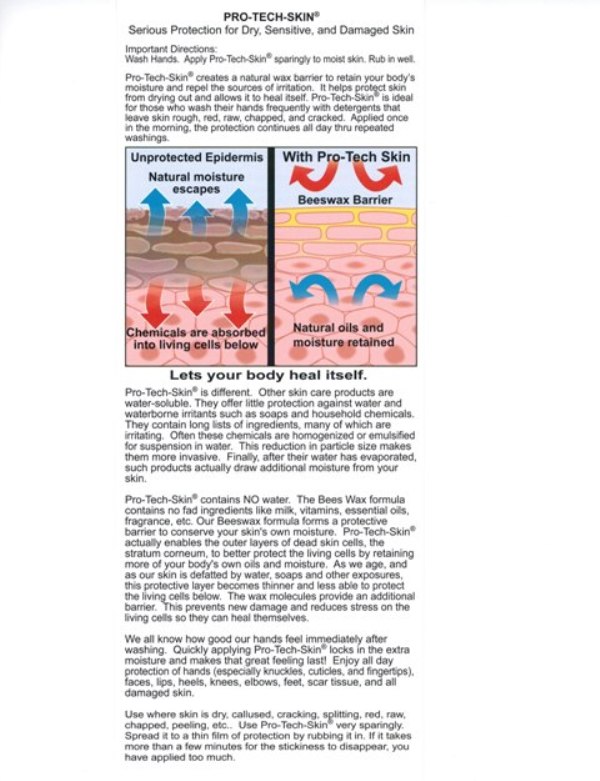
For skin care specifically, use a product actually formulated for that purpose rather than a leather/wood wax — Pro-Tech-Skin is Atsko’s food-grade option for protecting hardworking hands and skin.
Boot Care 101: Drying, Waterproofing, and Choosing the Right Treatment
Most boot advice covers fit and break-in. Almost nobody covers what happens after that — the maintenance that actually determines whether a good pair of boots lasts five seasons or fifteen. Two things ruin leather boots faster than anything else: drying them wrong, and waterproofing them wrong. Both are avoidable.
Rule One: Dry Them Slowly
When leather gets soaked — rain, wet grass, stepping in over the boot top — the instinct is to speed-dry them by a heater or in front of a fire. That’s the single fastest way to ruin a pair of boots. Heat forces moisture out of leather too quickly, and the leather responds by hardening and shrinking. A few cycles of that and the boots are done.
The right approach is slower and less satisfying: low or no heat, with enough airflow to dry a fully soaked boot over about two days. A boot that’s only partially wet can usually dry in a day. If you’re regularly soaking boots — hunting, fishing, working outdoors — the practical fix isn’t faster drying, it’s rotating between two or three pairs so nothing goes back into wet boots the next morning. In cold climates, this isn’t just about the boots — wet boots and cold feet are a real safety issue, not just a comfort one.
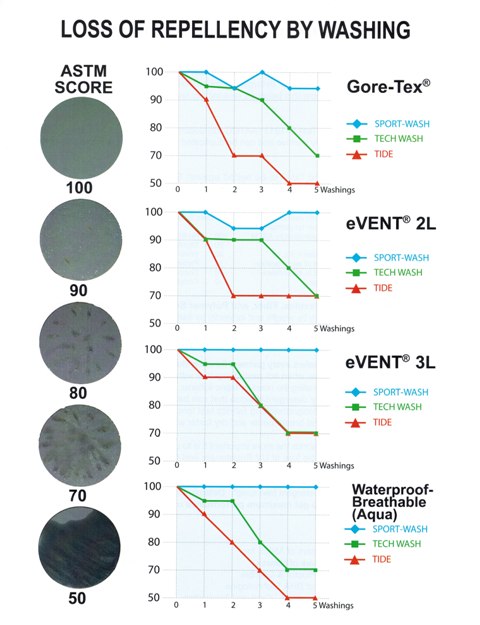
A Gore-Tex® liner doesn’t change this. The liner keeps liquid water away from your foot, but it does nothing to protect the outer leather from soaking up water and abuse — that’s still on you to manage with proper drying and waterproofing.
Rule Two: Understand What Waterproofing Actually Does
Before comparing products, it helps to know there are really only two ways a treatment keeps water out of leather:
Filling the pores. Something water-incompatible occupies the spaces in the leather so water has nowhere to go. This is the oldest method — beeswax, animal fats, mineral oil, and pine tar all work this way, and have for centuries.
Reducing surface tension. The treatment doesn’t fill space so much as change how water behaves on the surface, causing it to bead and roll off rather than soak in. Silicone and fluoropolymer treatments primarily work this way.
Which mechanism you want depends heavily on whether the treatment stays solid or stays liquid after it’s applied — and that distinction matters more than most boot buyers realize.
Comparing Waterproofing Methods
Method
How It Works
Strengths
Trade-offs
Beeswax
Fills pores; stays solid at normal temperatures
Maximum durability and water resistance; stays fixed in the outer leather rather than migrating through it; doesn’t need frequent reapplication
Darkens and adds slight sheen to leather; not ideal where a lighter, drier finish is wanted
Oils, greases, animal fats
Fill pores, but remain liquid/soft at normal temperatures
Easy to apply, traditional
Migrate through the leather over time rather than staying on the surface; require frequent reapplication; can eventually soften and weaken the leather, and animal-based fats can turn rancid and promote fungal growth
Silicone
Fills pores somewhat, plus reduces surface tension
Easy application; works well on suede, split, or sanded leather where wax would darken the appearance too much
Less durable and less water-resistant than wax; aqueous (water-based) silicone formulas underperform solvent-based ones significantly
Excellent for stain and oil resistance on textiles
Requires a very clean surface and factory-level heat (around 300°F) for full effectiveness — hard to replicate at home on boots; generally weaker at pure water repellency than wax or silicone
Why the solid-vs-liquid distinction matters so much: any liquid treatment — oil, grease, animal fat, or a non-solidifying wax blend — doesn’t stay where you put it. It migrates through the leather over time. Eventually it soaks all the way through, shows up on your socks, and leaves the leather soft, spongy, and unable to absorb foot perspiration the way it should — which means cold, clammy feet regardless of how “waterproof” the boot technically still is. A treatment that solidifies (like beeswax) stays fixed in the outer layer instead, leaving the rest of the leather’s thickness open for insulation and moisture absorption.
Prepping a Boot Before Waterproofing
Clean and dry the boot first. Scrub heavy dirt off with a wet brush; wipe light residue with a cloth dampened in water or solvent. Solvent evaporates faster, so you don’t have to wait as long before applying treatment.
Remove factory shine coatings if switching to wax. New boots often carry a temporary glycerin or carnauba wax coating for shelf shine. Since these are water-soluble, wash the boot with a residue-free detergent or mild dish soap and let it dry completely before applying a real waterproofing treatment — otherwise the new treatment is bonding to a coating, not the leather.
Match the treatment to the leather type. Smooth, full-grain leather takes wax well once any factory coating is removed. Split, suede, sanded, or recycled leather can also be waterproofed with wax, but expect it to darken and take on a slicker look — a trade-off worth knowing before you commit, especially if the boot’s appearance matters as much as its performance.
A Word on Emulsified/Water-Based Products
Some products are marketed as easier because they can be applied to already-wet leather — appealing when you didn’t prep ahead and your boots are already soaked. In practice, these emulsified wax or silicone formulas tend to underperform their solvent-based counterparts. Making wax or silicone mix with water requires a surfactant, and that same surfactant residue makes it easier for water to get back in later — which undercuts the entire point of waterproofing the boot in the first place.
How Atsko Products Help
Sno-Seal, Atsko’s original beeswax waterproofing, is built around the solid-wax approach this page describes — it stays fixed in the outer leather rather than migrating through it, which is why it doesn’t need constant reapplication the way oil- or grease-based treatments do. For split, suede, or leather/fabric combination boots where a heavy-duty repellent matters more than appearance, Silicone Water-Guard is a solvent-based option built to the same durability standard rather than a weaker water-based alternative.
How to Check Your Hunting Gear for UV Brighteners (and Fix It)
If deer are more sensitive to UV light than humans, and UV brighteners in fabric and detergent make camo and blaze orange reflect that light, the practical question is simple: how do you know if your own gear is a problem, and what do you actually do about it?
This page walks through both — a two-minute test you can run at home, and the full process for neutralizing brighteners if you find them.
Step 1: Test Your Gear for Brighteners
What you need: A UV (black light) flashlight or bulb, in a UV-A “BLB” (blacklight blue) wavelength — 350–365nm is the range typically used to check for brighteners. A small battery-powered UV flashlight works fine for spot-checking; an 18″ fluorescent BLB fixture mounted in a laundry room is a good option if you want to check gear regularly.
How to test:
Go into a dark room or closet — the darker, the more obvious the result.
Shine the UV light on your camo, blaze orange, or any treated fabric.
Look for a bright blue-white glow. That glow is the brightener fluorescing under UV light — visible to you because the light bulb converts UV into visible blue, but a preview of what a deer may see directly, since deer have some natural sensitivity in that range.
What counts as a fail: Any distinct glow. New fluorescent orange garments almost always contain brighteners as part of the manufacturing dye process, whether or not they’ve ever been washed. Most laundry detergents also contain them, so gear washed in a typical household detergent picks brighteners up even if it started clean.
Good habit: Test your washing machine and dryer too, not just the clothes — residue from previous loads (especially with kids’ or white laundry) can transfer brighteners onto anything washed afterward. Run a load of ordinary, non-hunting laundry through first if you’re worried about cross-contamination.
Step 2: Decide What You Need
If your gear…
Then you need…
Glows under UV but you just want to stop making it worse
Switch to a detergent formulated without optical brighteners
Glows under UV and you want the glow gone now
A UV-blocking treatment (like U-V-Killer) applied directly to the fabric
Doesn’t glow
You’re set — just avoid detergents with brighteners going forward
Regular detergent doesn’t remove brighteners once they’re bonded to fabric — a brightener-free wash just stops adding more. To actually eliminate an existing glow, the fabric needs a UV-blocking treatment applied on top.
Step 3: Prep the Garment
Before applying any UV-blocking treatment, the fabric needs to be genuinely clean — not just “recently washed.”
Wash first in a detergent that rinses completely, with no residue left behind. Leftover soap, oil, grease, dirt, or sizing on the fabric will prevent a UV-blocking treatment from bonding properly.
Avoid fabric softeners and “color-safe” bleach in this wash — both commonly deposit new brighteners onto the fabric, undoing the point of the wash.
Let the garment dry before moving to treatment.
Step 4: Apply the UV-Blocking Treatment
Technique differs slightly depending on the fabric.
Standard camo or blaze orange fabric:
Spray evenly until the surface is fully covered — treat it like you’re applying a new layer of color, not just misting it.
A small brush helps even out coverage, especially on textured fabric.
You can check your work with a UV light while the treatment is still wet — any spot that still glows needs another pass.
Fleece or insulated garments (extra care required):
Apply a thin coat only — work in small sections rather than spraying the whole garment at once.
Use a small stiff brush to raise a light froth on the surface as you go. The froth keeps the treatment sitting on the visible surface instead of soaking deep into the insulation, where it adds no UV-blocking benefit and can stiffen the fabric.
Deep soaking wastes product and doesn’t improve performance — surface coverage is what matters.
Water-repellent fabrics (including most fluorescent orange):
These resist wetting by design, so make sure whatever treatment you’re using is formulated to wet out on repellent fabric — otherwise it beads up instead of bonding.
Step 5: Cure Time
Garments can be worn once fully dry, but the bond needs roughly 72 hours of ventilation to reach full durability and for the garment to be scent-free.
Hold off on rewashing, waterproofing, or applying cover scent during that 72-hour window — those steps can interfere with the bond before it’s set.
Done correctly, the treatment is designed to last the life of the garment under normal use.
Maintenance Notes
One wash in ordinary detergent, fabric softener, or color-safe bleach won’t strip the treatment — but it will layer new brighteners on top of it, which defeats the purpose. Stick to a brightener-free detergent for treated gear going forward.
Check your gear each season with a UV light before the first hunt, especially if it’s been laundered with other household items in between.
Wash a load of non-hunting laundry first whenever you’re about to wash treated gear, to clear brightener residue out of the machine.
Quick FAQ
Does new gear need this, or only old/washed gear? Both. Brighteners are frequently present in fabric straight from manufacturing, before it’s ever been washed — test before you assume new gear is clean.
Can I just avoid the problem by never washing hunting clothes in regular detergent? That prevents new brighteners from being added, but it won’t remove ones already baked into the fabric from manufacturing. Test with a UV light to know which situation you’re in.
Does this apply to blaze orange too, not just camo? Yes — in some ways more so. Blaze orange is a long wavelength that deer are already weak at distinguishing; if it’s also carrying UV brighteners, it becomes far more visible to deer than the “safety” color is often assumed to be.
How long does one bottle of treatment last? Coverage varies by product, but as a rule of thumb, one bottle of a spray-on UV blocker like U-V-Killer treats about one insulated suit, or two thinner sets of camo/blaze orange.
How to Properly Wash an ACU (Army Combat Uniform)
The ACU is a highly engineered piece of gear, and washing it wrong can undo a lot of that engineering — fading the OCP pattern faster than it should, degrading the fabric’s moisture-wicking and durability features, and in one specific way that’s easy to overlook, working against the uniform’s actual purpose.
Why Detergent Choice Matters More Than People Think
ACUs are manufactured under military specification to be free of optical brighteners — the same additives found in many consumer laundry detergents that make white and light-colored fabric look “brighter” under UV light. The Army has restricted the use of optical brighteners in uniform manufacturing since 1984, for a straightforward reason: brighteners absorb UV energy and re-emit it as a highly visible glow, which defeats the point of a low-visibility uniform under night-vision and UV-sensitive optics, not just to the naked eye in daylight.
The uniform ships brightener-free. What happens to it after that is up to the detergent it’s washed in. Many consumer detergents contain optical brighteners — sometimes disclosed on the label as “Fluorescent Whitening Agents” or similar terms, sometimes not clearly disclosed at all, since manufacturers aren’t required to spell out “optical brightener dye” on the front of the package. That inconsistency means checking the ingredient label alone isn’t a reliable way to know whether a given detergent is safe for a uniform that needs to stay brightener-free.
How to Actually Check a Detergent
The reliable method isn’t reading labels — it’s testing directly with a UV (black light) source, the same approach used to test camo and blaze orange for brighteners (see our guide on checking gear for UV glow for the full method and safety notes). In short: in a dark room, a UV-A “BLB” black light will make brightener-treated fabric or liquid detergent glow blue-white. A genuinely brightener-free detergent won’t produce that glow.
If you want to confirm a specific detergent before committing your uniform to it, this is a five-minute test you can run yourself rather than relying on a label or a third-party list, since labeling practices for brighteners vary and aren’t always consistent from brand to brand.
Wash Instructions for the ACU
Prep the garment. Remove all patches from the coat and empty all pockets before washing. Close all hook-and-loop (Velcro) fasteners to prevent snagging.
Turn inside out. This helps protect the Velcro and reduces color fading on the OCP pattern.
Wash in cold water using a brightener-free detergent, on a permanent press cycle, or hand wash.
Make sure the detergent rinses completely. Detergent residue left in the fabric can interfere with the uniform’s performance features over time — the same issue that affects moisture-wicking and water-repellent treatments on other technical fabrics.
Do not wring or twist the fabric. Hang dry, or machine dry on low-to-medium heat (roughly 140–160°F; for the cap specifically, stay under 130°F).
No bleach — chlorine or non-chlorine.
No fabric softener.
No dry cleaning, starching, or commercial hot pressing.
No heat or ironing directly on hook-and-loop fastener areas — this can damage the material.
How Atsko Products Help
Sport-Wash laundry detergent is formulated without optical brighteners of any kind and is designed to rinse completely, which addresses both concerns above — no brightener contamination, and no residue left behind to affect the uniform’s technical performance. If a uniform has already picked up brighteners from a previous wash in a different detergent, rewashing in a brightener-free detergent going forward stops the problem from continuing, though it won’t remove what’s already bonded to the fabric — for that, the same UV-blocking treatment approach used on hunting camo (see our UV brightener guide) applies here too.
Silicone Water-Guard #1336L (375gram): More value in every can
By using CO2 non-flammable gas as a propellant we maximize value for you and minimize carbon in the atmosphere. This detailed explanation will enable you to make a more informed choice of products. You will learn that in addition to enjoying superior performance, Water-Guard is also saving you a lot of money and providing a net environmental benefit.
Most aerosol water repellents include between 1/4 and 1/3 of their “net contents” stated weight in propane/isobutene, a blend of highly flammable gas refined from petroleum production. The blends have a flash point of about -100 degrees F. and are similar to the propane for your barbeque. These blends are 83% Carbon by weight.
An aerosol container that displays a net weight of 300 grams and contains 1/3 of its weight in flammable gas propellant has 100 grams of this blend. So you only get 200 grams of usable product. Since the propellant blend is 83% carbon by weight, you have purchased and discharged into the atmosphere 83 grams of carbon just for the purpose of emptying the can. This is 41.5 grams of carbon to unload each 100 grams of product.
Other marketers do not disclose how much propellant they use, but because it is heavy and cheaper than the useable product, they have incentive to use more. They want to be sure there is still plenty of gas left when the product is gone because no one will complain if the can still has pressure when the product is all gone.
Some of our competitors use only ¼ of the net contents for propellant. In this case a 300 gram can has 75 grams of flammable gas blend. 75 grams x 83% carbon means that these cans are emptied by the discharge of 62 grams of carbon. They also give you 25 more grams of usable product. This is a significant improvement, but still using 27.5 grams of carbon to unload each 100 grams of product.
Now let’s examine Atsko’s Silicone Water-Guard #1336L. The can is 1.5 inches taller and shows a net weight of 375 grams. The 375 grams includes 364 grams of usable product, and 11 grams of propellant. The propellant, CO2, is a non-flammable gas drawn from a waste stream that was headed for atmospheric discharge. The CO2 is purified for our use but would have gone into the air anyway so we have simply sequestered it temporarily with no net new carbon production. Our use of new carbon to empty the entire 300 grams of usable product is zero. That is 0.0 grams of carbon to unload each 100 grams of product.
As a point of interest, if our CO2 was not a waste product or withdrawn from the air, the calculation would be as follows. 11 grams of CO2 x 27% carbon by weight is 2.97 grams of carbon to empty 364 grams of usable product. That is only 0.816 grams of carbon to unload 100 grams of product. This is a 97% reduction of propellant carbon compared to the product with 25% propellant and a 97.3% reduction of propellant carbon from the product using 1/3 propellant. While not all aerosols can be emptied with CO2, it certainly should be done whenever possible. You should always choose CO2 propellants when you purchase water repellents.
Safety beyond the reduced flammability of CO2.
Carbon Dioxide is beneficial even while our products are sitting on the shelf. It creates positive pressure in the container so there is no chance of degradation by water vapor from the air. There is also no risk of substance abuse. Propane/Isobutene is responsible for injury and death of individuals seeking to get high. There is no need to fear that CO2 will be abused like propane/isobutene propellant.
If, during transport or storage, our product is exposed to excessive heat it has a much greater margin of safety than a 2 phase flammable gas propellant like Propane/Isobutene. Since it is already all gas and dissolved gas, it will not have a rapid expansion at a phase change temperature below the boiling point of the solvent. Our container carries the same heat warnings, but is much safer. We also use a solvent with a much higher flash point than the heptane in many competing products, but that is another topic.
End of life and product recycling.
CO2 propellant provides additional benefits at the time of disposal. With CO2, there is never more that 20 seconds of pressure left when the product is all gone, and it is safe non-flammable carbon dioxide so you can quickly exhaust it leaving an empty can that is safe to dispose of with household mixed trash or metals for recycling. Regular aerosols using a mix of propane and isobutene can take several minutes to exhaust exposing you to risk of fire or explosion and possibly an opportunity for substance abuse. Those cans will chill significantly so that pressure seems to be gone, but as they rewarm the pressure increases and must be exhausted again before they are safe to dispose of. Even then, they will still contain some flammable gas.
If your community pulls anything at all from the mixed waste stream it is probably steel. Steel is the most recycled material on the planet. in the event that it manages to escape recycling, it is totally recyclable by nature. The iron atoms will combine with oxygen from the air in a process called oxidation, governed by the equation 2Fe+3O2=2FeO3. The end product, ferrous oxide, is the naturally occurring feed stock for making new steel.
How much usable product do you receive in each can? This if found by subtracting the weight of the propellant, from the net contents. Using cans marked 300 gram net weight there can be quite a range of usable product, and by law, the marketer does not have to tell you how much you are getting.
A product with 1/3 propellant gives you 200 grams of usable product.
A product with 1/4 propellant gives you 225 grams of usable product.
Silicone Water-Guard #1336L from Atsko gives you 364 grams of usable product. 375 gr – 11 gr of CO2.
Compared to a 300g product with 100 gr of propane/isobutene, #1336L is 364/200 or 82% more.
Compared to a 300g product with 72 gr of propane/isobutene, #1336L is 364/225 or 61.8% more.
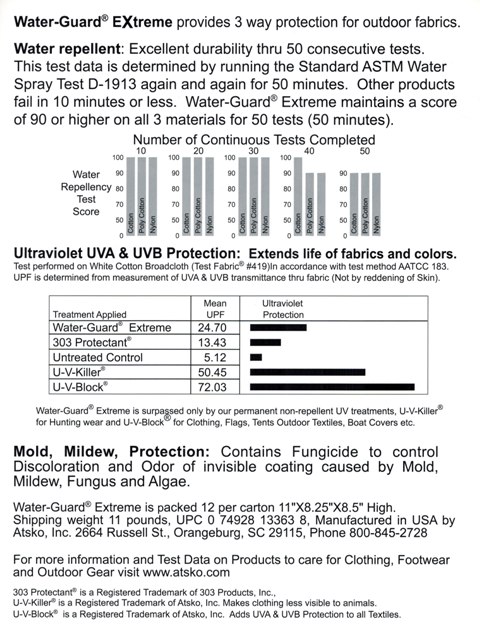
In addition to comparing how much you get , we also have to compare the efficacy and coverage of the product. The coverage of such products per application is very similar but need to consider efficiency as measured by effectiveness and durability. These can vary widely on different materials so we test on cotton, nylon, and polyester.
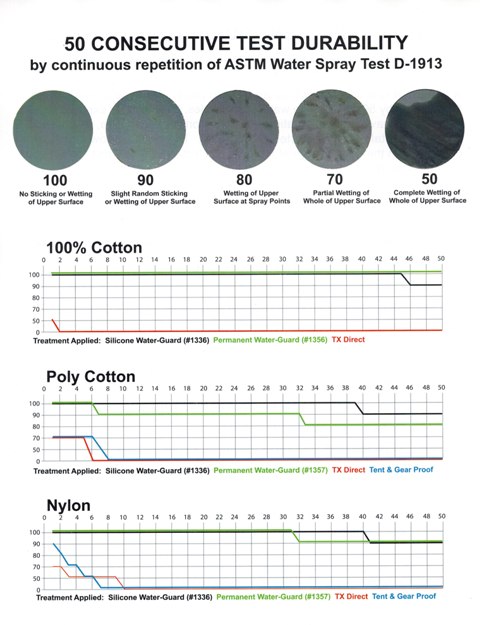
Silicone Water-Guard will score at least 90 on the ASTM standard Water Spray Test D-1913 (AATCC 22). We run this test 50 times without interruption to have a better model of real conditions. We achieve the same results in a single application that other brands achieve with 2 applications. This cuts time, costs, and resources in half compared to a product that suggests 2 applications. Our tests also indicate that Silicone Water-guard will often last twice as long.
Putting these factors together begins to show the real value of Silicone Water-Guard.
Relative to product with 1/4 propellant 1.618 X
Relative to product that requires 2 applications 2.00 X
Relative to a product that lasts ½ as long 2.00 X
Relative to product where all 3 apply 6.47 X
You could pay 6 times as much for Silicone Water-Guard and have equal value before even considering the effort, resources, and impact on the environment.
When a few ounces of an inexpensive product can renew, restore, and delay the recycling of a larger more expensive item like a coat or a tent, you are looking at one of the few value equations that is actually positive for you and the environment. This is the value you get from Silicone Water-Guard. This is the kind of value you will find with all Atsko/Sno-Seal Products. Learn about other ways to increase value and performance at www.atsko.com.
CO2 is too good to be true! So what is the catch?
Incorrect use can waste some of the savings. There are 2 things the user must do to get maximum performance from CO2.
While spraying, you must stop and give the can 2 sharp shakes every 10 to 20 seconds. This allows the dissolved CO2 in the product to escape into the head-space above the product. This keeps the discharge pressure higher and reduces how much of the CO2 leaves the can in the spray.
You must also keep the can upright while spraying. If the end of the dip tube is out of the liquid product it can exhaust all the propellant in a few seconds. If you must tilt the can, listen carefully for gas escaping with the liquid. When you hear gas discharge, stop spraying and rotate the spray tip to point directly over the paint dot on the ring of the valve. This is to insure that the dip tube is reachlng the lowest comer of the can.
When finished, do not invert the can to clear the tip as with paint cans. Silicone does not dry-up in the tip like paint does. Triggering an inverted can will exhaust the propellant.
Silicone Water-Guard, #1336 (300gram): More value in every can
By using CO2 non-flammable gas as a propellant we maximize value for you and minimize carbon in the atmosphere. This detailed explanation will enable you to make a more informed choice of products. You will learn that in addition to enjoying superior performance, Water-Guard is also saving you a lot of money and providing a net environmental benefit.
Most aerosol water repellents include between ¼ and 1/3 of their “net contents” stated weight in propane/isobutene, a blend of highly flammable gas refined from petroleum production. The blends have a flash point of about -100 degrees F. and are similar to the propane for your barbeque. These blends are 83% Carbon by weight.
An aerosol container that displays a net weight of 300 grams and contains 1/3 of its weight in flammable gas propellant has 100 grams of this blend. So you only get 200 grams of useable product. Since the propellant blend is 83% carbon by weight, you have purchased and discharged into the atmosphere 83 grams of carbon just for the purpose of emptying the can. This is 41.5 grams of carbon to unload each 100 grams of product.
Other marketers do not disclose how much propellant they use, but because it is heavy and cheaper than the useable product, they have incentive to use more. They want to be sure there is still plenty of gas left when the product is gone because no one will complain if the can still has pressure when the product is all gone. Some of our competitors use only ¼ of the net contents for propellant. In this case a 300gram can has 75 grams of flammable gas blend. 75 grams x 83% carbon means that these cans are emptied by the discharge of 62 grams of carbon. They also give you 25 more grams of useable product. This is a significant improvement, but still using 27.5 grams of carbon to unload each 100 grams of product.
Now let’s examine Atsko’s Silicone Water-Guard #1336. The can is the same size and shows a net weight of 300 grams. The 300 grams is all useable product, and does not include any propellant. The propellant consists of 9 grams of CO2 non-flammable gas drawn from a waste stream that was headed for atmospheric discharge. The CO2 is purified for our use but would have gone into the air anyway so we have simply sequestered it temporarily with no net new carbon production. Our use of new carbon to empty the entire 300 grams of useable product is zero. That is 0.0 grams of carbon to unload each 100 grams of product.
As a point of interest, if our CO2 was not a waste product or withdrawn from the air, the calculation would be as follows. 9 grams of CO2 x 27% carbon by weight is 2.43 grams of carbon to empty 300 grams of useable product. That is only 0.81grams of carbon to unload 100 grams of product. This is a 96.3% reduction of propellant carbon from the product with 25% propellant and a 98.5% reduction of propellant carbon from the product using 1/3 propellant. While not all aerosols can be emptied with CO2, it certainly should be done where ever possible and you can favor CO2 propellants when you purchase water repellents.
So how much useable product do you receive in each can? This if found by simply subtracting the weight of the propellant from the net contents. Using cans marked 300 gram net weight there can be quite a range of usable product, and by law, the marketer does not have to tell you how much you are getting.
The product with 1/3 propellant gives you 200 grams of useable product.
The product with 1/4 propellant gives you 225 grams of useable product.
Silicone Water-Guard from Atsko gives you 300 grams of useable product, before we add the propellant.
In addition to comparing how much usable product you get, we also have to compare the efficacy and coverage of the product. The coverage of such products per application is very similar, but there can be great differences in effectiveness and durability. These can vary widely on different materials so we test on cotton, nylon, and polyester.
Silicone Water-Guard will score at least 90 on the ASTM standard Water Spray Test D-1913 (AATCC 22). We run this test 50 times without interruption to have a better model of real conditions. We achieve the same results in a single application that other brands achieve with 2 applications. This cuts time, costs, and resources in half compared to a product that requires 2 applications. We also anticipate that Silicone Water-guard will last twice as long.
Putting these factors together begins to show the real value of Silicone Water-Guard.
Relative to product with 1/3 propellant 150%
Relative to product that requires 2 applications 200%
Relative to a product that lasts ½ as long 200%
Relative to product where all 3 apply 600%
You could pay 6 times as much for Silicone Water-Guard and have equal value before even considering the effort, resources, and impact on the environment.
When a few ounces of an inexpensive product can renew, restore, and delay the recycling of a larger more expensive item like a coat or a tent, you are looking at one of the few value equations that is actually positive for you and the environment. This is the value you get from Silicone Water-Guard. This is the kind of value you will find with all Atsko/Sno-Seal Products.
We are transitioning to valves with a dot on the top to indicate orientation of the dip tube.
Simply make sure the spray tip is facing the dot, and the dip tube will be in the deepest liquid.
If you hear any air, you must keep the can more upright.
UV Testing
UV Transmittance Results
International UV Testing Laboratories 324 South Cedarbrook Dr. Auburn, AL 36830 334-444-1036 334-844-1340 Fax 334-844-7340 [email protected][email protected]
Summary Report
October 14, 2004
Daniel Gutting ATSKO, Inc 2664 Russell S.E. Orangeburg, SC 29115
Dear Sir,
Eight fabric samples received October 12, 2004 were tested for UV Transmittance properties in accordance with Test method AATCC 183. The data are summarized in the following table.
Fabric
Sample#
%T UVA
%T UVB
Mean UPF
Label UPF
419
C
26.96
17.83
5.12
1
Untreated Cotton
419
W
12.86
2.85
23.92
20
Waterguard
419
T
15.87
9.88
9.67
5
Tectron
419
P
14.09
6.93
13.43
10
303 Protectant Aerospace
419
B
1.79
1.45
72.03
50+
UV Block
419
K
3.79
1.92
50.45
40
UV Killer
419
ES
21.51
8.35
9.58
5
Escourt Canada
Respectfully submitted,
Dr. B. Lewis Slaten
UV Transmittance
UV Transmittance Measurements
Treatment with U-V-Block Sun Protector fabric treatment by Atsko, Inc.
Tested by International UV Testing Laboratories, Aubrun, AL in accordance with test method AATCC183.
Fabric supplied by Test Fabrics, Inc. all white and lightweight with low initial UPF* using Labsphere Ultraviolet Transmittance Analyzer.
%UVA Transmitted
%UVB Transmitted
%UVA Blocked
%UVB Blocked
UPF*
Untreated
25.02
16.38
47.98
83.62
5.41
Treated
0.96
0.89
99.04
99.11
117
Treated Washed 6
1.58
1.26
98.48
98.74
80
%UVA Transmitted
%UVB Transmitted
%UVA Blocked
%UVB Blocked
UPF*
Untreated
25.02
16.38
47.98
83.62
5.41
Treated
0.96
0.89
99.04
99.11
117
Treated Washed 6
1.58
1.26
98.48
98.74
80
%UVA Transmitted
%UVB Transmitted
%UVA Blocked
%UVB Blocked
UPF*
Untreated
18.49
9.72
81.51
90.28
8.79
Treated
2.81
2.78
97.19
97.22
37
Treated Washed 6
2.38
2.03
97.62
97.97
49
Note: Shrinking and fuzzing decreased UV Transmittance with more washes.
%UVA Transmitted
%UVB Transmitted
%UVA Blocked
%UVB Blocked
UPF*
Untreated
29.59
20.51
70.41
79.49
4.4
Treated
0.98
0.88
99.02
99.12
116
Treated Washed 6
2.01
1.7
97.99
98.3
60
Note: Treatment applied twice because thin material absorbed little product.
*UPF is nominally a measure of how much longer you could stay in the sun just like SPF. In actual use UPF of 15 ~ SPF of 45 because most users get only about 1/3 the advertised protection. SPF is a measure of skin reddening caused by UVB measured under ideal conditions. UPF includes UVB (290-320 nm.) and also UVA (320-400 nm.), which causes damage and cancer with little or no reddening. UPF is measured by precise instruments and represents the minimum level of protection expected.
The Sense of Smell
How Game Animals See & Smell by Kurt von Besser
FORWARD It is a fact that deer do not see the world as we see it. But some people would rather you believe that the color or pattern of camouflage they make has the same appearance to a deer that it has to a human. How many pages of ads have asked “How many hunter’s do you see?” What “you see” makes absolutely no difference at all. It is what deer and other game see that is important, and their eyes are designed to see UV Brighteners as a brilliant bright glow. Why do camo manufacturers make their camouflage with UV brightening dyes in the fabric? Well they have sound business reasons for using fabric already treated with Ultraviolet brightening dye, even though deer see bright camo easier than you see blaze orange.
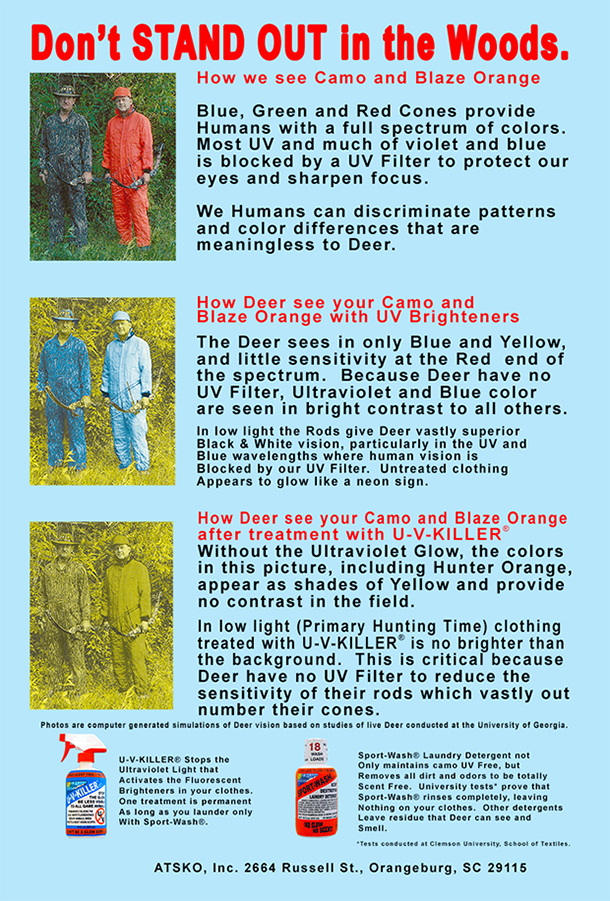
The pictures and the following points explain how important it is to avoid UV brighteners. The following 18 pages provide the scientific proof and technical detail you need to understand How Game Animals See.
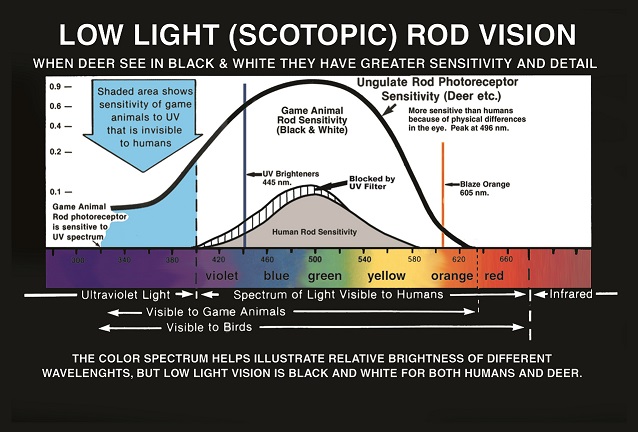
In low light and darkness, animals see in black and white and are tens of thousands of times more sensitive to ultraviolet and blue wavelengths than humans. After all, animals can run through the woods at night without bumping into trees.
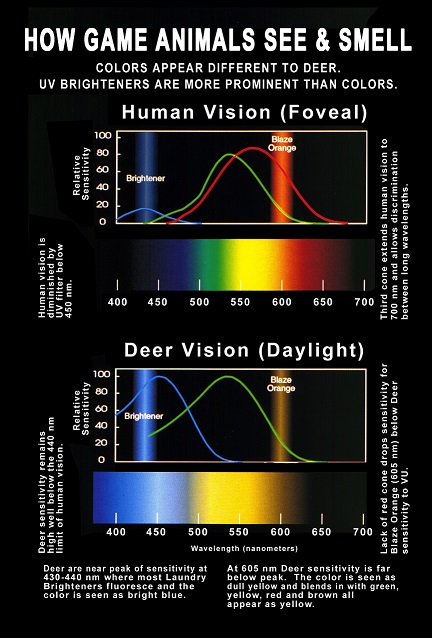
In daylight, deer see Ultraviolet and blue light as blue, but thousands of times brighter than we see it because the sensitivity of their blue cones is not reduced by the presence of a UV filter.
Instead of the way we see colors, deer see green, yellow, orange, red, and brown all as shades of yellow because deer have no red cones. (see back cover)
Birds have all the spectral vision capabilities of humans plus the blue and ultraviolet vision of deer. Plus many birds have additional cones with peak sensitivity in the UV wavelengths.
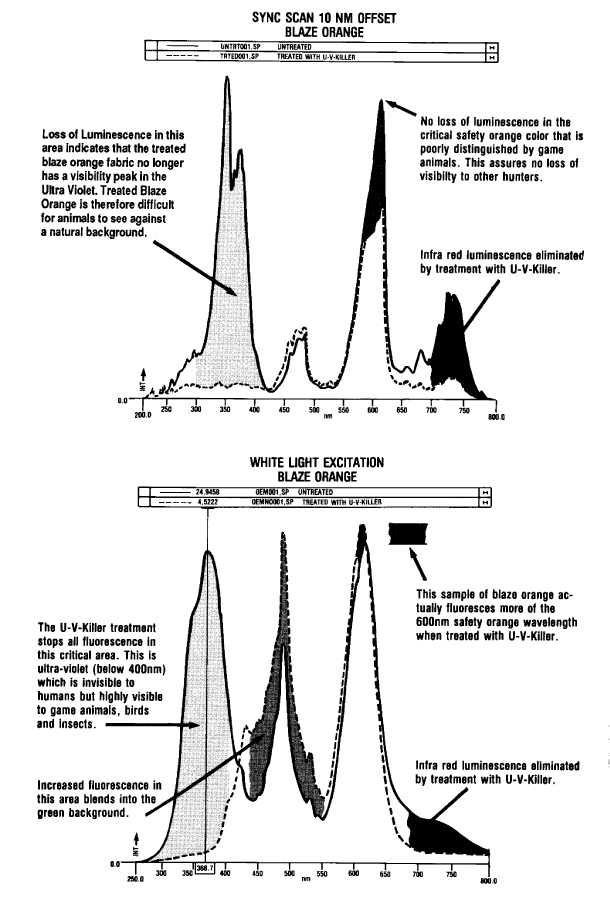
Ultraviolet brighteners gather energy from light over a wide range of wavelengths and reradiate that energy in a very powerful narrow band that corresponds almost exactly with the peak of sensitivity of the deer’s blue cones and their more numerous rods. This results in an unnaturally bright blue or white glow, brighter than the blue sky, or white snow.
Most camouflage, blaze orange, light colored street clothes, and laundry detergents all contain UV brighteners.
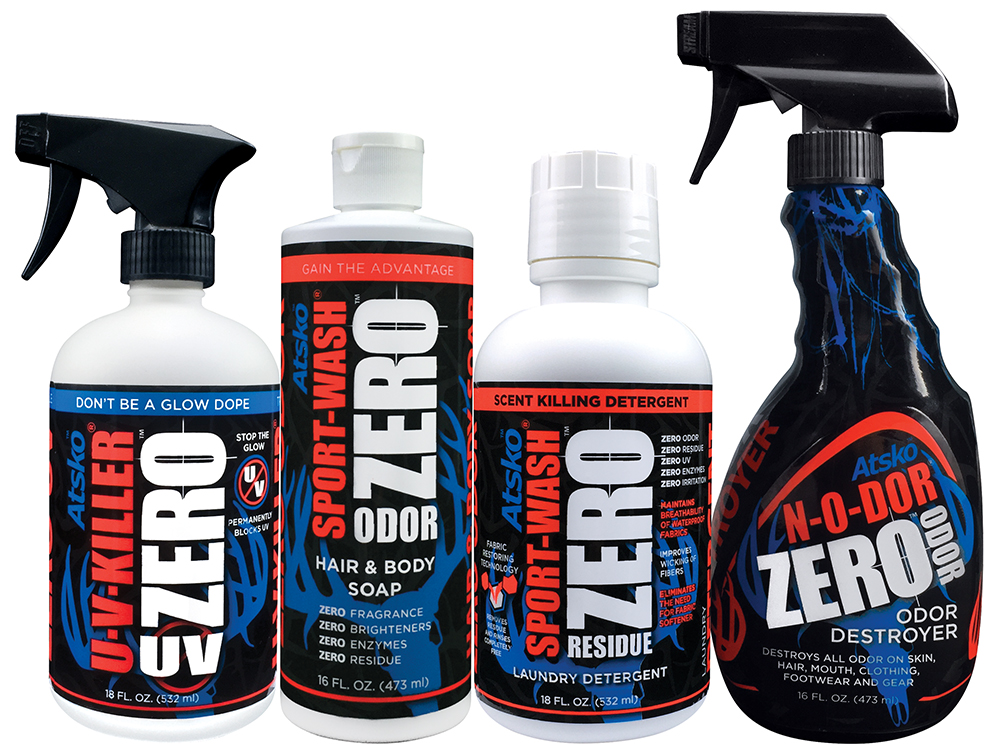
To avoid brighteners, choose a camouflage that bears a Hang-Tag saying it was manufactured free of brighteners and wash only with Sport-Wash laundry detergent to keep it UV brightener free.
Camouflage and blaze orange can be “Treated Permanently” with U-V-KILLER, which absorbs the UV energy before it reaches the brighteners.
This is only the tip of the iceberg. After you have read the entire book you will understand how to be more successful in the field.
WHAT ARE ULTRAVIOLET BRIGHTENERS They are called Blueing, Brightening dye, Optical Brightener, FWA (Fluorescent Whitening Agents), Color Safe Bleach, and Laundry Enhancers. They are actually a UV Dye used to collect energy from a wide range of Ultraviolet and short blue wavelengths and reradiate that energy in a powerful peak at about 440 nanometers. (See graph on inside front cover.) Notice that 440 nm. light is almost invisible to humans while near maximum sensitivity of the deer.
There are about 200 compounds used and most are permanent. Fabrics like the poly/cotton blends, commonly used in camo, are almost always pre-brightened when manufactured. This is because the printing and colors will be brighter and more attractive if applied to bright fabric. Because it is easier and cheaper to brighten clothes than to clean them, all detergents (except Sport-Wash) contain Ultraviolet brighteners. Many water repellents especially factory-applied polymer types are applied with extenders that function as brighteners.
Deer are much more sensitive than humans to the shorter wavelengths of light. They have a blue cone with peak sensitivity at 455-nm, just 15 nm from the 440-nm peak of spectral power caused by the UV brighteners. This is earth shaking news to a 2 legged predator that can’t imagine the brightness of light he barely sees. This 440-nm light is seen as bright blue by the dichromatic eye of the deer. It occurs on garments of any color from camo to blaze orange if UV brighteners are present. In very low light the deer, like a human, switches to rod (black, white, and gray) vision and the 440 nm light caused by the UV brighteners is seen by the deer as a bright white.
Game animals quickly learn to respond to the glow of brighteners just as they would to the smell or sound of the hunter. If it glows, it’s a human; and the bigger the buck, the less chance you have of seeing him if you glow.
I have often observed that northern guides were very successful in stalking game animals. The one thing they all had in common was the wearing of woolen garments in plaids, browns and greens. They blended into the background because natural wool does not contain UV brighteners and therefore does not respond to UV light. Wash your Wool garments in Sport-Wash or have them dry cleaned. (Woolite® now contains UV brighteners and must be avoided like all commercial detergents, softeners, and color safe bleach.)
You can observe, for yourself, the effect of UV brighteners on your own camo, if you have access to a fluorescent UV light. Simply hold your camo under the light and see if it glows. If it does, spray it with U-V-KILLER and watch the UV brightness disappear. This is not magic, it’s technically simple, you are covering the brightening dye with a blocking dye, and if you have a UV light, you can watch it happen. You can buy a 350 BLB Fluorescent Light from Atsko or most home center stores. You can practice viewing different samples of white paper and cloth. Placing a drop of U-V-KILLER on a swatch that glows will immediately darken it. Now observe this spot under ordinary light and you begin to understand how little we see of the brightener effect. Deer by contrast, are perfectly designed to see the effect of UV brighteners without the aid of an artificial light source.
DEER VISION IN BRIGHT LIGHT (PHOTOPIC COLOR VISION) North American white-tailed deer have been tested! The research was conducted from August 24 to 29, 1992, at the University of Georgia D. B. Warnell School of Forest Resources, in Athens, Georgia. Present were Dr. R. Larry Marchinton and Dr. Karl V. Miller of the University of Georgia with a staff of graduate students headed by Brian Murphy as research coordinator. The electroretinograph was administered by Dr. Jerry Jacobs and his assistant Jess Deegan of the University of California, assisting was Dr. Jay Neitz of the Medical College of Wisconsin. The Electroretinograph equipment, provided by Dr. Jacob’s lab, is the culmination of 12 years of refinements. Computer controlled light presentation and signal processing now enable scientists to accurately define the range of vision in animals.
Following is the abstract of what was presented to the Southeast Deer Study Group in February 1993.
PHOTOPIGMENTS OF WHITE-TAILED DEER Brian P. Murphy, Dr. Karl Miller, and Dr. Larry Marchinton, University of Georgia; Jess Deegan II, University of California; Dr. Jay Neitz, Medical College of Wisconsin; Dr. Gerald H. Jacobs, University of California.
All aspects of vision depend ultimately on the absorption of light by photopigments. The retinas of white-tailed deer (Odocoileus virginianus), like those of other ungulates, contain a mixture of rod and cone photoreceptors. We have used a noninvasive electrophysiological technique to measure the spectral absorption properties of the photopigments contained in these receptors. In this procedure, electroretinogram (ERG) flicker photometry, light-evoked potentials were sensed by a contact-lens electrode positioned on the eye of an anesthetized deer. The eye was stimulated with a rapidly-pulsed, monochromatic light; variations in pulse rate, stimulus wavelength and adaptation state of the eye allowed preferential access to signals from different classes of photoreceptor. Recordings were obtained from nine white-tailed deer. Three classes of photopigment were detected. One of these is the photopigment contained in rods; it has a peak sensitivity of about 496 nm., a value greatly similar to that found for rod photopigments of other mammals. These measurements also reveal the presence of two classes of cone. One contains a photopigment maximally sensitive in the middle wavelengths (peak value of 537 nm); The other cone class has a sensitivity peak in the short wavelengths, at about 455 nm. In light of what is known about the relationships between photopigments and vision in other species, these results suggest two likely characteristics of cone-based (i.e., daylight) vision in deer: (1) deer should be relatively less sensitive to longwavelength lights than many other mammals (e.g., humans), and (2) white-tailed deer would be expected to have dichromatic color vision.
In addition to this study which used the ERG to detail the spectral sensitivity of the deer, there have been recent spectro radiometric studies of ambient light and blaze orange with and without U-V-KILLER treatment. Following is an interpretation of the results of both of these studies by Dr. Jay Neitz, Medical College of Wisconsin.
PHOTORECEPTORS AND DAYLIGHT VISION OF THE DEER Vision is initiated when light is absorbed by photoreceptors of the retina, the light absorbing tissue that covers the back of the eye. The limits of vision depend on several factors, which include: In addition to this study which used the ERG to detail the spectral sensitivity of the deer, there have been recent spectro radiometric studies of ambient light and blaze orange with and without U-V-KILLER treatment. Following is an interpretation of the results of both of these studies by Dr. Jay Neitz, Medical College of Wisconsin.
PHOTORECEPTORS AND DAYLIGHT VISION OF THE DEER Vision is initiated when light is absorbed by photoreceptors of the retina, the light absorbing tissue that covers the back of the eye. The limits of vision depend on several factors, which include:
The optical properties of the eye, i.e., the size of the eye, the size of the pupil, the refractive power of the eye’s optical elements.
The properties of light absorbing filters through which light must pass before reaching the photoreceptors. In humans these include filters in the lens and in the central region of the retina that absorb strongly in the short wavelengths, blue, violet and ultraviolet.
The light absorbing properties of the photoreceptors themselves, the number of different classes of photoreceptors and their distribution in the retina.
The reflectivity of tissues that lie behind the photoreceptors. For example, many animals that are active in dim light have a reflective layer at the back of the eye that enhances sensitivity.
Some of these properties have been recently investigated for the eyes of whitetailed deer. A non-invasive procedure (harmless to the deer) was used on anesthetized deer to measure the sensitivity of the deer’s eyes to wavelengths of light across the spectrum.
Deer like all other mammals have two types of photoreceptor, rods and cones. The rods are responsible for vision in dim light and the cones are responsible for vision in daylight. The light absorbing properties of the rods in deer were found to be similar to those found in other mammals, including humans. Two classes of cone photoreceptor were detected in the deer. One most sensitive to shortwavelength light (blue-violet); the other most sensitive to middle-wavelength light (green-yellow).
The lens of the human eye contains a yellow pigment that absorbs ultraviolet light almost completely; it absorbs strongly in the violet and into the blue spectral regions. In contrast, the transmission of short wavelength light is very high for the lens of many mammals that are active at dusk, dawn and at night. The recent experiments indicate that this is true for the deer. The relative sensitivity of deer eyes to short wavelengths (blue and violet) is high compared to that of humans, as expected because deer lack yellow pigment in their lens.
In humans, the very central region of the retina (the fovea) is specialized for high acuity vision. Among mammals, this specialization is found only in humans and other primates. Also unique to primates is an additional yellow pigment, the macular pigment that covers and thus screens the central region of the retina. Humans use the central region of the retina whenever we look directly at an object; it is this region that we depend on most heavily for vision. Thus, when comparing the daylight vision of deer to that of humans it makes sense to consider human foveal vision.
The recent experiments suggest important differences between the daylight vision of deer compared to that of humans:
Humans have three classes of cone photoreceptors which are the basis of trichromatic (literally three-color) vision. In humans this three-receptor system confers excellent color vision. Humans can distinguish small differences in wavelength across the spectrum. In contrast, only two classes of cone photoreceptors were detected in deer. Deer can have no better than dichromatic (two-color) vision. Thus, the color vision capacities of deer are, at best, limited compared to humans. The two classes of cones in deer allow for the ability to see color differences between short and long-wave lights, e.g., blue and yellow, however, they lack the photoreceptor basis for seeing differences in the color of objects that reflect middle-to-long wavelength light, e.g., yellow-green, green, yellow, orange, and red.
Since humans have yellow pigments that screen out short-wavelength light, the relative sensitivity of deer to short wavelength light is much higher that the sensitivity of humans. This same difference would apply to low light conditions under which only rod photoreceptors operate.
The three classes of cone photoreceptors in humans are each sensitive to a different region of the visible spectrum. Together these confer sensitivity to a wide band of wavelengths. The three classes of human cone photoreceptors can be termed red, green and blue cones. One of the two cone photoreceptors detected in deer is similar to the human blue cones; the other is similar to human green cones. Thus, compared to humans, deer effectively lack red cone photoreceptors. This suggests that deer should be relatively less sensitive to long-wavelength light (orange and especially red) than humans. Human sensitivity is highest in the green-yellow region of the spectrum and, for equal intensities, these wavelengths are perceived as brightest. Humans are relatively insensitive throughout the short-wavelengths (blue and violet). Sensitivity also drops off rapidly in the very long wavelengths, e.g., we are relatively insensitive to deep reds. Humans can distinguish four basic colors; blue, green, yellow and red. We also distinguish dozens of intermediate colors, e.g., violet, blue-green, yellow-green, orange etc. Humans can make subtle color discriminations across the visible spectrum.
The region of highest sensitivity for the deer is at a shorter wavelength than that of humans. The relative sensitivity of deer to short-wavelength light is dramatically higher than human sensitivity to those wavelengths. For equal intensities, deer are expected to see short- and middle-wavelengths as brightest. Because of the absence of red cones, the drop off in sensitivity at the long-wavelength end of the spectrum occurs at shorter wavelengths for deer. They are less sensitive in the spectral region that appears orange to humans and are virtually insensitive to deep reds. With only two classes of cone photoreceptors, deer can distinguish no more than two basic colors, one for the short wavelength end of the spectrum and another for the middle-to-long wavelength end of the spectrum. Animals with dichromatic color vision do not see an intermediate color in the spectral region between the two colors. That is, they do not see a color that appears bluishyellow. Instead they see the intermediate spectral region as colorless (gray).
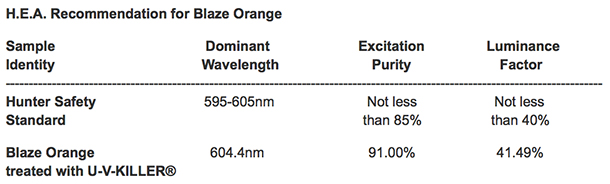
The issue of how deer see blaze orange is of considerable interest to hunters and those interested in hunter safety. Recent results lend insight into how deer may perceive blaze orange. Blaze orange is highly visible to humans because, for us, it is both intensely bright and intensely colored. The worst news for hunters would be if blaze orange was seen by deer as intensely colored and intensely bright as it is for humans. At the other extreme, perhaps the best news would be if blaze orange was not seen at all by the deer. Given what is known about deer vision neither of those extremes is likely to be true. The recommended specification of blaze orange requires a dominant wavelength between 595 and 605 nanometers. Deer are expected to see this band of wavelength. However, the deer’s relative sensitivity to 605 nanometers is less than half the relative human sensitivity. Although 605 nanometers is expected to be seen by deer as colored, that color would not be different from long-wavelength lights (the ones we see as red, yellow and yellowish-green).
Wavelengths that deer are likely to be able to distinguish from 605 nanometers are the ones we see as violet, blue, blue-green, and pure green. A garment that emitted only an intense band of light at 605 nanometers would be less colored and less bright to deer than it is to humans. However, it is important to understand that such a garment would be far different from an ideal camouflage. It would still stand out as colored and/or bright against dark backgrounds, against bluish-greens, pure greens, browns, tans, and grays.
Finally, the issue of how deer see short-wavelength light has received considerable attention. Recent results also lend insight into this issue. “The difference between daylight human foveal vision and daylight deer vision is expected to be even more dramatic for short-wavelength light than it is for longwavelength light. Humans are very insensitive to wavelengths below 450 nanometers. For example, relative to other wavelengths, deer are about eight times more sensitive than humans to lights of wavelengths near 430-440 nm (such as those emitted by UV brighteners). Garments can reflect (or emit) considerable light in this spectral band. Because of the deer’s high relative sensitivity to short wavelength light, the presence of blue, violet and UV components would make a garment stand out as both bright and colored against natural backgrounds. Those same components could be barely noticeable to humans.” Dr. Jay Neitz
This information about color vision is also summarized by the graphs on the outside front cover. More examples of Dichromatic vision are found on Dr. Neitz’s web site www.edu/cellbio/colorvision/test.htm.
Significance of these findings to the hunter. Much has been written lately about how UV brighteners effect a deer’s perception of camouflage, blaze orange, and other garments. In order to apply what has been learned about the visual systems of the deer we must define how UV brighteners effect the garment being seen. This is further complicated by the spectral composition of the ambient light in which the garment is viewed.
We can simplify the effects of variations in ambient light by simply assuming that, for the sake of a discussion about the effect of UV brighteners, we are talking about a time and place where Ultraviolet light is a high percentage of available light. In direct sun at high noon the longer wavelengths overwhelm our visual system completely and we see no effect from UV brighteners. As we move to dusk, dawn, deep overcast, or shade the absolute amount of UV and short blue light decreases, but the percentage share of total light contributed by UV increases greatly. We therefore confine discussion of UV brighteners to times and places where their effect is significant.
The garment’s color and other optical characteristics are also significant. Ignoring most variations again allows us to focus on the effects of UV brighteners. It should be noted, humans are very insensitive to UV and short blue wavelengths so the effects can only be observed (if at all) on white or light colored garments, unless a UV light source is used to enhance the effect. The deer, however, see these effects on almost any color. The background is also significant. Cones and Rods are classed by their wavelength of maximum sensitivity. Deer have cones sensitive to short (blue & UV) wavelengths and middle (green & yellow) wavelengths and no cones for long (red) wavelengths. Human cones are mostly long (red) wavelengths. We also have a good percentage of medium (green & yellow) wavelength cones, but fewer than 10% of our cones are the short (blue & UV) variety. The sensitivity of our few blue cones is further suppressed by our UV filter. At low light our disadvantage in the short wavelengths is even greater because we have so few rods. Deer are simply able to see short wavelengths better than humans in all conditions.
The research also verified that “Deer are much less sensitive to longer wavelengths than humans”. This means that if a blaze orange vest had no UV brightener dyes and was purely 605-nm blaze orange, the deer would not see it as we do. (See back cover) They lack our red cone completely. They’re green cone peaks at 537-nm, almost 70-nm away. Dramatic as this difference in sensitivity is, it is only part of the story. From studies of colorblind humans who have the same two cones as deer, we know that their color vision is limited to shades of blue and yellow.
“White-tailed deer would be expected to have dichromatic color vision.” Human dichromats called protanopes also lack the red cone function. A human with one dichromatic eye (blue/green cones) and one trichromatic eye (blue/green/red cones) can tell us the difference in color perception. They see blue as blue and the rest of the spectrum from green to red as the color yellow, with their dichromatic eye. Therefore, if blaze orange or most green/brown camouflage is without UV brightener effect, Deer will see it as yellow. It will all blend in well in a world of green leaves, yellow grass, and brown trees, because they too are all yellow.”
Now consider what effect UV brighteners would have on these garments that appear yellow in a yellow world. Blue flags? Yes, especially on blue, white, light shades of gray, and other colors that have some blue content. Other colors will simply appear brighter and whiter much as intended for humans. In low light the problem is even greater.
SCOTOPIC VISION Many subtle differences in physiology make the deer far more sensitive to dim light, especially shorter wavelengths. They switch to black and white rod vision as humans do but can detect light 1000X below our threshold in the blue and U-V wavelengths. The black and white (Rod) vision in Low Light where the cones can not function is called Scotopic Vision.
VISUAL SENSITIVITY Grazing animals depend on keen vision at dawn, dusk and night in order to survive. Their eyes are specialized to see best under very low light conditions in which we can barely see or cannot see at all.
The extraordinary capability of grazing animals to see in dim light (and even almost no light) is because:
Their pupil can open wider to admit more light. Since it is the total area of the pupil that is important, the light gathering power of the eye increases as the square of the pupil diameter. Thus, an eye of about the same size as the human eye with a pupil that can open to three times the diameter of the human pupil gathers 32 or 9 times more light. (Note that it is not the eye size that is important for visual sensitivity but rather the size of the pupil relative to eye size. Large eye size is important, however, for good resolution of detail).
Vision is initiated when light entering the pupil strikes the retina—the light sensitive layer of tissue at the back of the eye that is analogous to the film in a camera. The retina contains two kinds of light-sensitive receptor cells, rods and cones. The cones are responsible for day-time vision and color vision. Rods are responsible for vision in dim light. The central region of the human eye (the fovea) on which we depend on most for vision is tightly packed with cones but contains no rods. The rest of the human retina contains both rods and cones. The ratio of rods to cones increases in the periphery of the human retina.
Ungulates (hoofed animals) also have both rods and cones but rods predominate (even in the central area) making up well over 90 percent of the total photoreceptors over the entire area of the retina. The rods are incredibly sensitive to light—about one-thousand times more sensitive than cones. The high ratio of rods to cones in the eyes of ungulates makes them very sensitive to dim light and especially sensitive to shorter wavelengths of light as described below. Ungulates, cats, dogs, and predators have a reflective layer in back of the retina that greatly enhances sensitivity. This reflector is called a reflective tapetum. We see the effect of the reflective tapetum as “eye shine” in animals. Human eyes don’t shine at night because light that transits the retina without being absorbed by a photoreceptor cell is lost, absorbed by a black layer (the pigment epithelium) at the back of the eye. The effect of the tapetum for the animal is that light that passes through the retina without activating a photoreceptor the first time is “recycled”—reflected back to the photoreceptors for a second chance.
The human lens contains a filter that blocks UV light from reaching the retina. The UV filter in the human lens has a yellow appearance and also absorbs heavily in the violet and blue. This filter is not present in the lens of ungulates. They receive much of the UV light that we filter out.
In daylight, vision is based on cones that are most sensitive to middle and long wavelength lights. The yellow filter in our lens probably serves two purposes. First short wavelength light (blue, violet, and UV) is scattered and refracted much more in the eye than long wavelength light (yellow, orange, and red). If it were not filtered out by the lens the short wave light would fuzz the retinal image slightly and interfere with our ability to see fine detail. Expert marksmen know that acuity can even be further improved by wearing glasses with yellow lenses that block more blue light than the human lens. The other purpose of the UV blocking filter in the human lens is that it appears to protect the retina from UV damage. This damage probably progresses very slowly over decades of life, so protection is less important for animals with much shorter life spans than humans. As daylight fades to night, light levels drop below the threshold for cones and vision depends on rods. Unlike cones that are sensitive primarily to longer wavelengths the rods are most sensitive to shorter wavelengths. This transition from long wave sensitivity to short wave sensitivity that occurs during dark adaptation is termed the Purkinje shift. The rod sensitivity is highest to wavelengths near 500 nm (the blue green region of the spectrum). Rod sensitivity drops off quickly for wavelengths longer than 500 nm, but stays fairly high for wavelengths shorter than 500 nm, even into the ultraviolet.
The price that humans pay for protection from the UV Iight and slightly higher acuity in day light that is provided by the UV blocking filter is an extreme loss of sensitivity to much of the spectrum where rods are sensitive. 400 nm is the wavelength that is usually considered to be the break point between visible and ultraviolet light. This is because the average human lens absorbs 94% of the light at 400 nm and its absorption increases dramatically for wavelengths shorter than that. We do not see UV because it never reaches the retina. Animals without the UV filter have an enormous advantage over humans in ultraviolet sensitivity. For example, rod sensitivity is still fairly high to UV Iight with a wavelength of 380 nm (long wave UV). The lens in the human eye blocks over 99% of this light. This means that based on this factor alone eyes that don’t block UV will be over 100 times more sensitive to 380 nm light than humans.
One can easily see that with all these factors multiplied together, under many conditions, ungulates are expected to see hundreds of times better in dim light than humans. Under some special circumstances their advantage is even much greater. A distant object reflecting UV Iight whose image fell on the central region of the retina would be an incredible million times more visible to a carnivore or ungulate than it is to a human.
Humans are much better visually equipped than any game animal to read the fine print on a topo map at noon on a sunny day. But game animals are thousands of times better equipped to see objects that reflect short wavelength light under dim conditions.
Birds – Many birds are also sensitive to UV Iight. Their lenses also lack a UV filter. But, their sensitivity to UV comes about for a much different reason than in ungulates. Most birds are active in day-light and their retinas have a high concentration of cone photoreceptors. However, they have a type of cone photoreceptor that is not present in humans – a cone that is specifically sensitive to UV Iight. Scientists believe that many birds may actually see UV Iight as a separate color that is different than any of the three primary colors seen by humans.
COLOR VISION The ability to see color is an important aspect of human vision. Color differences often allow us to easily identify objects from their backgrounds that would otherwise be invisible. For example, at a distance, ripe red tomatoes on the vine are much more easily seen among the leaves than unripe green ones.
Humans are able to see color because of three different types of cone photoreceptor cells in the retinas of their eyes. One cone type is most sensitive to short wavelength (blue) lights a second is most sensitive to middle wavelengths (green) and a third is most sensitive to long wavelength (red) lights. The three different cone types are the basis for what has been termed trichromatic (literally three-color) vision in humans. It should be noted as an aside that the majority of the cone photoreceptors in the human retina are the long-wavelength sensitive type, the middle wavelength sensitive type are the next most common, and the short wavelength sensitive are rare—only about 10% of the cones. The blue sensitive cones are important for color vision, but because of their small number they provide little or no over-all sensitivity to short wavelength light.
Scientists have studied color vision capacities in a number of animals. Among mammals, only primates (monkeys and apes) have been found to have trichromatic color vision like that of humans. However, a number of other mammals have color vision that is based on only two different cone types; this is dichromatic (two-color) vision. This simplified type of color vision seems to be common among mammals and has been observed in carnivores (e.g. dogs and cats) and ungulates (hoofed mammals). Although vision is predominantly based on rods in these animals (more than 90 percent of the total photoreceptors in their eyes are rods giving them excellent night vision), they have enough cones to provide color vision. Obviously color vision based on only two different cone types is not going to be as good as human color vision that is based on three types. The deficiency in dichromatic color vision is in the ability to discriminate among the colors of objects that reflect light in the middle to long wavelengths, i.e. green, yellow, brown, orange, and red. The ungulates and carnivores with color vision based on only short wavelength sensitive cones and long wavelength sensitive cones, would find these colors difficult or impossible to distinguish. However, for these animals, blue, violet and near ultraviolet (which is invisible to us because it is blocked by the lens) stand out from the other colors. The colors of earthly objects are mostly browns, tans, greens and yellows. To an animal with dichromatic color vision, a sportsman wearing garments that strongly reflect short wavelength light would stand out against these backgrounds like a ripe red tomato on a green vine.
The scientific report from Dr. Neitz summarized by the graph on the inside front cover overwhelmingly confirms our observations and explanation of the way in which game animals see. Game animals, birds, and insects have certainly evolved a wide range of visual capabilities to spot predators. One conclusion is obvious, UV brighteners are a real standout to game animals in the Wild. Your camo and exposed clothing must absorb rather than reflect UV light and not reradiate it in the short blue wavelengths. By now you must realize that the white-tailed deer is perfectly designed to see the glow of UV brighteners over a vast range of conditions. It is doubtful, whether the latest instruments can detect the UV glow as well as these awesome animals. If prehistoric man had been handicapped by present day UV brighteners, civilization would never have advanced thru hunting to begin agriculture.
PHYSICAL DIFFERENCES OF THE EYE There are many differences in the structure and wiring of the deer eye vs. the human eye. Some of these are more difficult to understand than the simple absence of red cones and UV filters. Major differences include:
RECEPTOR DISTRIBUTION AND LOCATION 10 times as many rods as cones in the deer vs. 30 times more cones than rods in the human. This difference alone suggest a 300 fold advantage for deer in low light. In the deer, the rods and cones are both found mainly in a horizontal band across the back of the eye called the Macula. In humans most of the Retina has few receptors except for one central depression called the Fovea. It is packed with cones; the Fovea actually excludes all rods to contain as many cones as possible. The impact on function is predictable, even if counter intuitive. Deer actually see more detail in low light than in bright light. Humans, having more cones, see sharper in bright light when the rods don’t function so we wrongly assume this is true for all animals. The concentration of cones in our Fovea gives us fantastic color and detail over a small field in bright light. This is ideal for a day hunter. Deer have no sweet spot but can see the entire horizon at once with greater detail in low light than in bright light. This is ideal for night grazing and avoiding predators.
DEER HAVE A REFLECTIVE TAPETUM This is what causes eye “Shine”. Humans do not. This reflective structure receives light that has passed thru the layer of photoreceptors (Rods and Cones) without being absorbed (used to signal the brain). The reflections provide the photons of light a second chance to be seen on their way out. An easy doubling in sensitivity, but at the cost of a loss of sharpness. The human Retina has a light absorbing backing to favor sharpness over sensitivity.
PHOTORECEPTOR WIRING Human photoreceptors are wired one receptor to one nerve. Deer photoreceptors are wired several receptors to each nerve. This hurts sharpness because a pulse to the brain cannot be traced to a single receptor. The brain only knows it came from one of several in an area. This is an ideal way to increase the animal’s sensitivity to the motion of a predator.
SLIT vs PUPIL The deer’s eye opens 9 times as much area to gather available light. Like building a bigger telescope this causes proportional increase in sensitivity. The shape of the opening creates special capabilities.
The primate eye accommodates different levels of light by opening and closing a round aperture. This allows us to maintain sharpness of vision, in the small field seen by the Fovea, throughout a large range of light levels. We lose almost all peripheral vision but still see good detail in our straight-ahead binocular vision. This structure fails us seriously in very low light when vision is limited to rods. Indeed, when staring at a weak star it will disappear completely at center field because of the total lack of rods in our Fovea. Coupled with the UV filter it makes us unable to see in what we call darkness. Deer, by contrast, close their eye to a horizontal slit. This takes advantage of the horizontal Macula and side facing eyes to insure 320° horizontal vision over a wide range of light levels.
This horizontal slot along with the high concentration of rods allows the deer to see detail in significantly brighter light simply by partially closing his eyes. He still has 320° vision because of the horizontal slit. The opening and closing of our pupil takes precious seconds. The deer can optimize light entry instantaneously simply by moving his eyelids. This prevents loss of accommodation as he passes in and out of shadows. The deer can actually keep seeing with rods by choice. He can maintain rod vision thru the prime hunting hours of dawn and dusk, and under heavy cloud cover or forest canopy.
This raises interesting questions about deer freezing in lights. It suggests they should first shutter down the eyelids. Then we expect them to avoid the light so their rods can re-accommodate to darkness as the aperture closes to a horizontal slit. But we know they don’t even move their head to avoid the light, as we would, when a flashlight beam catches them. Is it possible that the beam is so well controlled within the eye that rods not directly in the beam can remain functional, while other rods are in the path of so much light that we see “eye shine” from the tapetum behind them. This is entirely possible while totally opposite to our common experience of becoming “night blinded” by looking at a flashlight for an instant. Perhaps the deer can continue to see good detail in other directions with rods that are not effected by our flashlight. Indeed, when he finally spooks he does not run blindly into the first tree. The deer doesn’t have to look with one eye to maintain dark adaptation on the other as military personal are trained to do. Within one eye the deer may enjoy the sharpness of rod vision in some directions while other rods are completely overpowered. Keep in mind that the brain easily adapts to take best possible advantage of physical structures. We suspect the structures of the deer’s eye are utilized to maximize advantage. In no case should we help them see us by wearing UV brighteners.
BIRD VISION Most Birds, with a few major exceptions, have little if any sense of smell, but they are amply compensated by superior visual acuity. First, they have all three-cone classes that humans possess for full color vision. Their acuity exceeds ours, and, having no UV filter, they are sensitive to all the UV and short Blue that the deer see. They may also have some rods for night vision like ours but theirs are unhindered by a UV filter. Many possess a 4th cone with peak sensitivity in the UV region and sensitive to below 300-nm. (A study conducted in 1997 presents behavioral confirmation of the UV capabilities that are suggested by physical structures and electroretinogram.) This 4th cone, combined with oil droplets in the eye, allows Birds to read scattering patterns to determine where the sun is on a cloudy day. Migrating birds may use this capability for navigation, and it certainly enables them to see the effects of UV brighteners. Except for blue and Ultraviolet, all Game Birds see colors quite similar to how we see them. Humans can match longer wavelength camo colors (green, yellow, orange, brown, and red) to the area hunted and birds would perceive the same measures of what is conspicuous and what blends in. A significant difference would occur, however, in the seeing of Ultraviolet and short blue. If UV brighteners are present the bird will see them (bright bluish white just as deer do) while we humans will be completely unaware of them. Duck, Dove, and Goose hunters will be more successful if UV brighteners are not present on their camo, blinds, or decoys.
FISH In the late 80’s and early 90’s vision studies of fish found that, like birds, fish possess the “short” cone that enables them to see ultraviolet wavelengths. Fish that were found to have the UV cone included Guppies, Goldfish, and many Game Fish. Carp, Brown Trout, Yellow Perch, Salmonoids, Rudd, Roach, and Japanese Dace all possess the short (UV) cones along with the three cones for visible light that humans use. This is initially surprising because after just a few feet of depth most UV has been blocked by the water. We know that fish and marine creatures often make good use of camouflage to evade predators. This appears to conflict with the need to use plumage for attraction. The solution is to take advantage of the different rates at which water adsorbs (Blocks) short wavelengths, like UV and Blue, verses longer wavelengths like yellow, brown, orange, and red. Nature uses short wavelength colors to make dazzling displays of plumage variations to attract mates that are already pursued to close proximity. This is done using short wavelengths to avoid the danger of attracting distant predators. The art of camouflage is maintained in the long wavelengths that are seen for great distances. Fishing lures should certainly be designed to provide the appropriate UV clues that would help them to better match the baitfish they are trying to mimic. Fishermen should, like hunters, avoid UV brighteners in their outer clothing or they will be easily seen.
BEHAVIORAL TEST, THE FINAL PROOF The research on fish and birds is interesting because much of it is behavioral. Such tests are more complicated when performed on animals that can tolerate little control while testing, as is the case with deer. Behavioral tests can often be misinterpreted until the more basic tests have determined what capabilities are likely to be found. The most basic tests are often autopsies for specific structures. An example of this would be removing the lens material of different eyes to observe which have a yellow or orange tint to block UV, and which are clear. Researchers also count photoreceptors under a microscope to learn their distribution and abundance. The next class of test would be to verify the function of structures. Examples would be measurement of the transparency of lens material to different wavelengths with a spectrophotometer. The pigments in photo receptors can be exposed to varying wavelengths of light to determine the exact wavelength of maximum adsorption. With the flicker ERG we actually measure pulses of electricity generated by the eye of a living animal in response to light of various wavelengths. Structure and Function methods would leave room for doubters to question whether the brain is able to make use of the pulses that these structures provide. (Scientists know that using the information is the easy part – each and every brain must do this during its own development; the tough part is the thousands of generations of evolution required to perfect the structures necessary to produce the information). Behavioral experiments, such as Andrew T.D. Bennett, Cuthill, I. C., Partridge, Lunau, K. (1997) Ultraviolet plumage colors predict mate preferences in starlings. Proc. Natl. Acad. Sci. USA Vol 94,,pp. 8618-8621, actually demonstrate that the brain is putting the information to use by changing behavior. These bird and fish behavioral tests are as good as asking an animal if he sees something because they measure a change in the animal’s behavior in response to UV stimulus. Recent research has shown how Kestrals, tiny raptors, find mouse burrows by UV clues in mouse urine that are totally invisible to humans.
BLAZE ORANGE One of the most exciting findings of this work is that, free of UV brightness from 450 nm down, blaze orange is an excellent choice of color for low visibility to deer. With effective hunter education, the use and therefore effectiveness of blaze orange could be dramatically improved. We hope that eventually all hunter orange will be made free of emission peaks below 450 nm. U-V-Killer treated blaze orange does not spook deer, and it remains just as visible to humans as untreated blaze orange.
With U-V-KILLER on your Blaze Orange you are safe and legal. H.E.A. Recommendation for Blaze Orange
Meeting this recommendation is only half the story, it doesn’t specify whether or not there is another fluorescent peak that only the animals can see. All major brands of Blaze Orange appear bright blue to game animals because of energy absorbed in the UV and short blue portion of the spectrum and reradiated in a powerful peak below 440 nm.
U-V-KILLER stops all the UV reflection and fluorescence on all your clothing, Blaze Orange or Camo, and stops you from glowing in daylight, at dawn and at dusk, in deep shade, and at night. You blend into their world. High contrast blue is replaced by a range of yellows that match the appearance of their world. You will see more animals because they will fail to see you.
U-V-KILLER is very effective on Blaze Orange. Humans are unable to observe this effect without a UV light source because our eyes are overpowered by the bright Orange to which we are so sensitive. Blaze Orange has been chosen by governments as the international safety color because it is the one color that we humans see the best against most backgrounds. Blaze Orange falls into the spectrum at 605-nm which is near the peak of sensitivity of our long cone. It and red are also the only colors to which our eyes are more sensitive than the deer’s (a graph of the ungulates sensitivity to the light spectrum is on the front cover). Blaze Orange gathers energy in the Green and Yellow portion of the spectrum and releases it in a powerful narrow peak at about 605-nm. (Near our peak sensitivity but almost invisible to deer). This brightness is the same effect the UV brightening dye has on our clothing when seen by the deer. (Remember the UV brighteners gather UV and short blue energy and reradiate it in a powerful peak near 440-nm.). The deer sees this wavelength as a bright glowing blue. This brilliant blue color is out of place in nature and stands out just as much to the animals as Blaze Orange does to our eye. While we humans are more sensitive to the reds and oranges in the longer wavelengths, the animals are more sensitive to the shorter wavelengths of light. The vision and environment of man are a perfect combination for seeing International Orange, just as the vision and environment of the deer is ideal for detecting UV brighteners.
In low light conditions, the effect of Blaze Orange is easy to understand, when comparing the dark-adapted eyes of humans and animals. Both are seeing only shades of gray (rod dominated function) but the game animals eyes are thousands of times more sensitive to the available light source. Blaze Orange will appear as a shade of gray to animals like the deer only if there are no Ultra Violet Brighteners present on the Blaze Orange clothing. But UV Brighteners are always present in the Blaze Orange pigments so the color seen by the deer will be a bright white glowing color, as bright and as out of place in nature as Blaze Orange is to you on a bright sunlit day. This situation occurs at night, at dawn and dusk, and in deep shaded forests on cloudy days; whenever the available light allows the eye of the deer to shift to rod dominated (scotopic) vision.
Animals like the deer prefer to function in lower light for superior vision. They see better in low light because their eye is rich in rods and deficient in cones. It is not often that we observe any game animals actively feeding and moving about in bright sunlight. They prefer shaded areas and cloudy overcast days. We humans are the opposite, we are more comfortable using our cones, (daylight vision) as we have few rods and none at all in the fovea, the area in the eye responsible for our sharpest vision. Deer will always try to use rod vision and this maximizes their sensitivity to brighteners in blaze orange.
Daylight vision of Blaze Orange is more complex. Ungulates like the deer have two cones (in limited concentration). This provides limited dichromatic color vision similar to a human with protanopia, red-green color blindness. They perceive blues and yellows but are unable to distinguish green, yellow, orange, red, tan, brown, and gray from different shades and intensities of yellow. In simple terms deer see their entire world, in full daylight, as shades of yellows, except for a blue sky, blue water, and a few blue flower petals. Even Blaze Orange would be just another yellow if you could stop the effect of the Ultra Violet Brightening Dye. The UV Brighteners cause a very powerful stimulation to the deer’s blue cones, which, when added to the stimulation of the yellow cones results in their seeing a BRIGHT BLUE-WHITE. It stands out against their natural world as a powerful signal, or warning just as the Blaze Orange does to the human eye.
When you treat your Blaze Orange garments with U-V-KILLER you stop the fluorescence of the UV light. You cannot see the effect because the Blaze Orange overpowers the human eye. Your Blaze Orange is still protecting you from other humans but blends into the deer’s yellow landscape.
EXPLANATION OF PERKIN ELMER GRAPHS ON OPPOSITE PAGE SYNC SCAN, 10nm OFFSET BLAZE ORANGE This graph is obtained from a Perkin Elmer LS50 Luminescence Spectrometer by exciting one small bandwidth at a time. It demonstrates that treatment with U-V-KILLER eliminates the emission of luminescence (resulting from excitation at 10-nm lower wavelength) in the UV and Near IR portions of the spectrum with no loss of luminescence in the human visible range, particularly the important 605-nm Blaze Orange Peak.
WHITE LIGHT EXCITATION BLAZE ORANGE This graph is also from the Perkin Elmer LS50. The graph illustrates the measured luminescence spectrum when the blaze orange sample is excited by the full spectrum from a Xenon lamp source. Notice that the 369-nm peak exhibited by the untreated sample is completely invisible to humans but falls in the area of UV that is strongly-visible to game animals. This peak is totally eliminated in the treated sample. The excitation energy is instead released by the treated sample at two peaks in the longer visible wavelengths not easily distinguished by game animals. The 605-nm peak vital to the effectiveness of Blaze Orange to Human eyes is actually increased by treatment with U-V-KILLER.
These measurements and actual observations in the field have proven that a hunter in blaze orange that has been treated with U-V-KILLER is more visible to other hunters but is no longer easily seen by game animals and birds. Birds will still see the orange as orange because they have red cones like we do, but the bright blue wavelengths will be eliminated. The U-V-KILLER treatment allows safer hunting and more successful hunting.
U-V-KILLER It does no good to treat only part of or some of your garments. Everything you are wearing must be treated. Hats, gloves, face masks, socks, etc. Otherwise the one brightly glowing item will give you away. A very important point to remember is that if you wash your U-V-KILLER treated garments in Sport-Wash, the U-V-KILLER treatment will last for years, but if you wash your treated garment in another detergent you will again dye the garment with UV brighteners. You will then have to retreat the garment with U-V-KILLER.
It makes no difference whether you are a beginner or the most successful hunter in the woods. When your clothes stop glowing you are going to be more successful and have more opportunities.
In order to be able to treat everything a hunter takes into the woods, we have a product for blocking UV reflection on bare metal, wood, plastic, and painted surfaces. Called U-V-SHIELD, it may also be brushed on hard fabric like snake leggings and treats items like backpack frames, tree stands, arrows, quivers, duck decoys, etc.
Complete instructions on how to apply U-V-KILLER and U-V-SHIELD are included with the product and should be read thoroughly before using. Additional tips to optimize application and frequently asked questions are available on line at www.atsko.com.
The first time I used U-V-KILLER on my Camo I was astounded by my success. While having hunted for years, I had never considered myself an expert. I lack patience, am always fidgeting on my stand and move too fast while stalking, but that season was an eye opener. I took a 140 pt. White-tail buck with a rifle, 5 bucks, (two in Michigan, 3 in South Carolina) and one doe and 3 javelinas with the bow. No, I did not spend months hunting, the fact is that I had less time that year and only had 5 days in Michigan, 4 days in Texas, and 8 weekends in South Carolina. I actually saw more deer in my time afield that year than I had seen in the preceding 5 years. I was also able to get much closer to the deer I arrowed than ever before, and believe me I need to get within 25 yards.
The most astounding result of the treatment of my camo with U-V-KILLER has been how much movement I have been able to get away with. We have all experienced how our eye catches or is attracted to anything that moves. When our head is still, and we are looking out across an opening, we instantly see a bird flitter from one seed stalk to another at 200 yards. Game animals are able to detect movement even better than we are. We can catch, out of the corner of our eye, movement in our peripheral vision; though we are unable to identify what moved until we turn our eye or head to focus on the subject. This is because we humans have a narrow field of vision, about 3 degrees, on which we are able to focus sharply, and our peripheral field of vision is approximately 180 degrees.
Deer have a much broader field of vision on which they are able to focus sharply, and their peripheral field of vision in which they can detect movement is over 300 degrees. This physical superiority gives the deer not only an advantage in detecting movement over a much wider field of vision but they are able to immediately focus in on and identify objects in a wider field of vision.
We have all had the experience of having a deer run off when we tried to stand up or raise our rifle or bow. Imagine how easy it was for the deer to see you move when your camo is as bright and reflective as blaze orange is to our eyes. Camo treated with U-V-KILLER is not bright and your camo blends in with the natural background. You are harder to see when you move, and if you move very slowly, you have an excellent chance of getting away with it. I was able to slowly draw on two deer at 25 yards while they were looking in my direction.
If you are an average deer hunter you are approximately 12% successful in harvesting a deer every year. With all of the modern weapons at our disposal, scents, and computer designed camo patterns, plus the fact that there are many more deer today, something is very wrong. An Indian of equal success would have starved to death. However the Indian, like the American pioneer, had something more going for him. There were no UV brighteners in his clothing. He did not glow, his garments were made of natural materials that were never dyed or washed with UV brighteners.
We have all heard the old saying that fishing lures are designed to “CATCH FISHERMEN”. Apparently a lot of the New Camo is only designed to “BAG HUNTERS”. Why would manufacturers allow UV Brighteners in their Camo after all that has been learned about deer’s sensitivity to short wavelength light? Two reasons:
First: It requires Time and Money to make camo Free of UV Brighteners. They have to special order fabric free of UV brighteners.
Second: It’s a proven fact that clothing with UV Brighteners looks more attractive to human eyes in the store even though it spooks game in the field.
The US Government refuses to buy camouflage that contains UV Brighteners and you should too!
THE SENSE OF SMELL Odor control is a major concern for hunters and fishermen. But until recently, most commercial and home odor control products have been useless. Available products have focused on making things smell “Good” rather than odorless. Research has centered on eliminating bad odors by creating a new odor that was not objectionable. Clothes, carpets, commodes and companions are all made to smell good, clean or fresh but never odorless. The cover scent is just stronger to humans than the objectionable odor it is blocking out. Many hunting and fishing odor control products use the same method. They try to block the human odor with cover scents like apples, skunks, fox and buck or doe urines.
We cannot tell you what animals smell. We know that deer are 10 thousand times more sensitive to odor than humans. A large portion of their brain is devoted to olfaction (the ability to smell) and scientists say deer are able to recognize six different odors at the same time. Certainly their marking of territory and other behaviors indicate that they readily smell things of which we are unaware.
We know they can tell the difference between an apple from North Carolina and one from Pennsylvania. This suggests that cover, attractants, and other artificial scents are readily recognized as foreign and function only through the inquisitive nature of animals. Trying to fool a deer’s nose is as futile as a child trying to trick Einstein with a riddle in relative physics. Fish may have even a more highly developed sense of smell. Sharks have shown their ability to detect a few parts per billion of blood in water at a distance of several miles. Salmon find their spawning streams by odor at great distances. Bass following a lure, attracted by its motion or vibration, turn away when they smell a contaminating odor. So how can a cover scent work? It can’t. Our Sport-Wash laundry detergent and Sport-Wash Hair & Body Soap both rinse completely leaving no residue. The only thing a deer can’t smell is nothing.
Other products that attempt to use this strategy do not have the technology to do the job. Their main ingredient is baking soda and/or washing soda with one or more antimicrobials added so nothing grows in the bottle. Baking soda raises skin pH to slow the growth of the bacteria that cause body odor but despite its reputation in the refrigerator it actually absorbs very little odor before it reaches equilibrium and releases odor molecules as fast as it reacts to new ones. Carbonates prefer water to organics and will actually release previously absorbed odors when wet to absorb more water. These products are only partially effective at best and are a poor value for the few cents worth of ingredients in deionized water.
In order to study and judge the effectiveness of different materials for odor control we had to create standard smells and develop a rating scale. Then we perfected test methods that gave consistent and reproducible results. The most sensitive observers were young non-smokers who favor a bland diet.
We tested wet and dry systems against a wide range of common odors. We found two ways to eliminate odor without introducing a new odor. The first method is by oxidation and the product is N-O-DOR the liquid spray. The second method is selective adsorption and the product is N-O-DOR II the powder.
N-O-DOR & N-O-DOR II are not fully compatible. Clothes that are heavily powdered with N-O-DOR II will deactivate N-O-DOR liquid. There are applications where either system could be used. However, some problems are better suited to the liquid application and others are best handled by the powder.
What is N-O-DOR the liquid? It is an oxidizer, a new application of natures own process for destroying organic waste. You are familiar with how chlorine destroys odor and bacteria. Chlorine is an oxidizer. Oxidizers combine with organic compounds and change them to non-volatile salts. The change is permanent and they no longer smell. The problem with chlorine is that it has its own odor. You recognize the smell of chlorine when you are close to a spa or swimming pool, sometimes you can smell it in drinking water. We found a new oxidizer that was developed for the food industry. It has no odor of its own, but like chlorine permanently destroys all odor caused by organic compounds and is safe for you to use on your skin, hair, clothing, carpeting, and pets. Other products instruct you to only spray them on your clothing as they can injure your skin.
N-O-DOR does not eliminate the need for washing your clothes & body. Our body odor is the result of accumulating waste products from bacteria that live in the skin. Heavy accumulations must be washed away from our clothing and skin. This is done with Sport-Wash unscented, non-brightening residue-free laundry detergent and SPORT-WASH unscented Hair & Body Soap. After most of the organic debris has been washed away, N-O-DOR provides a way to remove every trace of odor from your clothes & body while in the field. By chemical reaction, N-O-DOR transforms new organic odor sources into nonvolatile salt. This Oxidation-Reduction process permanently eliminates all odor and the germs that cause odors. As more organic material is generated N-O-DOR continues to oxidize it until it all dries away. Spraying your body from head to toe deodorizes you so completely you feel as refreshed as if you had taken a shower. Triple action: Oxidizing the organic material that odor causing bacteria feed upon, oxidizing the bacteria, and oxidizing any odorous products created by the bacteria.
Ideally, the hunter should begin each day with a shower using SPORT-WASH unscented Hair & Body Soap. When this is not possible one should spray N-O-DOR liberally ON THE SKIN AND THE HAIR. Lightly towel off excess liquid before dressing in clean clothes. If clean clothing is not available be sure to spray clothing with N-O-DOR. As the day progresses and perspiration persists, additional N-O-DOR can be applied to the skin and clothing as needed. With N-O-DOR you are able to remain scent free all day. Nature has always cleaned up her spent organic debris by oxidation. Now, thanks to the experts at Atsko, you can be odor-free and a more successful hunter.
N-O-DOR will also destroy odors in your car, home or wherever a problem exists. N-O-DOR II the powder, is a blend of ABSCENTS® crystals in a Body Powder. ABSCENTS® crystals are a molecular sieve of alumino silicate composition, in which the crystal framework of aluminum and silica atoms forms a three dimensional network of spherical cavities having a honey comb like structure. The crystals have a tremendous surface area. For example, one teaspoon has an internal surface area equal in size to a football field. This huge surface area is available for the adsorption of odor causing molecules. What sets ABSCENTS® crystals apart from other adsorbents is that they are hydrophobic, or water hating, and therefore exclude water. ABSCENTS® crystals maintain their odor removal capability in high humidity or in water. This enables them to remove odor efficiently from the human body. The ABSCENTS® crystals in N-O-DOR II capture and permanently hold odor causing molecules. Other products attempt to use baking soda as an odor absorber and it is not effective. It is only useful to raise pH to slow the growth of bacteria. A sponge absorbs water and lets it run out again. ABSCENTS® and Carbon are adsorbers, they hold odor until heated.
N-O-DOR II, like baking soda or other powders, is visible when applied. It keeps on working until its entire capacity is filled. This process continues whether the garment or boot is being worn or not. If you store powdered items in a plastic bag, there will be less airborne material available to exhaust N-O-DOR II. After the hunting trip N-O-DOR II and its burden of odorous molecules will be washed away with SPORT-WASH.
Now lets look at actual applications and determine when each form of N-O-DOR is appropriate. First in order of use is any preparation that can be done in advance of your trip. Most important is deodorizing the things that cannot be laundered with SPORT-WASH. Boots should be powdered liberally with N-O-DOR II. If dry and not used in daily wear, apply powder two weeks before hunting and wrap in plastic. If you must hunt in boots you wear everyday, they should be powdered every second day and old powder should be wiped out each time. The washables are easy; simply launder them in SPORT-WASH. Store in plastic bags containing local flora from a recent scouting trip or a shake of N-O-DOR II the powder. Leaves or earth from the wrong location can be as out of place as a commercial cover scent. If in doubt, the best odor is N-O-DOR.
The day of the hunt: If possible, Shave and shower with SPORT-WASH Hair & Body Soap. It’s scent free and cleanses so completely that it takes hours for odor causing bacteria to reappear. Be sure to do a thorough job on hair, feet and sweat areas. If a shower is not possible, spray your entire body with N-O-DOR liquid. This is as effective as showering and can be repeated in the field.
As you dress: If it will remain cold all day dry yourself completely and apply N-O-DOR II (powder) to critical areas of your Body, Clothes, and Boots. If you will be perspiring, dampen your body with N-O-DOR liquid as you dress (except Boots). Carry your outermost layer of clothes in a plastic bag if you will be riding in a vehicle.
Arriving at your hunting Area: Dress outside your vehicle. For cold weather, use powder inside as you finish dressing. Warmer weather, spray your inner clothing lightly with N-O-DOR liquid before dressing. In all weather the sleeves, collar, cuffs, and entire outer layer should be sprayed with N-O-DOR liquid. Spray the outside and bottoms of your Boots so you don’t leave a scent trail.
Arriving on stand: you can repeat spraying or powdering especially around sweat areas as necessary during the day. Don’t over look gloves, hat, release triggers, and other things you will be handling. Be careful not to get N-O-DOR II powder on lenses or coated optics. It contains superfine crystals that could scratch glass, plastic, and coatings. Apply extra liquid or powder to any stains or spills that may have occurred since you last washed your clothing in SPORT-WASH. Gasoline odor is particularly difficult to control due to the benzene rings. Wash gas spills in SPORT-WASH and treat with N-O-DOR spray.
Deer and other game can easily associate 2 or more odors just as we form visual associations. A human male watching a red convertible driven by a young blonde female will have no problem remembering the girl next time he spots the car a quarter mile away. Similarly, a Buck associates a popular cover scent with you or another human that has done a poor job of odor control or perhaps is identified by a bright UV Glow. The next time he smells that cover scent he knows a human is in the area even if he cannot see him or smell his human odors.
ATTENTION FISHERMEN Fish can detect an odor with as little as a few parts per billion in water from miles away. Fishermen must recognize that spraying their hands and lures with N-O-DOR is a critical part of a perfect presentation. N-O-DOR works faster and better than any product on the market and leaves no residue on the lure or fisherman’s hands.
CARBON SUITS The recent popularity of Carbon Suits has raised questions about their capabilities, limitations and care. Carbon Suits function by adsorbing odors in the crevices of activated (purged) carbon. The good news is that activated carbon has a tremendous capacity to adsorb odors, and still works well in an outfit that has been treated with U-V-Killer (if necessary). There are some compromises and limitations but the bottom line is that when used properly the carbon suit will drastically reduce escaping odors.
Carbon does not destroy odors, it holds them. Carbon has a big but limited capacity and when filled it can adsorb no more. It reaches an equilibrium where it is releasing odor as fast as it is adsorbing. When it has reached this point of fullness it will release odor if warmed or moistened because some odors will be replaced by water and the total capacity actually decreases as heat increases. Think of an odor-laden suit as a heaping full bucket of Ping-Pong balls. More balls will just fall off, adding water will float more out and boiling the water, shaking it violently, or blasting it with air will blow out more balls. If you want to adsorb more odors you must be sure you have lots of extra room in the carbon.
To maximize the capacity of the carbon suit you must keep it clean and sealed up where odors can not reach it until you are ready to wear it. Going back to the bucket and Ping-Pong ball analogy, you want to empty the bucket and put it into a box so that no more balls can fall into it. To clean and empty your carbon suit, wash it in Sport-Wash®, dry it, and heat it. Sport-Wash® is superior because it functions by surfactency, it attaches to organic molecules on one end while attached to water on the other. This allows it to grab the odor molecule on one end and pull it from the carbon as the water carries it away. More importantly, it leaves no trace of its own organic compounds behind. Instead it rinses completely leaving nothing to occupy odor-holding sites in the carbon. To keep it empty, store your carbon suite in an odorless barrier bag with N-O-DOR II® powder, a more powerful adsorber which scavenges odor from the bag and even draws down the odors remaining in the carbon suit until it is ready to use. Reseal it into the bag after each use until you have reached 8-24 hours of use before washing it again.
The odor molecules are adsorbed by becoming caught in the crevices and fissures of the carbon . Heat adds energy (velocity) to the odor molecules so that they are harder to capture and more likely to jiggle free and escape. This is why the capacity to hold them decreases as the temperature increases.
A very high heat (400° – 700° F) will rapidly dislodge and vaporize molecules whose boiling point is below the purging temperature. Unfortunately the high temperature will rapidly destroy the whole garment so this is out of the question.
Home clothes dryers reach 160° – 200° F. Most fabrics can handle this heat and will sustain only slight damage in two hours of tumbling. If your hunting schedule allows it, a low heat will restore capacity in a few days with absolutely no damage.
The capacity of an absorber like carbon to hold organic odors is affected by several factors that determine the equilibrium point where the rate at which molecules are captured equals the rate at which molecules are being released.
The capacity of carbon to hold odor decreases as temperature rises. The capacity to hold odor increases as the concentration of odor increases but falls off badly at low concentrations and also falls off as humidity increases. If you have a purged suit, low temperature, low humidity, and lots of odor (you didn’t shower with Sport-Wash® residue-free detergent) the carbon suit will do a remarkable job absorbing an unbelievable amount of odor.
Unfortunately, as conditions change, the carbon suit can become very ineffective. These shortcomings can be overcome by supplementing the carbon suit with N-O-DOR II® powder, which contains Abscents®.
In all cases Abscents® excels carbon as conditions change from ideal towards real world hunting conditions.
Abscents® has a positive affinity for organic odors. It takes more energy and therefore more heat to free the odor molecules from the Abscents® crystals. When carbon reaches its equilibrium capacity for a given temperature and cannot hold any more odors, Absents® will continue to work.
Abscents® remains effective at much lower concentrations. Because carbon has only a passive hold on odor, the molecules simply drift in and back out when the external concentration is very low. This is not much of an issue if you smell really bad, but if you’re doing everything right and have very little odor, the carbon won’t help much at all. Abscents®, however, will not release odors just because their concentration is low. It can scavenge odors out of a purged suit in a sealed bag, actually increasing the available capacity. This is an excellent way to maintain the suit between washings or heating.
Increasing humidity (perspiration) reduces the capacity of carbon because it can adsorb water, which uses up capacity. Abscents® suffers far less reduction of capacity by humidity because it is more hydrophobic and therefore does not waste as much capacity absorbing water vapor.
N-O-DOR II® with Abscents® has proven itself in hunter’s boots for several years and is the perfect product for maximizing the effectiveness of carbon suits. N-O-DOR II® powder does not have to be purged because it easily washes out of the suit with Sport-Wash®. It’s best to apply N-O-DOR II® powder right after heating, either as you put the suit on, or as you put it into a sealed bag.
It’s little wonder that carbon suites have become so popular, they work! Using, washing (in Sport-Wash®), heating, and storing them correctly is a solid start on total odor control. The next step is to add N-O-DOR II® powder in your boots, storage bag, and underclothes. Use N-O-DOR® liquid on soles and exterior of boots, camo and every thing you handle.
You will see more animals when you eliminate the odor and vision clues they use to detect us.
How Game Animals See and Smell
Picture courtesy of Jay Neitz, Ph.D. – Vision Scientist Medical College of Wisconsin
These graphs illustrate the difference between the Daylight (color) vision of the Human and the Whitetail deer. Each trace reveals the profile of sensitivity of a single class of receptor. Notice that the deer has only blue peaking and green peaking receptors while the human has a third receptor that is normally referred to as “red” because it gives us the ability to see red light. This third cone makes us far more sensitive to the longer wavelengths (such as blaze orange at 605 nanometers). Notice also that the sensitivities of our blue receptor and the short side of our green receptor are less than that of the deer. This is the result of our Ultraviolet (UV) Filter that is absent in the deer. It makes us unable to see UV and far less sensitive to all wavelengths below 500 nanometers. The color bars illustrate the full range of color and brightness that each would see if deer and human both observed the spectrum in equal brightness.
Scotopic or rod vision is the black/white/gray capability in low light conditions at the peak hunting hours when these animals are most active. While deer are clearly superior in low light at all wavelengths, the advantage is greatest at wavelengths where the deer’s sensitivity continues after human vision has ceased (Blocked by the UV Filter). This graph illustrates the extended capability of game animals and birds to see beyond our visible range. Note that at 400 nanometers (where human vision is fully blocked by our UV filter) the game animals have greater sensitivity than humans have for Blaze Orange. For ease of illustration, a logarithmic scale is used to compress the huge advantage in rod sensitivity of the deer.
Scotopic or rod vision is the black/white/gray capability in low light conditions at the peak hunting hours when these animals are most active. While deer are clearly superior in low light at all wavelengths, the advantage is greatest at wavelengths where the deer’s sensitivity continues after human vision has ceased (Blocked by the UV Filter). This graph illustrates the extended capability of game animals and birds to see beyond our visible range. Note that at 400 nanometers (where human vision is fully blocked by our UV filter) the game animals have greater sensitivity than humans have for Blaze Orange. For ease of illustration, a logarithmic scale is used to compress the huge advantage in rod sensitivity of the deer.
How Game Animals See & Smell by Kurt von Besser ATSKO/SNO-SEAL Inc.
FORWARD TO BOOK
It is a fact that deer do not see the world as we see it. But some people would rather you believe that the color or pattern of camouflage they make has the same appearance to a deer that it has to a human. How many pages of ads have asked “How many hunter’s do you see?” What “you see” makes absolutely no difference at all. It is what deer and other game see that is important, and their eyes are designed to see UV brighteners as a brilliant bright glow. Many camo manufacturers make their camouflage with UV brightening dyes in the fabric even though deer see bright camo easier than you see blaze orange. Eliminate those brighteners and you will see more Animals.
The pictures and the following points explain how important it is to avoid UV brighteners. This Book provides the scientific proof and technical detail you need to understand “How Game Animals See & Smell”.
In low light and darkness, animals see in black and white and are tens of thousands of times more sensitive to ultraviolet and blue wavelengths than humans. After all, animals can run through the woods at night without bumping into trees. In daylight, deer see Ultraviolet and blue light as blue, but thousands of times brighter than we see it because the sensitivity of their blue cones is not reduced by the presence of a UV filter.
Instead of the way we see colors, deer see green, yellow, orange, red, and brown all as shades of yellow because deer have no red cones. (see back cover)
Birds have all the spectral vision capabilities of humans plus the blue and ultraviolet vision of deer. Plus many birds have additional cones with peak sensitivity in the UV wavelengths.
Ultraviolet brighteners gather energy from light over a wide range of wavelengths and reradiate that energy in a very powerful narrow band that corresponds almost exactly with the peak of sensitivity of the deer’s blue cones and their more numerous rods. This results in an unnaturally bright blue or white glow, brighter than the blue sky, or white snow.
Most camouflage, blaze orange, light colored street clothes, and laundry detergents contain UV brighteners.
To avoid brighteners, choose a camouflage that bears a Hang-Tag saying it was manufactured free of brighteners and wash only with SPORT-WASH® laundry detergent to keep it UV brightener free or new military camo.
Camouflage and blaze orange can be “Treated Permanently” with U-V-KILLER®, which absorbs the UV energy before it reaches the brighteners.
This is only the tip of the iceberg. After you have read the entire book you will understand how to be more successful in the field.
CONTENTS
WHAT ARE UV BRIGHTENERS? How they work and why they hurt your hunting success.
DEER VISION IN BRIGHT LIGHT (BLUE AND YELLOW) PHOTOPIC University of Georgia research on live Deer in 1992. Explanation of Color capabilities by Dr. Neitz. What this means to hunters.
DEER VISION IN LOW LIGHT (BLACK AND WHITE) SCOTOPIC Explanation of the Deer’s superior vision in low light and darkness by Jay Neitz Ph.D. University of Wisconsin.
PHYSICAL DIFFERENCES BETWEEN HUMAN EYE AND DEER EYE Structural differences and how they affect vision.
BIRD VISION Combining the best of human and deer vision.
BLAZE ORANGE How it is seen by deer. How treating it with U-V-Killer® can make you safe, legal, and successful.
THE SENSE OF SMELL The superior sensitivity of animals, and their ability to form images and associations with odors.
ODOR CONTROL PRODUCTS Avoiding covers, attractants, and other attempts to fool animals with better senses. What works and what doesn’t.
CARBON SUITS How to clean and maintain them and maximize their performance.
OUR PRODUCTS
WHAT ARE ULTRAVIOLET BRIGHTENERS They are called Blueing, Brightening dye, Optical Brightener, FWA (Fluorescent Whitening Agents), Color Safe Bleach, and Laundry Enhancers. They are various UV Dyes used to collect energy from a wide range of Ultraviolet and short blue wavelengths and reradiate that energy in a powerful peak at about 440 nanometers. (See graph on inside front cover.) Notice that 440 nm. light is almost invisible to humans while near maximum sensitivity of the deer.
There are about 200 compounds used and most are permanent. Fabrics like the poly/cotton blends, commonly used in camo, are almost always pre-brightened when manufactured. This is because the printing and colors will be brighter and more attractive if applied to bright fabric. Because it is easier and cheaper to brighten clothes than to clean them, all detergents (except SPORT-WASH®) contain Ultraviolet brighteners. Many water repellents especially factory-applied polymer types are applied with extenders that function as brighteners.
Deer are much more sensitive than humans to the shorter wavelengths of light. They have a blue cone with peak sensitivity at 455 nm, just 15 nm from the 440 nm peak of spectral power caused by the UV brighteners. This is earth shaking news to a 2 legged predator that can’t imagine the brightness of light he barely sees. This 440 nm light is seen as bright blue by the dichromatic eye of the deer. It occurs on garments of any color from camo to blaze orange if UV brighteners are present. In very low light the deer, like a human, switches to rod (black, white, and gray) vision and the 440 nm light caused by the UV brighteners is seen by the deer as a bright white.
Game animals quickly learn to respond to the glow of brighteners just as they would to the smell or sound of the hunter. If it glows, it’s a human; and the bigger the buck, the less chance you have of seeing him if you glow.
I have often observed that northern guides were very successful in stalking game animals. The one thing they all had in common was the wearing of woolen garments in plaids, browns and greens. They blended into the background because natural wool does not contain UV brighteners and therefore does not respond to UV light. Wash your Wool garments in SPORT-WASH® or have them Dry-Cleaned. (Woolite® now contains UV brighteners and must be avoided like all commercial detergents, softeners, and color safe bleach.)
You can observe, for yourself, the effect of UV brighteners on your own camo, if you have access to a fluorescent UV light. Simply hold your camo under the light and see if it glows. If it does, spray it with U-V-KILLER® and watch the UV brightness disappear. This is not magic, it’s technically simple, you are covering the brightening dye with a blocking dye, and if you have a UV light, you can watch it happen. You can buy a 350 BLB Fluorescent Light from Atsko or most home center stores. You can practice viewing different samples of white paper and cloth. Placing a drop of U-V-KILLER® on a swatch that glows will immediately darken it. Now observe this spot under ordinary light and you begin to understand how little we see of the brightener effect. Deer by contrast, are perfectly designed to see the effect of UV brighteners without the aid of an artificial light source.
DEER VISION IN BRIGHT LIGHT (PHOTOPIC COLOR VISION) North American white-tailed deer have been tested! The research was conducted from August 24 to 29, 1992, at the University of Georgia D. B. Warnell School of Forest Resources, in Athens, Georgia. Present were Dr. R. Larry Marchinton and Dr. Karl V. Miller of the University of Georgia with a staff of graduate students headed by Brian Murphy as research coordinator. The electroretinograph was administered by Dr. Jerry Jacobs and his assistant Jess Deegan of the University of California, assisting was Dr. Jay Neitz of the Medical College of Wisconsin. The Electroretinograph equipment, provided by Dr. Jacob’s lab, is the culmination of 12 years of refinements. Computer controlled light presentation and signal processing now enable scientists to accurately define the range of vision in animals.
Following is the abstract of what was presented to the Southeast Deer Study Group in February 1993.
PHOTOPIGMENTS OF WHITE-TAILED DEER Brian P. Murphy, Dr. Karl Miller, and Dr. Larry Marchinton, University of Georgia; Jess Deegan II, University of California; Dr. Jay Neitz, Medical College of Wisconsin; Dr. Gerald H. Jacobs, University of California.
All aspects of vision depend ultimately on the absorption of light by photo pigments. The retinas of white-tailed deer (Odocoileus virginianus), like those of other ungulates, contain a mixture of rod and cone photoreceptors. We have used a noninvasive electrophysiological technique to measure the spectral absorption properties of the photopigments contained in these receptors. In this procedure, electroretinogram (ERG) flicker photometry, light-evoked potentials were sensed by a contact-lens electrode positioned on the eye of an anesthetized deer. The eye was stimulated with a rapidly-pulsed, monochromatic light; variations in pulse rate, stimulus wavelength and adaptation state of the eye allowed preferential access to signals from different classes of photoreceptor. Recordings were obtained from nine white-tailed deer. Three classes of photopigment were detected. One of these is the photopigment contained in rods; it has a peak sensitivity of about 496 nm., a value greatly similar to that found for rod photopigments of other mammals. These measurements also reveal the presence of two classes of cone. One contains a photopigment maximally sensitive in the middle wavelengths (peak value of 537 nm); The other cone class has a sensitivity peak in the short wavelengths, at about 455 nm. In light of what is known about the relationships between photopigments and vision in other species, these results suggest two likely characteristics of cone-based (i.e., daylight) vision in deer: (1) deer should be relatively less sensitive to long wavelength lights than many other mammals (e.g., humans), and (2) white-tailed deer would be expected to have dichromatic color vision.
In addition to this study which used the ERG to detail the spectral sensitivity of the deer, there have been recent spectro radiometric studies of ambient light and blaze orange with and without U-V-KILLER® treatment. Following is an interpretation of the results of both of these studies by Dr. Jay Neitz, Medical College of Wisconsin.
PHOTORECEPTORS AND DAYLIGHT VISION OF THE DEER Vision is initiated when light is absorbed by photoreceptors of the retina, the light absorbing tissue that covers the back of the eye. The limits of vision depend on several factors, which include:
(1) The optical properties of the eye, i.e., the size of the eye, the size of the pupil, the refractive power of the eye’s optical elements.
(2) The properties of light absorbing filters through which light must pass before reaching the photoreceptors. In humans these include filters in the lens and in the central region of the retina that absorb strongly in the short wavelengths, blue, violet and ultraviolet.
(3) The light absorbing properties of the photoreceptors themselves, the number of different classes of photoreceptors and their distribution in the retina.
(4) The reflectivity of tissues that lie behind the photoreceptors. For example, many animals that are active in dim light have a reflective layer at the back of the eye that enhances sensitivity.
Some of these properties have been recently investigated for the eyes of whitetailed deer. A non-invasive procedure (harmless to the deer) was used on anesthetized deer to measure the sensitivity of the deer’s eyes to wavelengths of light across the spectrum.
Deer like all other mammals have two types of photoreceptor, rods and cones. The rods are responsible for vision in dim light and the cones are responsible for vision in daylight. The light absorbing properties of the rods in deer were found to be similar to those found in other mammals, including humans. Two classes of cone photoreceptor were detected in the deer. One most sensitive to short wavelength light (blue-violet); the other most sensitive to middle-wavelength light (green-yellow).
The lens of the human eye contains a yellow pigment that absorbs ultraviolet light almost completely; it absorbs strongly in the violet and into the blue spectral regions. In contrast, the transmission of short wavelength light is very high for the lens of many mammals that are active at dusk, dawn and at night. The recent experiments indicate that this is true for the deer. The relative sensitivity of deer eyes to short wavelengths (blue and violet) is high compared to that of humans, as expected because deer lack yellow pigment in their lens.
In humans, the very central region of the retina (the fovea) is specialized for high acuity vision. Among mammals, this specialization is found only in humans and other primates. Also unique to primates is an additional yellow pigment, the macular pigment that covers and thus screens the central region of the retina. Humans use the central region of the retina whenever we look directly at an object; it is this region that we depend on most heavily for vision. Thus, when comparing the daylight vision of deer to that of humans it makes sense to consider human foveal vision.
The recent experiments suggest important differences between the daylight vision of deer compared to that of humans:
(1) Humans have three classes of cone photoreceptors which are the basis of trichromatic (literally three-color) vision. In humans this three-receptor system confers excellent color vision. Humans can distinguish small differences in wavelength across the spectrum. In contrast, only two classes of cone photoreceptors were detected in deer. Deer can have no better than dichromatic (two-color) vision.
Thus, the color vision capacities of deer are, at best, limited compared to humans. The two classes of cones in deer allow for the ability to see color differences between short and long-wave lights, e.g., blue and yellow, however, they lack the photoreceptor basis for seeing differences in the color of objects that reflect middle-to-long wavelength light, e.g., yellow-green, green, yellow, orange, and red.
(2) Since humans have yellow pigments that screen out short-wavelength light, the relative sensitivity of deer to short wavelength light is much higher than the sensitivity of humans. This same difference would apply to low light conditions under which only rod photoreceptors operate.
(3) The three classes of cone photoreceptors in humans are each sensitive to a different region of the visible spectrum. Together these confer sensitivity to a wide band of wavelengths. The three classes of human cone photoreceptors can be termed red, green and blue cones. One of the two cone photoreceptors detected in deer is similar to the human blue cones; the other is similar to human green cones. Thus, compared to humans, deer effectively lack red cone photoreceptors. This suggests that deer should be relatively less sensitive to long-wavelength light (orange and especially red) than humans.
Human sensitivity is highest in the green-yellow region of the spectrum and, for equal intensities, these wavelengths are perceived as brightest. Humans are relatively insensitive throughout the short-wavelengths (blue and violet). Sensitivity also drops off rapidly in the very long wavelengths, e.g., we are relatively insensitive to deep reds. Humans can distinguish four basic colors; blue, green, yellow and red. We also distinguish dozens of intermediate colors, e.g., violet, blue-green, yellow-green, orange etc. Humans can make subtle color discriminations across the visible spectrum.
The region of highest sensitivity for the deer is at a shorter wavelength than that of humans. The relative sensitivity of deer to short-wavelength light is dramatically higher than human sensitivity to those wavelengths. For equal intensities, deer are expected to see short and middle-wavelengths as brightest. Because of the absence of red cones, the drop off in sensitivity at the long-wavelength end of the spectrum occurs at shorter wavelengths for deer. They are less sensitive in the spectral region that appears orange to humans and are virtually insensitive to deep reds. With only two classes of cone photoreceptors, deer can distinguish no more than two basic colors, one for the short wavelength end of the spectrum and another for the middle-to-long wavelength end of the spectrum. Animals with dichromatic color vision do not see an intermediate color in the spectral region between the two colors. That is, they do not see a color that appears bluish yellow. Instead they see the intermediate spectral region as colorless (gray).
The issue of how deer see blaze orange is of considerable interest to hunters and those interested in hunter safety. Recent results lend insight into how deer may perceive blaze orange. Blaze orange is highly visible to humans because, for us, it is both intensely bright and intensely colored. The worst news for hunters would be if blaze orange was seen by deer as intensely colored and intensely bright as it is for humans. At the other extreme, perhaps the best news would be if blaze orange was not seen at all by the deer. Given what is known about deer vision neither of those extremes is likely to be true. The recommended specification of blaze orange requires a dominant wavelength between 595 and 605 nanometers.
Deer are expected to see this band of wavelength. However, the deer’s relative sensitivity to 605 nanometers is less than half the relative human sensitivity. Although 605 nanometers is expected to be seen by deer as colored, that color would not be different from long-wavelength lights (the ones we see as red, yellow and yellowish-green).
Wavelengths that deer are likely to be able to distinguish from 605 nanometers are the ones we see as violet, blue, blue-green, and pure green. A garment that emitted only an intense band of light at 605 nanometers would be less colored and less bright to deer than it is to humans. However, it is important to understand that such a garment would be far different from an ideal camouflage. It would still stand out as colored and/or bright against dark backgrounds, against bluish-greens, pure greens, browns, tans, and grays.
Finally, the issue of how deer see short-wavelength light has received considerable attention. Recent results also lend insight into this issue. “The difference between daylight human foveal vision and daylight deer vision is expected to be even more dramatic for short-wavelength light than it is for longwavelength light. Humans are very insensitive to wavelengths below 450 nanometers. For example, relative to other wavelengths, deer are about eight times more sensitive than humans to lights of wavelengths near 430-440 nm (such as those emitted by UV brighteners). Garments can reflect (or emit) considerable light in this spectral band. Because of the deer’s high relative sensitivity to short wavelength light, the presence of blue, violet and UV components would make a garment stand out as both bright and colored against natural backgrounds. Those same components could be barely noticeable to humans.” Dr. Jay Neitz
This information about color vision is also summarized by the graphs on the outside front cover. More examples of Dichromatic vision are found on Dr. Neitz’s website.
Significance of these findings to the hunter Much has been written lately about how UV brighteners effect a deer’s perception of camouflage, blaze orange, and other garments. In order to apply what has been learned about the visual systems of the deer we must define how UV brighteners effect the garment being seen. This is further complicated by the spectral composition of the ambient light in which the garment is viewed.
We can simplify the effects of variations in ambient light by simply assuming that, for the sake of a discussion about the effect of UV brighteners, we are talking about a time and place where Ultraviolet light is a high percentage of available light. In direct sun at high noon the longer wavelengths overwhelm our visual system completely and we see no effect from UV brighteners. As we move to dusk, dawn, deep overcast, or shade the absolute amount of UV and short blue light decreases, but the percentage share of total light contributed by UV increases greatly. We therefore confine discussion of UV brighteners to times and places where their effect is significant.
The garment’s color and other optical characteristics are also significant. Ignoring most variations again allows us to focus on the effects of UV brighteners. It should be noted, humans are very insensitive to UV and short blue wavelengths so the effects can only be observed (if at all) on white or light colored garments, unless a UV light source is used to enhance the effect. The deer, however, see these effects on almost any color. The background is also significant. Cones and Rods are classed by their wavelength of maximum sensitivity. Deer have cones sensitive to short (blue & UV) wavelengths and middle (green & yellow) wavelengths and no cones for long (red) wavelengths. Human cones are mostly long (red) wavelengths. We also have a good percentage of medium (green & yellow) wavelength cones, but fewer than 10% of our cones are the short (Blue & UV) variety. The sensitivity of our few blue cones is further suppressed by our UV filter. At low light our disadvantage in the short wavelengths is even greater because we have so few rods. Deer are simply able to see short wavelengths better than humans in all conditions.
The research also verified that “Deer are much less sensitive to longer wavelengths than humans”. This means that if a blaze orange vest had no UV brightener dyes and was purely 605 nm blaze orange, the deer would not see it as we do. (See back cover) They lack our red cone completely. They’re green cone peaks at 537 nm, almost 70 nm away. Dramatic as this difference in sensitivity is, it is only part of the story. From studies of colorblind humans who have the same two cones as deer, we know that their color vision is limited to shades of blue and yellow.
“White-tailed deer would be expected to have dichromatic color vision.” Human dichromats called protanopes also lack the red cone function. A human with one dichromatic eye (blue/green cones) and one trichromatic eye (blue/green/red cones) can tell us the difference in color perception. They see blue as blue and the rest of the spectrum from green to red as the color yellow, with their dichromatic eye. Therefore, if blaze orange or most green/brown camouflage is without UV brightener effect, Deer will see it as yellow. It will all blend in well in a world of green leaves, yellow grass, and brown trees, because they too are all yellow.”
Now consider what effect UV brighteners would have on these garments that appear yellow in a yellow world. Blue flags? Yes, especially on blue, white, light shades of gray, and other colors that have some blue content. Other colors will simply appear brighter and whiter much as intended for humans. In low light the problem is even greater.
SCOTOPIC (BLACK & WHITE) VISION Many subtle differences in physiology make the deer far more sensitive to dim light, especially shorter wavelengths. They switch to black and white rod vision as humans do but can detect light 1,000X below our threshold in the blue and UV wavelengths. The black and white (Rod) vision in Low Light where the cones cannot function is called Scotopic Vision. (See inside cover) The following letter from Dr. Neitz is based on conclusions from work done by researches predating the color research done at the University of Georgia in August of 1992.
The scientific report from Dr. Neitz summarized by the graph on the inside front cover overwhelmingly confirms our observations and explanation of the way in which game animals see. Game animals, birds, and insects have certainly evolved a wide range of visual capabilities to spot predators. One conclusion is obvious, UV brighteners are a real standout to game animals in the Wild. Your camo and exposed clothing must absorb rather than reflect UV light and not reradiate it in the short blue wavelengths. By now you must realize that the white-tailed deer is perfectly designed to see the glow of UV brighteners over a vast range of conditions. It is doubtful, whether the latest instruments can detect the UV glow as well as these awesome animals. If prehistoric man had been handicapped by present day UV brighteners, civilization would never have advanced thru hunting to begin agriculture.
PHYSICAL DIFFERENCES OF THE EYE There are many differences in the structure and wiring of the deer eye vs. the human eye. Some of these are more difficult to understand than the simple absence of red cones and UV filters. Major differences include:
RECEPTOR DISTRIBUTION AND LOCATION 10 times as many rods as cones in the deer vs. 30 times more cones than rods in the human. This difference alone suggest a 300 fold advantage for deer in low light. In the deer, the rods and cones are both found mainly in a horizontal band across the back of the eye called the Macula. In humans most of the Retina has few receptors except for one central depression called the Fovea. It is packed with cones; the Fovea actually excludes all rods to contain as many cones as possible. The impact on function is predictable, even if counter intuitive. Deer actually see more detail in low light than in bright light. Humans, having more cones, see sharper in bright light when the rods don’t function so we wrongly assume this is true for all animals. The concentration of cones in our Fovea gives us fantastic color and detail over a small field in bright light. This is ideal for a day hunter. Deer have no sweet spot but can see the entire horizon at once with greater detail in low light than in bright light. This is ideal for night grazing and avoiding predators.
DEER HAVE A REFLECTIVE TAPETUM This is what causes eye “Shine”. Humans do not. This reflective structure receives light that has passed thru the layer of photoreceptors (Rods and Cones) without being absorbed (used to signal the brain). The reflections provide the photons of light a second chance to be seen on their way out. An easy doubling in sensitivity, but at the cost of a loss of sharpness. The human Retina has a light absorbing backing to favor sharpness over sensitivity.
PHOTORECEPTOR WIRING Human photoreceptors are wired one receptor to one nerve. Deer photoreceptors are wired several receptors to each nerve. This hurts sharpness because a pulse to the brain cannot be traced to a single receptor. The brain only knows it came from one of several in an area. This is an ideal way to increase the animal’s sensitivity to the motion of a predator.
SLIT vs. PUPIL The deer’s eye opens 9 times as much area to gather available light. Like building a bigger telescope this causes proportional increase in sensitivity. The shape of the opening creates special capabilities.
The primate eye accommodates different levels of light by opening and closing a round aperture. This allows us to maintain sharpness of vision, in the small field seen by the Fovea, throughout a large range of light levels. We lose almost all peripheral vision but still see good detail in our straight-ahead binocular vision. This structure fails us seriously in very low light when vision is limited to rods. Indeed, when staring at a weak star it will disappear completely at center field because of the total lack of rods in our Fovea. Coupled with the UV filter it makes us unable to see in what we call darkness. Deer, by contrast, close their eye to a horizontal slit. This takes advantage of the horizontal Macula and side facing eyes to insure 320° horizontal vision over a wide range of light levels.
This horizontal slot along with the high concentration of rods allows the deer to see detail in significantly brighter light simply by partially closing his eyes. He still has 320° vision because of the horizontal slit. The opening and closing of our pupil takes precious seconds. The deer can optimize light entry instantaneously simply by moving his eyelids. This prevents loss of accommodation as he passes in and out of shadows. The deer can actually keep seeing with rods by choice. He can maintain rod vision thru the prime hunting hours of dawn and dusk, and under heavy cloud cover or forest canopy.
This raises interesting questions about deer freezing in lights. It suggests they should first shutter down the eyelids. Then we expect them to avoid the light so their rods can re-accommodate to darkness as the aperture closes to a horizontal slit. But we know they don’t even move their head to avoid the light, as we would, when a flashlight beam catches them. Is it possible that the beam is so well controlled within the eye that rods not directly in the beam can remain functional, while other rods are in the path of so much light that we see “eye shine” from the tapetum behind them. This is entirely possible while totally opposite to our common experience of becoming “night blinded” by looking at a flashlight for an instant. Perhaps the deer can continue to see good detail in other directions with rods that are not effected by our flashlight. Indeed, when he finally spooks he does not run blindly into the first tree. The deer doesn’t have to look with one eye to maintain dark adaptation on the other as military personal are trained to do. Within one eye the deer may enjoy the sharpness of rod vision in some directions while other rods are completely overpowered. Keep in mind that the brain easily adapts to take best possible advantage of physical structures. We suspect the structures of the deer’s eye are utilized to maximize advantage. In no case should we help them see us by wearing UV brighteners.
BIRD VISION Most Birds, with a few major exceptions, have little if any sense of smell, but they are amply compensated by superior visual acuity. First, they have all three-cone classes that humans possess for full color vision. Their acuity exceeds ours, and, having no UV filter, they are sensitive to all the UV and short Blue that the deer see. They may also have some rods for night vision like ours but theirs are unhindered by a UV filter. Many possess a 4th cone with peak sensitivity in the UV region and sensitive to below 300 nm. (A study conducted in 1997 presents behavioral confirmation of the UV capabilities that are suggested by physical structures and electroretinogram.) This 4th cone, combined with oil droplets in the eye, allows Birds to read scattering patterns to determine where the sun is on a cloudy day. Migrating birds may use this capability for navigation, and it certainly enables them to see the effects of UV brighteners. Except for blue and Ultraviolet, all Game Birds see colors quite similar to how we see them. Humans can match longer wavelength camo colors (green, yellow, orange, brown, and red) to the area hunted and birds would perceive the same measures of what is conspicuous and what blends in. A significant difference would occur, however, in the seeing of Ultraviolet and short blue. If UV brighteners are present the bird will see them (bright bluish white just as deer do) while we humans will be completely unaware of them. Duck, Dove, and Goose hunters will be more successful if UV brighteners are not present on their camo, blinds, or decoys.
FISH VISION In the late 80’s and early 90’s vision studies of fish found that, like birds, fish possess the “short” cone that enables them to see ultraviolet wavelengths. Fish that were found to have the UV cone included Guppies, Goldfish, and many Game Fish. Carp, Brown Trout, Yellow Perch, Salmonoids, Rudd, Roach, and Japanese Dace all possess the short (UV) cones along with the three cones for visible light that humans use. This is initially surprising because after just a few feet of depth most UV has been blocked by the water. We know that fish and marine creatures often make good use of camouflage to evade predators. This appears to conflict with the need to use plumage for attraction. The solution is to take advantage of the different rates at which water adsorbs (Blocks) short wavelengths, like UV and Blue, verses longer wavelengths like yellow, brown, orange, and red. Nature uses short wavelength colors to make dazzling displays of plumage variations to attract mates that are already pursued to close proximity. This is done using short wavelengths to avoid the danger of attracting distant predators. The art of camouflage is maintained in the long wavelengths that are seen for great distances. Fishing lures should certainly be designed to provide the appropriate UV clues that would help them to better match the baitfish they are trying to mimic. Fishermen should, like hunters, avoid UV brighteners in their outer clothing or they will be easily seen.
BEHAVIORAL TEST, THE FINAL PROOF The research on fish and birds is interesting because much of it is behavioral. Such tests are more complicated when performed on animals that can tolerate little control while testing, as is the case with deer. Behavioral tests can often be misinterpreted until the more basic tests have determined what capabilities are likely to be found. The most basic tests are often autopsies for specific structures. An example of this would be removing the lens material of different eyes to observe which have a yellow or orange tint to block UV, and which are clear. Researchers also count photoreceptors under a microscope to learn their distribution and abundance. The next class of test would be to verify the function of structures. Examples would be measurement of the transparency of lens material to different wavelengths with a spectrophotometer. The pigments in photo receptors can be exposed to varying wavelengths of light to determine the exact wavelength of maximum adsorption. With the flicker ERG we actually measure pulses of electricity generated by the eye of a living animal in response to light of various wavelengths. Structure and Function methods would leave room for doubters to question whether the brain is able to make use of the pulses that these structures provide. (Scientists know that using the information is the easy part – each and every brain must do this during its own development; the tough part is the thousands of generations of evolution required to perfect the structures necessary to produce the information). Behavioral experiments, such as Andrew T.D. Bennett, Cuthill, I. C., Partridge, Lunau, K. (1997) Ultraviolet plumage colors predict mate preferences in starlings. Proc. Natl. Acad. Sci. USA Vol 94,,pp. 8618-8621, actually demonstrate that the brain is putting the information to use by changing behavior. These bird and fish behavioral tests are as good as asking an animal if he sees something because they measure a change in the animal’s behavior in response to UV stimulus. Recent research has shown how Kestrals, tiny raptors, find mouse burrows by UV clues in mouse urine that are totally invisible to humans. Behaviors that depend upon seeing brighteners are the undisputed proof.
NEW MATERIAL ANNOUNCING BEHAVIORAL CONFIRMATION
These paragraphs in italics were added in July of 2014 and are not yet included in printed copies.
The properly designed and controlled behavioral test is the final answer. The quest begins with every primitive human’s desire to know what an animal can see. It starts with field observation that deer are active all night long without the vision limitations experienced by humans. Science begins feeding us crumbs of information by examination. We document that deer have rods, 2 classes of cones and a clear lens vs humans that have rods, 3 classes of cones and a yellow lens. In the next 40 years new techniques and instruments make it possible measure spectral absorbance of every structure in an eye and eventually even measure electrical pulses made by the eye in response to different colors of light.
In August of 1992 at the UGA, the most advanced of these techniques were applied for the first time to living White-tailed Deer. This work enabled scientists to predict exactly how well deer could see different colors. At this point, Atsko wrote the book HOW GAME ANIMALS SEE, to explain to hunters how differently deer see and what we must do to be able to see more animals. This was a courageous venture, because final behavioral proof was not yet available. In some cases actual vision as confirmed by behavioral tests can be a little different than what is predicted by the instruments. But Atsko was willing to risk apology for minor errors in order to bring hunters the information and products they needed to be more successful.
In 2012, again at the University of Georgia, Warnell School of Forest Resources in Athens, BEHAVIORAL tests were successfully done with white-tailed deer. It took a couple more years until it was published in the Wildlife Society bulletin (Behavioral measure of the light-adapted visual sensitivity of white-tailed deer: Bradley S. Cohen1,*, David A. Osborn1, George R. Gallagher2, Robert J. Warren1 and Karl V. Miller1, Article first published online: 16 MAY 2014, DOI: 10.1002/wsb.438). The abstract is on the Atsko website and the entire study can be found at Wiley Online Library http://onlinelibrary.wiley.com/doi/10.1002/wsb.438/abstract.
The suspense is over. after 20 years, the behavioral tests confirm the spectral sensitivity predicted by the measurements of Neitz and Jacobs. There is no need to repeat the findings here as they are exactly as explained in this book, currently called HOW GAME ANIMALS SEE AND SMELL.
BLAZE ORANGE One of the most exciting findings of this work is that, free of UV brightness from 450 nm down, blaze orange is an excellent choice of color for low visibility to deer. With effective hunter education, the use and therefore effectiveness of blaze orange could be dramatically improved. We hope that eventually all hunter orange will be made free of emission peaks below 450 nm. U-V-KILLER® treated blaze orange does not spook deer, and it remains just as visible to humans as untreated blaze orange.
With U-V-KILLER® on your Blaze Orange you are safe and legal.
Meeting this recommendation is only half the story, it doesn’t specify whether or not there is another fluorescent peak that only the animals can see. All major brands of Blaze Orange appear bright blue to game animals because of energy absorbed in the UV and short blue portion of the spectrum and reradiated in a powerful peak below 440 nm.
U-V-KILLER® stops all the UV reflection and fluorescence on all your clothing, Blaze Orange or Camo, and stops you from glowing in daylight, at dawn and at dusk, in deep shade, and at night. You blend into their world. High contrast blue is replaced by a range of yellows that match the appearance of their world. You will see more animals because they will fail to see you.
This graph is obtained from a Perkin Elmer LS50 Luminescence Spectrometer by exciting one small bandwidth at a time. It demonstrates that treatment with U-V-KILLER® eliminates the emission of luminescence (resulting from excitation at 10-nm lower wavelength) in the UV and Near IR portions of the spectrum with no loss of luminescence in the human visible range, particularly the important 605 nm Blaze Orange Peak.
WHITE LIGHT EXCITATION BLAZE ORANGE This graph is also from the Perkin Elmer LS50. The graph illustrates the measured luminescence spectrum when the blaze orange sample is excited by the full spectrum from a Xenon lamp source. Notice that the 369 nm peak exhibited by the untreated sample is completely invisible to humans but falls in the area of UV that is strongly-visible to game animals. This peak is totally eliminated in the treated sample. The excitation energy is instead released by the treated sample at two peaks in the longer visible wavelengths not easily distinguished by game animals. The 605 nm peak vital to the effectiveness of Blaze Orange to Human eyes is actually increased by treatment with U-V-KILLER®.
These measurements and actual observations in the field have proven that a hunter in blaze orange that has been treated with U-V-KILLER® is more visible to other hunters but is no longer easily seen by game animals and birds. Birds will still see the orange as orange because they have red cones like we do, but the bright blue wavelengths will be eliminated. The U-V-KILLER® treatment allows safer hunting and more successful hunting.
U-V-KILLER® is very effective on Blaze Orange. Humans are unable to observe this effect without a UV light source because our eyes are overpowered by the bright Orange to which we are so sensitive. Blaze Orange has been chosen by governments as the international safety color because it is the one color that we humans see the best against most backgrounds. Blaze Orange falls into the spectrum at 605 nm which is near the peak of sensitivity of our long cone. It and red are also the only colors to which our eyes are more sensitive than the deer’s (a graph of the ungulates sensitivity to the light spectrum is on the front cover). Blaze Orange gathers energy in the Green and Yellow portion of the spectrum and releases it in a powerful narrow peak at about 605 nm. (Near our peak sensitivity but almost invisible to deer). This brightness is the same effect the UV brightening dye has on our clothing when seen by the deer. (Remember the UV brighteners gather UV and short blue energy and reradiate it in a powerful peak near 440 nm.). The deer sees this wavelength as a bright glowing blue. This brilliant blue color is out of place in nature and stands out just as much to the animals as Blaze Orange does to our eye. While we humans are more sensitive to the reds and oranges in the longer wavelengths, the animals are more sensitive to the shorter wavelengths of light. The vision and environment of man are a perfect combination for seeing International Orange, just as the vision and environment of the deer is ideal for detecting UV brighteners.
In low light conditions, the effect of Blaze Orange is easy to understand, when comparing the dark-adapted eyes of humans and animals. Both are seeing only shades of gray (rod dominated function) but the game animals eyes are thousands of times more sensitive to the available light source. Blaze Orange will appear as a shade of gray to animals like the deer only if there are no Ultraviolet brighteners present on the Blaze Orange clothing. But UV brighteners are always present in the Blaze Orange pigments so the color seen by the deer will be a bright white glowing color, as bright and as out of place in nature as Blaze Orange is to you on a bright sunlit day. This situation occurs at night, at dawn and dusk, and in deep shaded forests on cloudy days; whenever the available light allows the eye of the deer to shift to rod dominated (scotopic) vision.
Animals like the deer prefer to function in lower light for superior vision. They see better in low light because their eye is rich in rods and deficient in cones. It is not often that we observe any game animals actively feeding and moving about in bright sunlight. They prefer shaded areas and cloudy overcast days. We humans are the opposite, we are more comfortable using our cones, (daylight vision) as we have few rods and none at all in the fovea, the area in the eye responsible for our sharpest vision. Deer will always try to use rod vision and this maximizes their sensitivity to brighteners in blaze orange.
Daylight vision of Blaze Orange is more complex. Ungulates like the deer have two cones (in limited concentration). This provides limited dichromatic color vision similar to a human with protanopia, red-green color blindness. They perceive blues and yellows but are unable to distinguish green, yellow, orange, red, tan, brown, and gray from different shades and intensities of yellow. In simple terms deer see their entire world, in full daylight, as shades of yellows, except for a blue sky, blue water, and a few blue flower petals. Even Blaze Orange would be just another yellow if you could stop the effect of the Ultraviolet Brightening Dye. The UV brighteners cause a very powerful stimulation to the deer’s blue cones, which, when added to the stimulation of the yellow cones results in their seeing a BRIGHT BLUE-WHITE. It stands out against their natural world as a powerful signal, or warning just as the Blaze Orange does to the human eye.
When you treat your Blaze Orange garments with U-V-KILLER® you stop the fluorescence of the UV light. You cannot see the effect because the Blaze Orange overpowers the human eye. Your Blaze Orange is still protecting you from other humans but blends into the deer’s yellow landscape (see back cover).
U-V-KILLER® It does no good to treat only part of or some of your garments. Everything you are wearing must be treated. Hats, gloves, face masks, socks, etc. Otherwise the one brightly glowing item will give you away. A very important point to remember is that if you wash your U-V-KILLER® treated garments in SPORT-WASH®, the U-V-KILLER® treatment will last for years, but if you wash your treated garment in another detergent you will again dye the garment with UV brighteners. You will then have to retreat the garment with U-V-KILLER®.
It makes no difference whether you are a beginner or the most successful hunter in the woods. When your clothes stop glowing you are going to be more successful and have more opportunities.
In order to be able to treat everything a hunter takes into the woods, we have a product for blocking UV reflection on bare metal, wood, plastic, and painted surfaces called U-V-SHIELD®. It may also be brushed on hard fabric like snake leggings and treats items like backpack frames, tree stands, arrows, quivers, duck decoys, etc.
Complete instructions on how to apply U-V-KILLER® and U-V-SHIELD® are included with the product and should be read thoroughly before using. Additional tips to optimize application and frequently asked questions are available at the articles section on the website.
The first time I used U-V-KILLER® on my Camo I was astounded by my success. While having hunted for years, I had never considered myself an expert. I lack patience, am always fidgeting on my stand and move too fast while stalking, but that season was an eye opener. I took a 140 pt. Whitetail buck with a rifle, 5 bucks, (two in Michigan, 3 in South Carolina) and one doe and 3 javelinas with the bow. No, I did not spend months hunting, the fact is that I had less time that year and only had 5 days in Michigan, 4 days in Texas, and 8 weekends in South Carolina. I actually saw more deer in my time afield that year than I had seen in the preceding 5 years. I was also able to get much closer to the deer I arrowed than ever before, and believe me I need to get within 25 yards.
The most astounding result of the treatment of my camo with U-V-KILLER® has been how much movement I have been able to get away with. We have all experienced how our eye catches or is attracted to anything that moves. When our head is still, and we are looking out across an opening, we instantly see a bird flitter from one seed stalk to another at 200 yards. Game animals are able to detect movement even better than we are. We can catch, out of the corner of our eye, movement in our peripheral vision; though we are unable to identify what moved until we turn our eye or head to focus on the subject. This is because we humans have a narrow field of vision, about 3 degrees, on which we are able to focus sharply, and our peripheral field of vision is approximately 180 degrees.
Deer have a much broader field of vision on which they are able to focus sharply, and their peripheral field of vision in which they can detect movement is over 300 degrees. This physical superiority gives the deer not only an advantage in detecting movement over a much wider field of vision but they are able to immediately focus in on and identify objects in a wider field of vision.
We have all had the experience of having a deer run off when we tried to stand up or raise our rifle or bow. Imagine how easy it was for the deer to see you move when your camo is as bright and reflective as blaze orange is to our eyes. Camo treated with
U-V-KILLER® is not bright and your camo blends in with the natural background. You are harder to see when you move, and if you move very slowly, you have an excellent chance of getting away with it. I was able to slowly draw on two deer at 25 yards while they were looking in my direction.
If you are an average deer hunter you are approximately 12% successful in harvesting a deer every year. With all of the modern weapons at our disposal, scents, and computer designed camo patterns, plus the fact that there are many more deer today, something is very wrong. An Indian of equal success would have starved to death. However the Indian, like the American pioneer, had something more going for him. There were no UV brighteners in his clothing. He did not glow, his garments were made of natural materials that were never dyed or washed with UV brighteners.
We have all heard the old saying that fishing lures are designed to “CATCH FISHERMEN”. Apparently a lot of the New Camo is only designed to “BAG HUNTERS”. Why would manufacturers allow UV brighteners in their Camo after all that has been learned about deer’s sensitivity to short wavelength light? Two reasons: First: It requires Time and Money to make camo Free of UV brighteners. They have to special order fabric free of UV brighteners. Second: It’s a proven fact that clothing with UV brighteners looks more attractive to human eyes in the store even though it spooks game in the field.
The US Government refuses to buy camouflage that contains UV brighteners and you should too!
THE SENSE OF SMELL Odor control is a major concern for hunters and fishermen. But until recently, most commercial and home odor control products have been useless for hunters. Available products have focused on making things smell “Good” rather than odorless. Research has centered on eliminating bad odors by creating a new odor that was not objectionable. Clothes, carpets, commodes and companions are all made to smell good, clean or fresh but never odorless. The cover scent is just stronger to humans than the objectionable odor it is blocking out. Many hunting and fishing odor control products use the same method. They try to block the human odor with cover scents like apples, skunks, fox and buck or doe urines.
We cannot tell you what animals smell. We know that deer are 10 thousand times more sensitive to odor than humans. A large portion of their brain is devoted to olfaction (the ability to smell) and scientists say deer are able to recognize six different odors at the same time. Certainly their marking of territory and other behaviors indicate that they readily smell things of which we are unaware.
We know they can tell the difference between an apple from North Carolina and one from Pennsylvania. This suggests that cover, attractants, and other artificial scents are readily recognized as foreign and function only through the inquisitive nature of animals. Trying to fool a deer’s nose is as futile as a child trying to trick Einstein with a riddle in relative physics. Fish may have even a more highly developed sense of smell. Sharks have shown their ability to detect a few parts per billion of blood in water at a distance of several miles. Salmon find their spawning streams by odor at great distances. Bass following a lure, attracted by its motion or vibration, turn away when they smell a contaminating odor. So how can a cover scent work? It can’t. Our SPORT-WASH® laundry detergent and SPORT-WASH® HAIR & BODY SOAP both rinse completely leaving no residue. The only thing a deer can’t smell is nothing.
Our approach is to simply reduce the odors of the hunter and fisherman to the lowest possible level without introducing any new odor. Having no odor means no detection by game or fish.
Other products that attempt to use this strategy do not have the technology to do the job. Their main ingredient is baking soda and/or washing soda with one or more antimicrobials added so nothing grows in the bottle. Baking soda raises skin pH to slow the growth of the bacteria that cause body odor but despite its reputation in the refrigerator it actually absorbs very little odor before it reaches equilibrium and releases odor molecules as fast as it reacts to new ones. Carbonates prefer water to organics and will actually release previously absorbed odors when wet to absorb more water. These products are only partially effective at best and are a poor value for the few cents worth of ingredients in deionized water.
In order to study and judge the effectiveness of different materials for odor control we had to create standard smells and develop a rating scale. Then we perfected test methods that gave consistent and reproducible results. The most sensitive observers were young non-smokers who favor a bland diet.
We tested wet and dry systems against a wide range of common odors. We found two ways to eliminate odor without introducing a new odor. The first method is by oxidation and the product is N-O-DOR® the liquid spray. The second method is selective adsorption and the product is N-O-DOR® II the powder.
N-O-DOR® & N-O-DOR® II are not fully compatible. Clothes that are heavily powdered with N-O-DOR® II will deactivate N-O-DOR® liquid. There are applications where either system could be used. However, some problems are better suited to the liquid application and others are best handled by the powder.
What is N-O-DOR® the liquid? It is an oxidizer, a new application of natures own process for destroying organic waste. You are familiar with how chlorine destroys odor and bacteria. Chlorine is an oxidizer. Oxidizers combine with organic compounds and change them to non-volatile salts. The change is permanent and they no longer smell. The problem with chlorine is that it has its own odor. You recognize the smell of chlorine when you are close to a spa or swimming pool, sometimes you can smell it in drinking water. We found a new oxidizer that was developed for the food industry. It has no odor of its own, but like chlorine permanently destroys all odor caused by organic compounds and is safe for you to use on your skin, hair, clothing, carpeting, and pets. Other products instruct you to only spray them on your clothing as they can injure your skin.
N-O-DOR® does not eliminate the need for washing your clothes & body. Our body odor is the result of accumulating waste products from bacteria that live on the skin. Heavy accumulations must be washed away from our clothing and skin. This is done with SPORT-WASH® unscented, non-brightening residue-free laundry detergent and SPORT-WASH® unscented Hair & Body Soap. After most of the organic debris has been washed away, N-O-DOR® provides a way to remove every trace of odor from your clothes & body while in the field. By chemical reaction, N-O-DOR® transforms new organic odor sources into nonvolatile salt. This Oxidation-Reduction process permanently eliminates all odor and the germs that cause odors. As more organic material is generated N-O-DOR® continues to oxidize it until it all dries away. Spraying your body from head to toe deodorizes you so completely you feel as refreshed as if you had taken a shower. Triple action: Oxidizing the organic material that odor causing bacteria feed upon, oxidizing the bacteria, and oxidizing any odorous products created by the bacteria.
Ideally, the hunter should begin each day with a shower using SPORT-WASH® unscented Hair & Body Soap. When this is not possible one should spray N-O-DOR® liberally ON THE SKIN AND THE HAIR. Lightly towel off excess liquid before dressing in clean clothes. If clean clothing is not available be sure to spray clothing with N-O-DOR®. As the day progresses and perspiration persists, additional N-O-DOR® can be applied to the skin and clothing as needed. With N-O-DOR® you are able to remain scent free all day. Nature has always cleaned up her spent organic debris by oxidation. Now, thanks to the experts at Atsko, you can be odor-free and a more successful hunter.
N-O-DOR® will also destroy odors in your car, home or wherever a problem exists.
N-O-DOR® II the powder, is a blend of ABSCENTS® crystals in a Body Powder. ABSCENTS® crystals are a molecular sieve of aluminosilicate composition, in which the crystal framework of aluminum and silica atoms forms a three dimensional network of spherical cavities having a honey comb like structure.
Now lets look at actual applications and determine when each form of N-O-DOR® is appropriate. First in order of use is any preparation that can be done in advance of your trip. Most important is deodorizing the things that cannot be laundered with
SPORT-WASH®. Boots should be powdered liberally with N-O-DOR® II. If dry and not used in daily wear, apply powder two weeks before hunting and wrap in plastic. If you must hunt in boots you wear everyday, they should be powdered every second day and old powder should be wiped out each time. The washables are easy, simply launder them in SPORT-WASH®. Store in plastic bags containing local flora from a recent scouting trip or a shake of N-O-DOR® II the powder. Leaves or earth from the wrong location can be as out of place as a commercial cover scent. If in doubt, the best odor is N-O-DOR®.
The day of the hunt: If possible, shave and shower with SPORT-WASH® Hair & Body Soap. It’s scent free and cleanses so completely that it takes hours for odor causing bacteria to reappear. Be sure to do a thorough job on hair, feet and sweat areas. If a shower is not possible, spray your entire body with N-O-DOR® liquid. This is as effective as showering and can be repeated in the field.
As you dress: If it will remain cold all day dry yourself completely and apply N-O-DOR® II (powder) to critical areas of your Body, Clothes, and Boots. If you will be perspiring, dampen your body with N-O-DOR® liquid as you dress (except Boots). Carry your outermost layer of clothes in a plastic bag if you will be riding in a vehicle.
Arriving at your hunting Area: Dress outside your vehicle. For cold weather, use powder inside as you finish dressing. Warmer weather, spray your inner clothing lightly with N-O-DOR® liquid before dressing. In all weather the sleeves, collar, cuffs, and entire outer layer should be sprayed with N-O-DOR® liquid. Spray the outside and bottoms of your Boots so you don’t leave a scent trail.
Arriving on stand: You can repeat spraying or powdering especially around sweat areas as necessary during the day. Don’t overlook gloves, hat, release triggers, and other things you will be handling. Be careful not to get N-O-DOR® II powder on lenses or coated optics. It contains superfine crystals that could scratch glass, plastic, and coatings. Apply extra liquid or powder to any stains or spills that may have occurred since you last washed your clothing in SPORT-WASH®. Gasoline odor is particularly difficult to control due to the benzene rings. Wash gas spills in SPORT-WASH® and treat with N-O-DOR® spray.
Deer and other game can easily associate two or more odors just as we form visual associations. A human male watching a red convertible driven by a young blonde female will have no problem remembering the girl next time he spots the car a quarter mile away. Similarly, a Buck associates a popular cover scent with you or another human that has done a poor job of odor control or perhaps is identified by a bright UV Glow. The next time he smells that cover scent he knows a human is in the area even if he cannot see him or smell his human odors.
ATTENTION FISHERMEN Fish can detect an odor with as little as a few parts per billion in water from miles away. Fishermen must recognize that spraying their hands and lures with N-O-DOR® is a critical part of a perfect presentation. N-O-DOR® works faster and better than any product on the market and leaves no residue on the lure or fisherman’s hands.
GETTING MAXIMUM PERFORMANCE FROM CARBON SUITS The recent popularity of Carbon Suits has raised questions about their capabilities, limitations and care. Carbon Suits function by adsorbing odors in the crevices of activated carbon. The good news is that activated carbon has a tremendous capacity to adsorb odors, and still works the same in an outfit that has been treated with U-V-KILLER® There are many compromises and limitations but the bottom line is that when designed and used properly, the carbon suit can reduce the amount of escaping odors.
Carbon does not destroy odors, it holds them. Carbon has a big but limited capacity and when filled it can adsorb no more. It reaches an equilibrium where it is releasing odor as fast as it is adsorbing. When it has reached this point of fullness it will release odor if warmed or moistened because some odors will be replaced by water vapor and the total capacity actually decreases as temperature increases..
Capacity decreases as ambient concentration decreases. Capacity decreases as temperature rises. Capacity decreases as ambient concentration of water vapor or other organics increases.
For simplicity consider only the vertical bar where the concentration of organics is 1 gram per cubic meter of air. As you move from 68o to 122o to 194o the equilibrium capacity of 100 grams of carbon drops from 25 to 17 to 9 grams. Now move to .2 grams of organics per cubic meter of air and notice how much less the capacity is. When levels are extremely low, carbon is not nearly as effective as a deer’s nose.
No one can determine the capacity of a carbon suit by looking at it. Exposure, history, temperatures, different odors, different carbons, amount of carbon, time to reach equilibrium, humidity, closeness of carbon layer to body, activity level are all variables that defy quantification. A visual analogy helps provide a feel for how the different variables effect capacity.
Think of an odor-laden suit as a heaping full bucket of Ping-Pong balls. Add more balls and they just fall off, adding water will float more out and boiling the water, shaking it violently, or blasting it with air will blow out more balls. If you want to adsorb more odors you must be sure you have lots of extra room in the carbon. To maximize the capacity of the carbon suit you must keep it clean and sealed up where odors cannot reach it until you are ready to wear it. Going back to the bucket and Ping-Pong ball analogy, you want to empty the bucket and put it into a box so that no more balls can fall into it.
Your odor is one of thousands of organics and the carbon is not real fussy about which ones it holds. Let’s say ping pong balls come in 100 colors but human odor is always Hot Pink. If the rain of ping pong balls is only 5 percent Hot Pink (human Odor) most of the capacity of our bucket is actually wasted holding and releasing other odors. Some of these may be even more alarming to the deer.
To clean and care for your carbon suit, wash it in SPORT-WASH®, dry it, and heat it. SPORT-WASH® is superior because it functions by surfactency, it attaches to organic molecules on one end while attached to water on the other. This allows it to grab the odor molecule on one end and pull it from the carbon as the water carries it away. More importantly, it leaves no trace of its own organic compounds behind. Instead it rinses completely leaving nothing to occupy odor-holding sites in the carbon. SPORT-WASH® has been laboratory tested at Clemson University and proven to rinse completely leaving no residue. Drying on a line outside will minimize wear and tear and house odors, and prepare the suit for heating.
Now we need to dry and heat the fabric. Remember water decreases how many Ping-Pong balls the bucket will hold. The clothes dryer or hanging in a breeze can remove the water. Heating brings the suit to equilibrium with less organics in it so that when it cools down, it has excess capacity. The Ping-Pong balls are bouncing around in the bucket. When you let them settle (cool) you will find there’s room for more.
The odor molecules are adsorbed by becoming caught in the crevices and fissures of the charcoal. Heat adds energy (velocity) to the odor molecules so that they are harder to capture and more likely to jiggle free and escape. This is why the capacity to hold odors decreases as the temperature increases. This heating is often referred to as reactivation, but it is nothing like the original activation process. Activated Charcoal has been heated to 1,100o F with oxygen excluded by steam or CO2. The capacity that can be restored by heating a finished garment is only a small fraction of the original capacity of newly activated carbon. When you receive a new hunting suit, it is already at equilibrium with its environment and must be heated and sealed in a bag until use.
A very high heat (400o-700o F) will rapidly dislodge and vaporize molecules whose boiling point is below the purging temperature. Unfortunately, the high Temperature will rapidly destroy the whole garment so this is out of the question.
Home clothes dryers reach 180o-200o F. Most fabrics can handle this heat and will sustain only slight damage in two hours of tumbling.
If your hunting schedule allows it, a low heat will restore some capacity in a few days with absolutely no damage.
Proper storage will maintain the capacity you have restored.
You can actually increase your suit’s capacity while you store it. Use an odorless barrier bag with N-O-DOR® II powder, a more powerful absorber than carbon. It scavenges odor from within the bag and even draws down some of the odors remaining in the charcoal suit until it is ready to use. Reseal it into the bag after each use until you have reached 8-24 hours of use before washing it again. Do not wear your carbon suit except in the woods and always keep it in a sealed bag when not in use. There is odor everywhere; it’s raining Ping-Pong balls. As soon as you stop shaking the bucket (letting the suit cool) it will fill up. You must cover it or put it in a box to keep it empty. You must seal your hot suit into an airtight bag.To understand how this is possible we must compare how temperature, humidity, and concentration effect carbon and N-O-DOR® II powder.
The capacity of carbon to hold odor decreases as temperature rises. Its capacity to hold odor increases as the concentration of odor increases but falls off badly at low concentrations and also falls off as humidity increases. Unfortunately, as conditions change, the charcoal suit can become very ineffective, and can even be working against you. These shortcomings can be overcome by supplementing the charcoal suit with N-O-DOR® II powder, which contains Abscents® crystals.
In all cases N-O-DOR® II powder surpasses carbon as conditions change from ideal towards real world hunting conditions.
N-O-DOR® II powder has a strong affinity for organic odors. It takes more energy and therefore more heat to free the odor molecules from the N-O-DOR® II powder. We don’t even try to remove organic from N-O-DOR® II, we simply wash it away and replace it.When carbon reaches its equilibrium capacity for a given temperature and cannot hold any more odors, N-O-DOR® II powder will continue to work.
N-O-DOR® II powder remains effective at much lower concentrations. Because charcoal has only a passive hold on odor, the molecules simply drift in and back out when the external concentration is very low. This is not much of an issue if you smell really bad, but if you’re doing everything right and have very little odor, the carbon won’t help much at all. N-O-DOR® II powder, however, will not release odors just because their concentration is low. It can scavenge odors out of a carbon suit in a sealed bag, actually increasing the available capacity. This is an excellent way to maintain the suit between washings or heating.
Increasing humidity (perspiration) reduces the capacity of charcoal because it can adsorb water, which uses up capacity. N-O-DOR® II powder suffers far less reduction of capacity by humidity because it is extremely hydrophobic and therefore does not waste any capacity adsorbing water vapor.
N-O-DOR® II powder has proven itself in hunter’s boots for many years and is the perfect product for maximizing the effectiveness of carbon suits. Simply sprinkle a tablespoon of N-O-DOR® II powder into your storage bag before inserting a freshly heated suit. Heavy Duty zipper close Barrier Bags are available at atsko.com. Each time the suit is heated, remove old powder from the bag with a damp cloth and sprinkle in another tablespoon (½ oz.) of new powder.
If your suit is incomplete, (No socks, or gloves, or hat) consider powdering an ordinary garment with N-O-DOR® II powder as you dress. Sealed N-O-DOR® II powder remains at maximum capacity in its closed bottle, but begins adsorbing as soon as it is out in the air. Unlike Carbon, used N-O-DOR® II powder can simply be washed away after hunting, so you don’t have to worry about trying to restore some precious little percentage of its capacity. After use, washing and drying, apply fresh N-O-DOR® II powder and store it in the sealed bag with your carbon suit till the next time you wear it.
A carbon suit is a big investment and it’s very difficult to measure its effectiveness in the field. Without proper care and use it can actually be working against you. You must understand carbon’s limitations and maximize its capabilities using SPORT-WASH® and N-O-DOR® II powder.
OUR PRODUCTS ARE MADE IN THE USA
SNO-SEAL®Item #1330 The Original Beeswax Waterproofing protects leather from rain, sun, snow, and salt. Enjoy dry feet all year. Waterproofs, preserves, and restores leather. Allows leather to breathe. Will not damage glue seams, stitching, or welts. Sno-Seal® is the longest lasting waterproofing you can use. Now available in Black and Brown.
SPORT-WASH® Item #1338 Total care for all sporting wear destroys odors and eliminates residue that can hold new odors. Maximize performance of all high-tech fabric and insulation, restore performance of cotton, wool, silk, Gore-Tex® fabric, down, Thinsolate®, microfibers, polyethylene, polypropylene, nylon, polyester, acrylic, and blends, whether fleeced, coated, laminated, or treated. Restores Factory applied waterproofing (DWR) wicking, breathability, rapid-dry features and insulation. Scent free detergent is safe for all washables yet removes odors and stains including grass, blood, and oil. Contains no UV brighteners. Makes high-tech fibers and treatments work better by getting them really clean with no residues. Biodegradable and phosphate free. Concentrated-use only 1 oz. per Wash-Load.
SPORT-WASH® HAIR & BODY SOAP 4 oz. tube Item #1345, 16 oz. bottle #1345B Sport-Wash® Hair & Body Soap is scent free and rinses completely. It removes bacteria, odor and residues of other soaps. Leaves nothing to alert game, attract insects, or irritate skin.
SILICONE WATER-GUARD® Spray Item #1336 Heavy duty silicone water repellent achieves maximum effectiveness in a single treatment. Restores and replaces factory waterproofing on silicone impregnated leather boots. Waterproofs backpacks, tents, duffels, clothing, etc. Also available in one gallon container.
SILICONE WATER-GUARD® EXTREME Spray Item #1336X Maximum water repellency plus an invisible coating that resists UV damage, odor and discoloration caused by mold, mildew, fungi and algae. Choose for continuous outdoor exposure. Protects everything from artificial flowers to genuine rock. Also available in one gallon container.
SILICONE WATER-GUARD® ARROW TREATMENT Item #1337AT Waterproofs all feather fletching. Absorbed moisture changes the weight and flight of arrows. SILICONE WATER-GUARD® ARROW TREATMENT protects feather fletching from water and weight gain.
PERMANENT WATER-GUARD® Item #1357 Restore or apply new durable water repellent (DWR) to washable fabrics. Non flammable, No Solvents, No VOC’s, Still beads water after 25 washings in SPORT-WASH® or SENSI-CLEAN®. Water beads up, runs off, leaving fabric dry & breathable. Dries odor free. Leaves fabric soft and quiet. Non-yellowing. PERMANENT WATER-GUARD® is a fluoropolymer surface treatment applied in a water system without solvents, silicone, waxes, or any other extenders. PERMANENT WATER-GUARD® is the most effective and durable water repellent you can apply. It is compatible with all washable fabrics and performs best when heat activated with an iron or clothes dryer. When applied according to directions on fabric that can be washed and ironed, PERMANENT WATER-GUARD® will exceed the performance of factory applied water repellents. Item #1356 17 fl. oz. Spray bottle for natural absorbent fabrics Item # 1357 10 oz. Aerosol can for synthetic fabrics.
WELT-SEAL® Item #1339 2 fl oz. Squeeze tube with applicator tip. A nitrile rubber coating which seals, protects, and waterproofs the welt and stitching of work and sport boots. Stops leaks at thread holes while protecting stitching from abrasion, cuts, chemicals, fuel, and sparks.
PRO-TECH-SKIN® Item #1352 4 fl. Oz. Jar. Heavy-duty protection for hard-working skin. Pro-Tech-Skin® has no perfume, protein, or vitamin or other fad ingredients. We do not claim that PRO-TECH-SKIN® heals your skin. However, by protecting it from further damage and retaining natural moisture, it will enable your skin to heal itself. Your hands will look and feel healthier immediately and continue to improve as natural healing occurs.
N-O-DOR® OXIDIZER LIQUID SPRAY Item #13496 N-O-DOR® spray deodorizes clothing, hair, skin, and all wetable surfaces quickly and safely by permanently oxidizing the organic molecules creating new odorless, nonvolatile compounds. N-O-DOR® does not cover, absorb, or mask odors, but totally destroys them. The unique packaging assures absolute freshness with economy and ease of use. With N-O-DOR®, you are able to remain scent free all day.
N-O-DOR® ODOR OXIDIZER Item #13492 Twin Pack New pre filled system. Just add the activator. The freshest, most powerful odor control system. Twin pack (2 ea. – 8 oz. bottles). Activate one now, save one for your next trip. Refill with Item #13494
N-O-DOR® ODOR OXIDIZER Item #13496 New larger size trigger spray totally fresh because you add the enclosed activator. Refill with item #13494
N-O-DOR® II THE POWDER Item #1347 8 oz. Bottle Improves the performance of Carbon Suits. A mixture of Abscents® crystals which adsorbs every trace of odor and Baking Soda to slow the creation of new odor by increasing pH. This powder performs wet or dry and washes away easily when done. Ideal to deodorize your daily wear boots for hunting, or maximize the capacity of your carbon suit in sealed zipper bag item #1347B.
U-V-KILLER® Item #1341 18-oz. spray bottle. Blocks Ultraviolet light reflection and luminescence. For all fabric, camo, and blaze orange. One bottle will treat two sets of hunting clothes. Stop the Glow so you will see more animals.
U-V-BOWSTRING WAX Item #1344 1.4 oz. Tube 100% beeswax with Ultraviolet absorbent dye. For all synthetic and natural bowstrings. Lasts longer than synthetic waxes.
U-V-SHIELD® Item#1343 8 oz. Jar A durable outdoor clear coat with Ultraviolet absorbent dye. For all painted surfaces, metal, wood, and plastic. Tree-stands, decoys, archery equipment, etc.
U-V-KILLER® TREATED BLAZE ORANGE VEST Item #1000 Allows you to be safe, legal, and invisible to animals. Extremely fade resistant. One size fits all.
U-V-KILLER® CAMO VEST Item #1009 Seen as camouflage by Deer and 100% solid orange by humans. Viewed by Humans, the U-V-Killer® Camo Vest appears to be identical to ordinary Blaze Orange. You are safe and legal but U-V-Killer® Camo Vest won’t spook animals. Viewed by Deer, the U-V-Killer® Camo Vest is a dull yellow and brown camouflage that matches and blends into their world.
UV FLASHLIGHT Item FLLT (6” fluorescent 350 BLB) Enables humans to determine if brighteners are present in camo, blaze orange, etc. Don’t guess! Check all your clothing and gear with this 350 BLB Ultraviolet light source. (imported).
GLOW TEST KIT Item #13413 With the Ultraviolet Brightener Detection Kit you can check your old camouflage/Blaze Orange clothing and check all new camouflage before buying so you will not be GLOWING in the woods. Detection Kit contains our custom made 370-390 nanometers LED Black Light, a copy of our DVD “Whitetail Sight and Scent Strategies” and the book “How Game Animals See & Smell”.
RAPID-ROD® Item #1100 Folds to fit in your shirt pocket. Rapid-Rod® will keep your barrel clear and safe. Opens in seconds to a rigid cleaning rod. No loose pieces. Weighs only 2 ounces. Fits rifles from .22 cal. and up with 26” barrel Fits shotguns from 20 gauge and up with 30” barrel. Obstructions such as mud, snow, dirt, ice, shotgun wadding, shell casings or a bullet can and do get lodged in chambers and barrels. This dangerous and frustrating situation renders your weapon useless until cleared. Rapid-Rod will quickly, quietly, and safely clear all obstructions and save your day in the field. Why would anyone go to the field without it?
U-V-BLOCK® Item #2344 17-fl. oz Spray bottle. Sun protection. Permanent fabric treatment. You can now apply UV protection to white or light colored (cool) clothing instead of skin. Eliminate the repeated chemical exposure and cost of applying sunscreen to the skin. U-V-Block® treats any fabric. On many fabrics U-V-Block® will achieve UPF 50+, the highest rating allowed by ASTM fabric labeling standard, in just one application. For Fishing Hats, shirts, etc. Also 1-Qt size for outdoor furniture, boat covers, awnings and umbrellas, to protect them from the sun’s harmful UV Rays, and make them last 4 times longer.
N-O-DOR® PET SHAMPOO Item #1396 16 fl. Oz. Bottle The best unscented, free-rinsing pet shampoo on the market today. Safe and economical for regular use. The clear liquid produces a rich lather that leaves your pet’s coat and skin so clean it delays the re-growth of odor causing bacteria but contains no harmful residue to attract insects, or cause skin irritation. With N-O-DOR® Pet Shampoo you can enjoy having a clean pet without making him endure the smell of perfume or medication. No scent, no medication, no residue, and no irritation.
Waterproofing Durability Test
Application Chart
Water-Guard Extreme Benefits
Heavy duty repellent with polymers that cross-link maximum waterproofing and durability in a single application.
For tents, boots, outdoor clothing, tarps, boat covers, umbrellas, luggage, flags, golf bags, etc.
Allows leather and fabric to breathe.
Scent free when dried and cured.
Safe for Gore-Tex and all waterproof breathable fabrics.
Contains U-V-Block to protect colors and fabric from sun damage.
Contains a fungicide to protect the invisible coating from odors and discoloration caused by mold, mildew, fungus, and algae.
LEAD Technologies Inc. V1.01
Pro-Tech-Skin Leaflet
The Detergent Conspiracy
Why your clothes are less clean each time you wash them
It seems like common sense that washing clothes would remove obvious dirt and everything else. You believe washed clothes are cleaner, but are they? If you believe that clean means there is less “stuff” in your clothes, the answer is certainly NO. How is this possible? How can this deception be maintained? How can so many people be wrong about such an obvious assumption?
Tests done in 1995 at the Clemson University School of Textiles and Polymer Science showed that washing in regular grocery store detergent actually added a measurable amount of weight (contamination) to the clothes. Washing added 2% of the weight of the cloth in just 10 washings. The residue was equal to the full amount of detergent recommended to wash clothes. Let me be specific about this. When you pour in the detergent before the wash cycle, the scoop of powder or cup of liquid, you use is equal to the amount of chemical you will have in your clothes after 10 washes. It doesn’t increase much beyond 10 washes because you reach a point where you are washing out as much as you are washing in.
This is not a closely guarded secret. The laundry ball and laundry disk products were based on the idea that for 30 days of use you would still have “clean” clothes from the detergent residue that was already in your clothes from your previous washings. This is a lot of chemical to wrap your body in 24/7. No wonder some people become sensitive to laundry products.
So what are these chemicals and why are they in our clothes. More importantly, what do they do to clothes and to us. There is a long list of chemicals in most laundry products. It would seem that if you can’t clean clothes with less than six chemicals, maybe you’re not focused on cleaning. The distinctions between green, natural and free, or between detergents and soaps are relatively small. Every washing agent should contain chemicals to separate soil from fabric and carry it away with the water. These are called surfactants and they do whatever cleaning occurs. All the other ingredients are there to help the surfactants or to make you believe your clothes are clean, and these must remain in your clothes to be effective.
Two obvious additives are fragrance and brighteners. There are thousands of fragrances and over 200 brighteners which might be called dyes, colorants, color enhancers, color safe bleach, fluorescent whitening agents (FWA), etc. Then we add oils, silicones, and polymers to attach the fragrances and brighteners. Lubricants to make the fabrics less stiff, other lubricants for your washing machine pump, polyvinylpyrrolidone to seal the surfaces and ends of fibers, antiredeposition agents, perhaps sanitizers, enzymes and oxidizers, also softeners, and of coarse inert fillers so you know by the size of the expensive containers that you got your money’s worth.
These ingredients are almost universal across standard brands, greens, naturals, frees, and other specialties. For example most free and clear products will glow under a UV light, as will most brands declared “Safe” for army camouflage. The highest levels of fragrance are often found in “Baby” detergents. Perhaps, so you will be trained regarding how a clean baby should smell, or so your friends won’t be offended when the diaper needs changing. Detergents for colors and blacks have higher levels of polymer to hide the scattering “fading” caused by fiber erosion.
The latest news in home laundry detergents is P&G’s Proprietary Protective Fiber Complex. This goes beyond polymers to a new silicone complex that not only provides additional lubrication, but also forms little cells of oiliness to keep the silicone complex and other care ingredients from washing away.
This technology is especially important for HE machines. The new machines not only save water and power, but rinse clothes more completely. The designers of HE machines apparently are not part of the conspiracy. Better rinsing is good for you but makes it difficult for the detergent makers to leave enough residue to assure you that your clothes are clean. Detergent makers had initially been forced to add more of the “care” chemicals, but this new technology allows them to overcome the great rinsing performance of you new HE machine and attach exactly the right amount of residue to your clothes.
All this residue is not without consequence. It impacts every feature and benefit of modern high tech clothing. Wicking, breathability, rapid drying and water repellency are all degraded in just a few washings. Over time detergent residue actually erodes the fibers and color much as water and ice destroy mountains. Oxidizers and enzymes attack the smooth surface of the fibers causing tiny pits and fissures that hold particles of residue. As temperature and humidity change, these imperfections swell and shrink. The crystals force the pits and fissures to deepen the spread. The eroded surface scatters light causing colors to look bleached and faded and the fibers weaken, loose memory, and even break. Elastomers fail quicker than other fibers causing daily washed swimwear and exercise outfits to degrade in just a few weeks. Even the flame resistance of children’s 100% polyester sleepwear is lost. Detergent residue not only slows drying, but will rehydrate itself when dry by drawing moisture from the air or from you. PVP (polyvinylpyrrolidone) for example will hold 40% of its weight in water. Extra moisture reduces the efficiency of insulation. Insulation is also less able to loft up when coated with sticky residue, this further decreases effectiveness. Fabrics feel stiffer when coated with sticky chemicals because fibers cannot slip against each to allow a soft hand. Detergent manufacturers try to overcome some of this friction with silicone but deliberately leave some stiffness to ensure an opportunity to sell fabric softener. It is only a small exaggeration to say that washing clothes in regular detergents destroys them as fast as not washing them at all.
What are the effects of laundry residue on humans? An increasing slice of the population is experiencing episodes of eczema, psoriasis, and other reactive skin irritations loosely referred to as contact dermatitis. In cases where the irritation clearly stops where clothing contact stops, most pediatricians, dermatologists, and allergists will recommend elimination of fabric softener. This would be a halfway solution if it was possible, but within a few weeks the clothes become stiff and scratchy, causing the patient to return to using fabric softeners before the next disappointing visit. Since babies are perfumed from birth to smell like baby powder they have ample opportunity to develop sensitivity to laundry chemicals before their own immune system matures. Some people experience burning eyes, and headaches or nausea in the detergent aisle, but most are conditioned to surround themselves with “Natural” fragrances and don’t ever connect the dots to the allergies and discomfort they spend good money to control.
IS THIS REALLY A CONSPIRACY?
A conspiracy implies that people are secretly plotting to cause something. Everyone knows that diapers and baby detergents all smell like baby powder. Everybody knows what the detergent aisle smells like at the grocery store. You may know someone who has spent a fortune on allergy shots; perhaps to be desensitized to one detergent he can use the rest of his life. There is no secrecy here.
So why don’t people choose clean instead of perfume, brighteners, and other residues? Why are scented candles and perfume considered desirable when they were originally invented to cover foul odor in ages before personal hygiene? Indeed, for most of the last 30 years, laundry care detergents have borrowed heavily from the personal care products industry. Much of the marketing is remarkably similar. The world leader in personal care also leads the pack in laundry care and they are both sold to the same consumers. We should not expect the world leaders to change the strategies that have succeeded for three generations, and we can expect that their competitors will continue to copy winning ways.
Does this mean that there will never be laundry products to simply clean your clothes and thus restore brand new performance? No, it just tells us not to expect “clean” from the world leaders. An alternative product, a Residue-Free Detergent (RFD), has been available for over 20 years. It grew out of necessity for special users like hunters, athletes, infants, and elderly where regular detergents simply don’t work. Now as the need for an RFD becomes more apparent, there are copy cat products making remarkably similar claims. Some make a feeble attempt to mimic our formulation but most simply follow the world leaders while applying a label that suggests suitability for the growing applications that require a Residue-Free Detergent. So the need and the product are here, but the conspiracy persists.
Let’s examine how this legacy of contamination is maintained (right under our noses) and try to determine if there is really a conspiracy or just the invisible hand of capitalism? Remember; there are no secrets. What I’m about to reveal is obvious to everyone. I am simply going to help you connect the dots.
Let’s arbitrarily begin at birth. The newborn has been listening and feeling for months but will begin seeing and smelling for the first time ever. The eyes will take a few weeks to reach good acuity and several years for the brain to learn to see efficiently with techniques like pattern completion. All smells are new smells so they are more important now than sight, sounds, or touch. Other animals permanently imprint at birth to parents and location. So what does our newborn smell first? How about the hospital’s laundry detergent? Arriving at home he encounters baby powder, baby oil, and more laundry detergent and fabric softener and perhaps flavored surface cleaners, sanitizers, and room deodorizers. Every time mom rescues baby from hunger, boredom, or a wet diaper, the love is reinforced with the fragrance she uses accidentally, or deliberately, in her hair, skin, and clothes. Can this be a conspiracy if it is not secret?
In some infants this overload of perfume causes immediate problems, but in either case it is likely to continue and be reinforced with over-flavored foods and intentional perfuming of the house. Recent developments for this purpose include time release fabric softener, heated smell producers, and devices that release different odors in sequence because we tend to acclimate rapidly to odor making it less noticeable after just a few minutes. So we keep releasing new odors so they are noticeable again. New laundry products promise to attach little capsules of fragrance that release upon touch. Now every time mother and baby touch, the smell of fresh laundry will be positively reinforced upon the baby. Odor recognition may have helped our ancestors avoid bad food and other dangers but these skills are long lost because most of us are reared in an artificially flavored world. There may also be serious long term consequences for the human race.
The phrase “opposites attract” pays homage to the need for nature to maintain maximum genetic variation. Diversity provides protection against any species becoming so homogenous that a single microbe could eradicate them completely. Two similar immune systems could not endow the offspring with significant new capabilities; but two very different immune systems could create a being with ability to survive what neither of the parents could survive. So how does nature select for most opposed immune capabilities? People with opposite immune compatibilities are naturally attracted to each other’s odor.
In a world of artificial fragrances, where your natural odor is replaced by multiple commercial fragrances we are attracted to individuals without regard for the natural choice that would improve the survivability of our species. So now we have artificial fragrances causing people to choose the wrong mates.
When this leads to dissatisfaction, incompatibility, and unhappiness the market has a solution. People can simply eat more to feel better by associating food and flavor with mothers love. This is profitable for industry, but it is also fattening. People must control their eating so they go to BB&B or Ye Olde Candle & Soap Shop where they can indulge in the fragrance of mothers love. This enables them to feel better without gaining weight.
It is clear that, whether by conspiracy or not, fragrances and the goo to paste them on your clothes are going to remain central to the mainstream laundry products. Successful companies in the business of brightening and flavoring clothes are unlikely to choose to also promote brands to do the opposite. This is understandable, but surely there are others who would benefit by promoting residue free cleaning.
How about the people that manufacture high tech, high performance, clothing? Their business depends on offering special features like wicking, breathability, rapid drying, water repellency, and superior insulation. If they choose to recommend residue-free detergent (RFD), their products can provide a lifetime of superior performance that will ensure customer satisfaction. Yet over the last 20 years dozens of companies have avoided making the single care recommendation that could keep customers happy and their warrantee claims near zero, the recommendation for an RFD.
So how are they drawn into the conspiracy? Is there any way they can benefit from failure and disappointment? Yes, indeed. Making the claim is what sells the garment the first time, but keeping the promise won’t necessarily sell a second one. More than likely, if the jacket is still warm, dry, comfortable, and looking good, 5 years later, it will become an object of love and be kept for another 10. If every garment lasted 3 times as long before recycling, the manufacturer could make only 1/3 as many. Worse yet, the dealers could only sell 1/3 as many. Are the dots coming into focus?
Another big disincentive is the fear of becoming a “special needs” item. If a manufacturer admits that his super hot, new technology has to be residue-free for maximum performance, he puts himself at a huge disadvantage to all of his competitors. They say “no special care”, “just wash with your regular detergent”.
This is also a win-win for the garment retailer, and he enjoys a third win. He can often sell a high priced imported treatment to “restore” repellency. Win #4 is that after a few more washes to apply more residue, it’s time for another expensive revival. Or win #5, a new jacket. In these challenging economic times it doesn’t take much of a conspiracy to encourage all parties to keep the secret.
Before this message self-destructs I want to offer you a mission. Should you decide to accept, we will be available to help you get maximum performance from all your clothing, foot wear, and outdoor gear.
Atsko, Inc. wants to give you a 1 wash load sample of Sport-Wash (RFD) Residue-Free Detergent. All we ask is that you try it on your worst, most hopeless, hasn’t-worked-since-new piece of high tech disappointment.
Let me tell you what to expect. NOTHING, no residue at all. Not very glamorous or attractive, no wonder it’s not at the top of every label. But now let me summarize the benefits. Residue free clothes look better, perform better, and last longer. Special features and benefits are restored and maintained.
Water repellency of fabrics with factory durable water repellent (DWR) can be restored again and again simply by washing in Sport-Wash and reactivating with heat. Our own DWR’s called Permanent Water-Guard are guaranteed to repel water for 25 washes in Sport-Wash.
Odors are easily removed with Sport-Wash, even from polypropylene and other olefin fabrics. It simply removes the oils that retain the odors. Odor removal has made Sport-Wash #1 with hunters and outdoorsmen for over 20 years. Residue-free fabrics hold very little odor. Most odor is held by the residue of other detergents, especially the oils and polymers that are used to hold the fragrance and brighteners.
Breathability is lost when materials are coated with oils and detergent residue, but restored when washed with Sport-Wash. If a waterproof breathable fabric is coated with residue, the outer surface will wet-out in the rain. This forms a film of water that is an excellent barrier to air and vapor passage. When washed with Sport-Wash the repellent keeps the surface dry, allowing air and moisture to pass though for maximum comfort.
Rapid drying depends upon moving moisture away quickly. Wicking fibers have special surfaces that move water by capillary action which is much faster than wicking like cotton. When coated, the high speed capillary action is replaced by slow wicking and slow drying. Sport-Wash restores the high speed drying.
Softness is lost when residue causes fibers to adhere to each other. Clean fibers slip easily against each other so Sport-Wash eliminates the need for fabric softener. Stiff fabrics also wear faster and abrade the skin. Residue free fibers feel soft, control friction, and reduce wear so your clothes stay new longer. If every household in the US eliminated just 1 box of fabric softener sheets it would reduce land fill by 6000 tons.
Insulation is restored to maximize loft and efficiency when residue free. Washing down and other insulations in Residue Free Detergent (RFD) will make them fluff up better than new because the feathers dry better and have no oil to paste them together.
Flame resistance of children’s 100% polyester sleepwear is ruined by detergent and softener residue. In tests done by Clemson University, Sport-Wash RFD actually reduces the char length test results of 100% polyester to less than when tested new.
Residue-free detergent can eliminate rash, redness, and irritation caused by contact with laundry chemicals. Over 1500 dermatologists, allergists, and pediatricians have recommended Sensi-Clean, another label of Sport-Wash, for their patients with various forms of contact dermatitis. RFD eliminates the irritation caused by detergent without introducing new, potentially more irritating chemicals. People with reactive skin conditions frequently ask what ingredients are used in a detergent. This is the wrong question. It assumes that all the ingredients will contact your skin and you just need to avoid the one that can be identified as irritating to you.
This approach is clumsy, expensive, and unreliable as most products are continuously changing. The simple, effective, reliable and free alternative is to select an RFD (Sport-Wash or Sensi-Clean). When a product rinses completely there is no trace of the ingredients, so by definition, irritation is impossible.
To get all the benefits of residue-free clothes you might expect to pay a fortune or give up convenience and versatility, or have to risk destroying your clothes, your washer, your septic tank system, or the environment? Quite the opposite is true. Sport-Wash RFD is safe for all washable fabrics including washable wool, silk, down, and with extra care, it can replace a lot of dry cleaning. It is gentle to fibers and colors and maintains elastics and other sensitive treatments such as screen printing and glued on decorations. Frequently washed items will last noticeably longer.
Sport-Wash is right for all washers from the oldest top loaders to the most advanced HE. It is low sudsing and it eliminates the need for periodic “cleaning” cycles. RFD releases the full potential of HE machines to leave less residue while using less water and power. It works well in hot or cold and hard or soft water for more savings and completely eliminates the need for fabric softener while leaving your clothes softer and more absorbent than ever before.
Sport-Wash RFD is READILY biodegradable so it actually helps your septic system operate more efficiently. It is renewable, made from coconut based straight chain surfactants and cannot cause skin irritation because it rinses away completely. Optical brighteners found in other detergents are so indestructible in the environment that population studies often utilize data gathered by measuring the amount of brighteners found in rivers, lakes, and streams. In Sport-Wash we never use optical brighteners of any kind.
Sport-Wash is highly efficient using only 1 ounce per standard wash load. This is in part because it has no counter productive ingredients. Every fragrance and dye the world leaders deposit in your clothes, and all the new agents they use to keep them there, are fighting their cleaning agents so they must use more of both. It all winds up in the environment. When you only CLEAN clothes and leave no residue, it takes a lot less chemicals to do the job. This is part of why Sport-Wash is able to be competitive with major brands. We also save packaging and freight by making it in the USA and keeping it concentrated so you need only 1 oz per wash load. Major brands in the USA still require over 1 oz to wash a standard load of clothes, a big waste to justify a big price.
Now you know the rest of the story and you can choose to wash with a residue-free detergent. It will save many times its small cost by ending the premature recycling of perfectly restorable items. With the time, money, travel, and shopping you save you can get out and enjoy the environment more. Please enjoy your free sample of Sport-Wash and tell you friends about RFD’s. Many are unaware that there is any alternative to perfume and dyes, poor performance and early replacement. They are victims of the detergent conspiracy. “The truth is out there”, just connect the dots.
If you enjoyed this read you may also appreciate “The Camo Conspiracy.” It and many more technical essays on the care of clothing, footwear, and gear can be found at atsko.com.
Enjoy the outdoors more, Dan Gutting Vice-President Atsko, Inc.
References: May 1995, Nicholson, R. Detergent Evaluation, Clemson University, College of Engineering and Science. January 2009, Esposito, Christine, Happi Pages 78-80. June 1996, Nicholson, R. Flammability-Children Sleepwear, Clemson University College of Engineering and Science.
Don’t Wash Away Performance
Laundry detergent residue stops features including wicking, breathing, water repellency, and the ability to dry quickly. The decrease in test scores appears to indicate that the water repellency has washed away. In reality, the chemical residue of the other detergents has coated the fabric enabling water to stick and penetrate the outer lining. We know this because re-washing failed fabrics with Sport-Wash® restores water repellency.
The ASTM standard Water Spray Test D-1913 (AATCC 22) documents the loss of repellency caused by detergent residue. This test is highly intuitive and can be duplicated by ordinary users without elaborate test instruments.
We have chosen Tech Wash® and Tide® to be tested against Sport-Wash® because Tech Wash® is extensively promoted as a specialty detergent to maintain High Tech Outdoor clothing, and Tide® because it is well known and typical of conventional detergents.
Test fabrics were washed in accordance with manufacturers directions. Test fabrics were dried in a dryer on permanent press setting until dry. Test fabrics were evaluated by ASTM Standard Water Spray Test D-1913.
Testing was conducted as follows: Spray rate = 8 fl. oz. (237 ml.) water per 30 seconds. At the end of each iteration the test fabrics were evaluated and scored in accordance with the ASTM Standard Spray Test Ratings.
Standard Spray Test Ratings:
100 No Sticking or Wetting of Upper Surface 90 Slight Random Sticking or Wetting of Upper Surface 80 Wetting of Upper Surface at Spray Points 70 Partial Wetting of Whole of Upper Surface 50 Complete Wetting of Whole of Upper Surface Complete Wetting of Whole Upper and Lower Surface
Clemson University School of Textiles, Fiber, and Polymer Science has also testedSport-Wash® measuring detergent residue directly by weight and indirectly by flame resistance. The details of these tests are on our website (www.atsko.com). Additional tests by gas chromatography and residue vaporization all confirm the unique rinsability of Sport-Wash®
Freedom from detergent residue makes every garment function like new. Down and synthetic insulation can fluff up for maximum insulation value when not pasted together with detergent residue. Totally clean fibers move easily against each other eliminating the need for fabric softener. Rash, redness, and irritation are caused by continuous exposure to laundry detergent residue that can be eliminated by Sport-Wash®. Clothes, ropes, webbing, and working/moving/stretching fabrics last longer when free of abrasive particles of detergent residue. Fabrics wick and breath better and dry faster when free of chemical residue.
The more you depend on Hi-Tech fabrics the more important it is to use only Sport-Wash®to maintain them. Hunters and photographers must be free of UV Brighteners and fragrances to avoid spooking animals. Fire turnout gear must be free of flammable residue to prevent flashover. Every time the care tag says, “Wash with a residue-free detergent” you will get better results with Sport-Wash®. Don’t settle for “Sport-Wash type”. Don’t fall for “detergent free soap”. Detergent replaced soaps because soap rinses so poorly, especially in hard water. To get maximum performance use Sport-Wash®.
Sport-Wash® is a registered trademark of Atsko, Inc. Tech Wash® is a registered trademark of Nikwax Tide® is a registered trademark of Proctor & Gamble eVENT® is a registered trademark of BHA Technologies Gore-Tex® is a registered trademark of W.L. Gore and Associates