












You’ve probably heard some version of this in a deer camp: wash your camo in the wrong detergent, and you might as well be wearing a glow stick because the deer see UV. It sounds like hunting folklore — the kind of claim that gets repeated so often nobody remembers where it started. But this one has an actual research trail behind it, and it’s worth understanding what the science shows, what it doesn’t, and what it means for the gear you wear to the stand.
The short version
Deer eyes are built differently than ours. Compared to humans, they have far more rod cells and fewer cone types, which trades away fine color discrimination for extreme sensitivity in low light — useful if you’re a prey animal most active at dawn and dusk. Part of that trade-off is a visual system tuned toward the short end of the light spectrum, including some ultraviolet, while being relatively poor at picking out long wavelengths like red and orange.
That’s not just a theory. In 2014, researchers at the University of Georgia’s Warnell School of Forestry and Natural Resources — Bradley Cohen, David Osborn, George Gallagher, Robert Warren, and Karl Miller — ran a behavioral test to check it directly. They trained white-tailed deer to discriminate between lit and unlit LED lights at different wavelengths, lowering the intensity until the deer could no longer tell the light was on. The results, published in the Wildlife Society Bulletin, showed deer do have measurable sensitivity to UV light — confirming, with actual animal behavior, what earlier physiological studies had predicted.
Where the “glowing camo” idea comes from
Here’s the connection to your hunting clothes: many laundry detergents contain optical brighteners (sometimes called fluorescent whitening agents) that make white and colored fabrics look “cleaner” and brighter to human eyes. They work by absorbing UV light and re-emitting it as visible blue light — which is a neat trick for a t-shirt, and a potential problem for camo, since it means treated fabric can be reflecting light in exactly the part of the spectrum deer are more sensitive to than humans.
What this actually means for hunters
A few practical takeaways, without the hype:
- New camo and blaze orange often contain brighteners straight from the factory, even before it ever meets a washing machine — it’s part of how the dye and fabric-treatment process works.
- You can check for this yourself. A UV (black light) flashlight will make brightener-treated fabric visibly glow blue-white in a dark room. If your gear lights up, that’s a real, testable signal — not folklore.
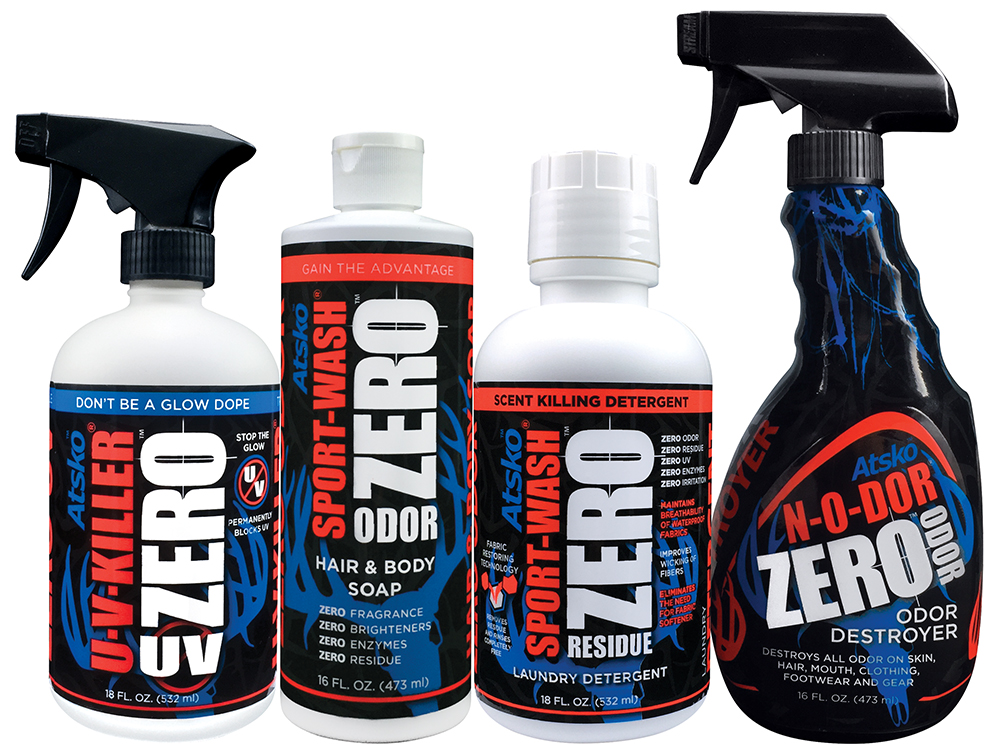
- Regular detergent can add brighteners over time, since many mainstream detergents include them by design. A scent-free, brightener-free wash (like Atsko’s Sport-Wash) at least won’t be adding the problem back in every time you launder your gear.
- If you want to actively neutralize existing brighteners rather than just avoid adding new ones, that’s a different step — a treatment like The Original U-V-Killer® is designed to sit on top of the fabric and block UV reflection rather than remove the brighteners, since they can’t be washed out.
The bottom line
Deer vision isn’t magic, and it isn’t the same as ours. They trade color range for low-light sensitivity, they’re weaker at seeing red/orange than we are, and they’re better than us at picking up short-wavelength and UV light. That’s backed by real behavioral research, not just marketing copy. Whether it changes what’s in your laundry room is up to you — but it’s at least based on something more solid than deer-camp legend.
Further reading: Cohen, B.S., et al. “Behavioral Measure of the Light-Adapted Visual Sensitivity of White-Tailed Deer.” Wildlife Society Bulletin 38, no. 3 (2014): 480–485.