








Why Cover Scents Don’t Fool a Deer’s Nose (and What Actually Works)

Most scent-control advice on the market is built around the same idea: cover up your smell with something stronger — apple, fox urine, skunk, pine. It’s intuitive, it’s been sold for decades, and it doesn’t really work. Understanding why gets you most of the way to understanding what does.

Deer Smell in a Different League

A deer’s sense of smell is estimated to be roughly 10,000 times more sensitive than a human’s, with a proportionally large share of their brain devoted to processing scent. Deer can reportedly distinguish multiple distinct odors at once and use scent for territory marking, mate recognition, and threat detection — it’s not a secondary sense the way it is for us, it’s closer to their primary one.

That level of sensitivity is exactly why a “cover scent” strategy tends to backfire. A cover scent doesn’t erase human odor — it just adds a second, usually unnatural, odor on top of it. To a nose that sensitive, a strong smell of apple or fox urine coming from a spot on the landscape where those things don’t belong isn’t camouflage. It’s a second signal, layered on top of the first one, and deer are perfectly capable of learning to associate the two. Once a buck has smelled your cover scent alongside a poorly-scent-controlled hunter once, that cover scent itself becomes a warning sign the next time he encounters it — even from a distance, even without seeing you.

The honest answer to “how do you fool a deer’s nose” is: you largely don’t. The more realistic goal is reducing your own odor output to as close to nothing as possible, rather than trying to hide it under something else.

Masking vs. Elimination

Most household and commercial odor products — for skin, laundry, carpet, anything — are built around masking. They introduce a second, “cleaner” smell to compete with or cover the objectionable one. That’s a reasonable approach for a bathroom. It’s a poor one for hunting, because it assumes the goal is to smell pleasant rather than to smell like nothing.

Elimination is a different mechanism entirely. Instead of adding a competing odor, an oxidizing agent chemically converts odor-causing organic compounds into new, non-volatile compounds that don’t register as an odor at all — the same basic principle behind how chlorine breaks down organic waste in a pool, minus chlorine’s own strong smell. Baking soda and washing soda, common ingredients in a lot of “odor eliminating” hunting products, work on a related but much weaker principle: they raise skin pH slightly to slow bacterial odor production, but they have limited actual odor-absorbing capacity and can re-release what they’ve absorbed once they’re wet.

The practical difference matters in the field: a masking product runs out of “cover” the moment your own odor output exceeds it, while a true oxidizer keeps working on odor as it’s produced rather than trying to out-compete it.

A Practical Scent-Control Routine

Before the trip:

  • Items that can’t be laundered (boots, packs) benefit from advance odor treatment — a couple of weeks ahead if possible, then sealed until use. Launder everything washable in a scent-free, no-residue detergent. Standard detergents leave behind fragrance and residue that gives odor-causing bacteria something to work with. Store gear with something scent-neutral — a bit of local leaf litter or dirt from your actual hunting area works better than a commercial “earth” scent, since deer can often tell the difference between odors that genuinely belong to a location and ones that don’t.

Morning of:

  • Shower with a scent-free soap rather than a fragranced one if at all possible — it buys hours before odor-causing bacteria repopulate. If a shower isn’t an option, a full-body application of a scent-elimination spray is a reasonable substitute.

Getting dressed and heading out:

  • Treat your outer layer — collar, cuffs, sleeves — right before heading afield, along with boot exteriors, to avoid leaving a scent trail on the way in. Reapply through the day as needed, especially to sweat-prone areas, gloves, and anything else you’ll be handling.

On stand:

  • Address any fresh spills, sweat, or contact odors as they happen rather than waiting until the next full wash. None of this requires eliminating 100% of your scent — that’s not realistic. The goal is minimizing it enough, and often enough, that you’re not leaving an obvious trail a deer’s nose can’t miss.

How Atsko Products Help Hunters

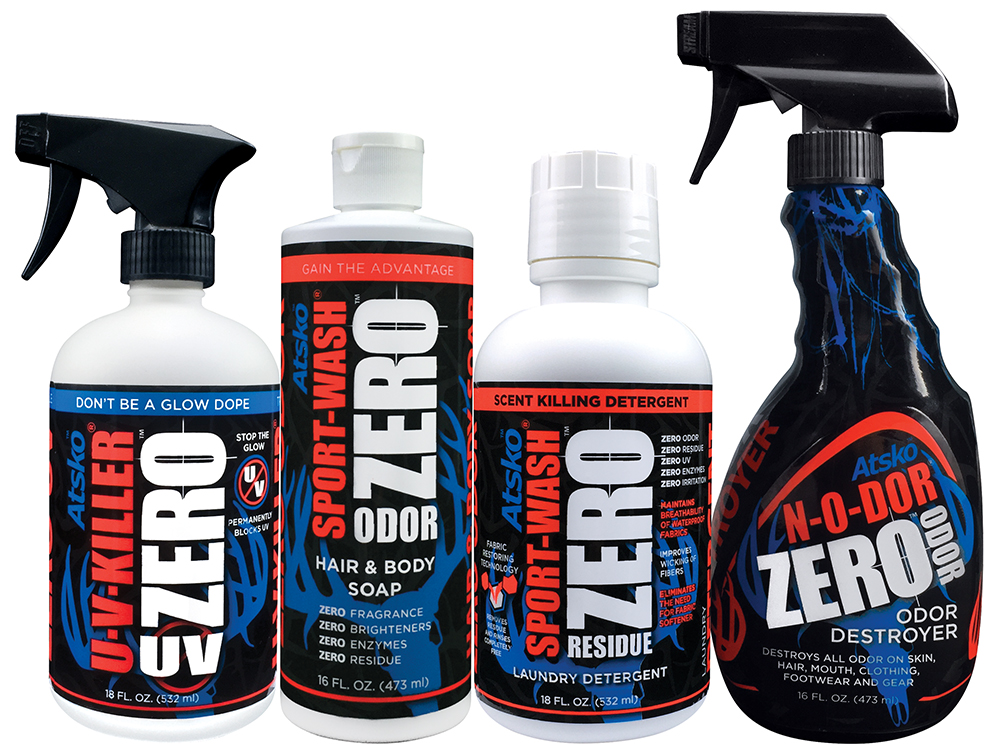
Atsko’s scent-control line is built around the elimination principle rather than masking — Sport-Wash laundry detergent removes residue and odor-causing buildup completely rather than leaving fragrance behind, and ZERO N-O-DOR Oxidizer spray  works by oxidizing odor at the source instead of covering it with a competing smell. If you’re rethinking your scent routine based on how deer actually process odor, that’s the starting point.

Related Reading

Why Deer See So Well in Low Light: The Anatomy Behind It

Everyone knows deer are active at dawn and dusk. Fewer people know exactly why deer vision is so much better suited to that light than ours — and the anatomy behind it explains a lot more than just “good night vision.” It shapes how deer scan a treeline, how they react to movement, and why a flashlight beam doesn’t send them bolting the way you’d expect.

This page covers the physical structure of a deer’s eye. For how UV brighteners in fabric and detergent interact with that structure — and what to do about it — see [Can Deer Really See UV?] and [How to Check Your Hunting Gear for UV Brighteners].

Rods vs. Cones: A Different Ratio Entirely

Every mammal eye uses two types of light-sensing cells: rods, which handle low-light and motion detection, and cones, which handle color and fine detail in bright light. The ratio between them is where deer and humans diverge sharply.

In the human eye, cones dominate — especially in the fovea, the small central patch we rely on for sharp focus, which contains cones almost exclusively and no rods at all. That’s why staring directly at a faint star in the night sky can make it seem to disappear: the exact center of your vision is the part least equipped to see dim light.

Deer are built the opposite way. Rods make up the large majority of their photoreceptors, spread across a horizontal band called the macula rather than concentrated in one central point. The practical effect is almost counterintuitive: deer actually resolve more detail in low light than in bright daylight, because that’s where their receptor advantage is. Humans, with our cone-heavy fovea, are the ones built for a sunny afternoon.

No “Sweet Spot,” But a Wider View

Because human detail vision is concentrated in the small foveal area, we effectively point our eyes at whatever we want to examine closely. Deer don’t work that way — their receptors are spread along that horizontal band, giving them a wide field of usable detail across roughly 300 degrees rather than a narrow zone of sharp focus surrounded by blur.

That wide, evenly-sensitive field is also why deer are so good at picking up movement at the edge of their vision. Where a human might catch motion in their peripheral vision but need to turn and look directly at it to identify what moved, a deer’s visual field gives them detail across a much broader arc without needing to reorient.

The Reflective Layer Behind the Retina

Deer, like many nocturnal and crepuscular animals, have a reflective structure behind the retina called a tapetum lucidum. It’s what causes “eye shine” when a light hits an animal’s eyes at night. Functionally, it gives light a second pass through the photoreceptors — any light that wasn’t absorbed the first time gets bounced back for another chance at triggering a rod or cone.

Humans lack this structure entirely. Behind our retina is a light-absorbing layer that does the opposite job: it soaks up stray light to keep the image sharp, trading sensitivity for clarity. It’s a reasonable trade for a species that does most of its important seeing in daylight — much less useful for one that needs to navigate a dark treeline at 5:45am.

A Slit, Not a Circle

The shape of a deer’s pupil matters as much as its size. Deer close their eyes to a horizontal slit rather than the round aperture humans use. Combined with their horizontally-oriented band of receptors, this shape supports that wide field of vision across a large range of light levels, and lets deer adjust light intake almost instantly by moving their eyelids — no waiting on a pupil to physically dilate or contract the way ours does.

That’s also a plausible piece of why deer don’t always react to a flashlight beam the way people expect. Rather than needing to turn away and let their eyes readjust in the dark like we do, the working theory is that a deer may be able to keep functioning with the receptors outside the beam’s path, while only the directly-lit portion of the retina is temporarily overwhelmed.

Wiring: Sensitivity Over Sharpness

One more structural difference is easy to miss: how photoreceptors connect to the nerves that carry their signal to the brain. In humans, each receptor generally has something close to its own dedicated nerve connection, which supports fine detail. In deer, multiple receptors often feed into a shared nerve pathway — a wiring choice that sacrifices some sharpness but increases sensitivity, particularly to motion. It’s a small piece of anatomy, but it lines up with everything else about the deer’s visual system: built for detecting something moving in low light, not for resolving fine print in bright sun.

What This Means Practically

None of this is really actionable in the way a product tip is — you can’t change deer anatomy. But it reframes a few common hunting assumptions:

  • A deer’s best vision window isn’t your best vision window. Their low-light performance advantage is largest exactly when yours is weakest — dawn, dusk, and overcast conditions.
  • Movement discipline matters more than most hunters assume, given how much of a deer’s visual system is built around detecting motion across a wide field rather than examining a fixed point.
  • A deer freezing in a light beam isn’t necessarily “blinded” the way a human would be — the anatomy suggests they may retain more functional vision outside the beam than we would in the same situation.

How Atsko Products Help Hunters

Understanding how a deer’s eyes work is most useful when it changes what you actually do in the field. Since their visual system is tuned to pick up motion and short-wavelength light far better than ours, the practical edge comes down to two things: moving carefully, and not giving off light or scent signals you can’t see or smell yourself. That’s the gap Atsko’s hunting gear is built to close — from UV-blocking treatments that keep fabric from glowing in exactly the light range deer are most sensitive to, to scent-control products that address the sense most hunters underestimate entirely.

Related Reading

Can Deer Really See UV? Here’s What the Science Actually Says

You’ve probably heard some version of this in a deer camp: wash your camo in the wrong detergent, and you might as well be wearing a glow stick because the deer see UV. It sounds like hunting folklore — the kind of claim that gets repeated so often nobody remembers where it started. But this one has an actual research trail behind it, and it’s worth understanding what the science shows, what it doesn’t, and what it means for the gear you wear to the stand.

The short version

Deer eyes are built differently than ours. Compared to humans, they have far more rod cells and fewer cone types, which trades away fine color discrimination for extreme sensitivity in low light — useful if you’re a prey animal most active at dawn and dusk. Part of that trade-off is a visual system tuned toward the short end of the light spectrum, including some ultraviolet, while being relatively poor at picking out long wavelengths like red and orange.

That’s not just a theory. In 2014, researchers at the University of Georgia’s Warnell School of Forestry and Natural Resources — Bradley Cohen, David Osborn, George Gallagher, Robert Warren, and Karl Miller — ran a behavioral test to check it directly. They trained white-tailed deer to discriminate between lit and unlit LED lights at different wavelengths, lowering the intensity until the deer could no longer tell the light was on. The results, published in the Wildlife Society Bulletin, showed deer do have measurable sensitivity to UV light — confirming, with actual animal behavior, what earlier physiological studies had predicted.

Where the “glowing camo” idea comes from

Here’s the connection to your hunting clothes: many laundry detergents contain optical brighteners (sometimes called fluorescent whitening agents) that make white and colored fabrics look “cleaner” and brighter to human eyes. They work by absorbing UV light and re-emitting it as visible blue light — which is a neat trick for a t-shirt, and a potential problem for camo, since it means treated fabric can be reflecting light in exactly the part of the spectrum deer are more sensitive to than humans.

What this actually means for hunters

A few practical takeaways, without the hype:

  • New camo and blaze orange often contain brighteners straight from the factory, even before it ever meets a washing machine — it’s part of how the dye and fabric-treatment process works.
  • You can check for this yourself. A UV (black light) flashlight will make brightener-treated fabric visibly glow blue-white in a dark room. If your gear lights up, that’s a real, testable signal — not folklore.
  • Regular detergent can add brighteners over time, since many mainstream detergents include them by design. A scent-free, brightener-free wash (like Atsko’s Sport-Wash) at least won’t be adding the problem back in every time you launder your gear.
  • If you want to actively neutralize existing brighteners rather than just avoid adding new ones, that’s a different step — a treatment like The Original U-V-Killer® is designed to sit on top of the fabric and block UV reflection rather than remove the brighteners, since they can’t be washed out.

The bottom line

Deer vision isn’t magic, and it isn’t the same as ours. They trade color range for low-light sensitivity, they’re weaker at seeing red/orange than we are, and they’re better than us at picking up short-wavelength and UV light. That’s backed by real behavioral research, not just marketing copy. Whether it changes what’s in your laundry room is up to you — but it’s at least based on something more solid than deer-camp legend.

Further reading: Cohen, B.S., et al. “Behavioral Measure of the Light-Adapted Visual Sensitivity of White-Tailed Deer.” Wildlife Society Bulletin 38, no. 3 (2014): 480–485.