












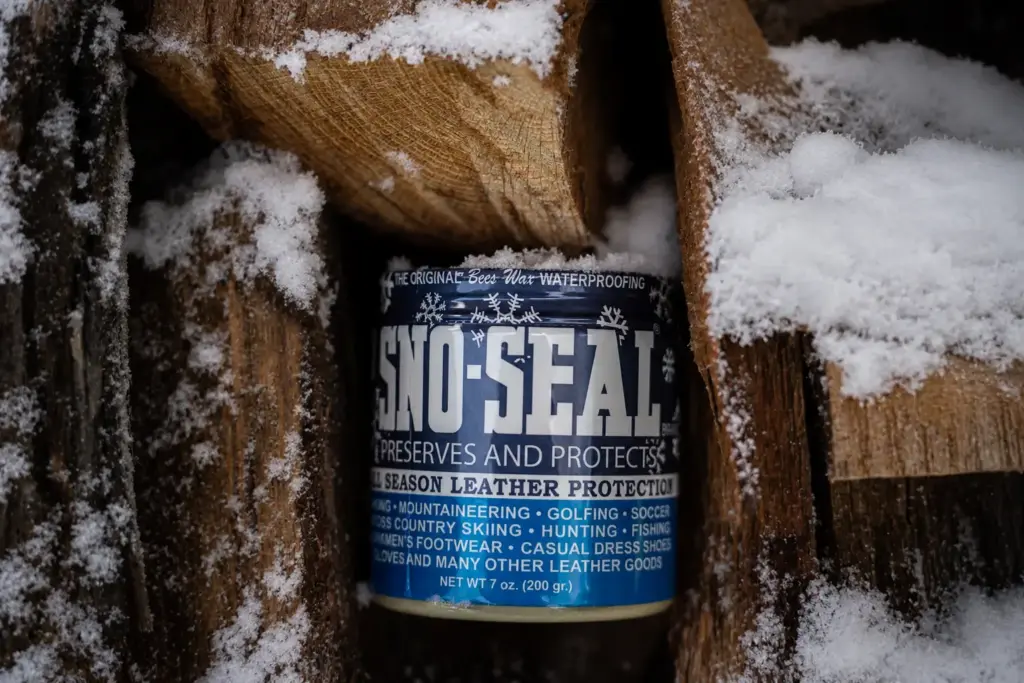
If you’ve read our guide to boot care and waterproofing methods, you already know why a solid wax like beeswax outperforms oils, greases, and animal fats for long-term leather waterproofing — it stays fixed in the outer layer of the leather instead of migrating through it over time. This page covers the right way to apply Sno-Seal for the most effective waterproofing.
The Basic Method
- Preheat clean, dry boots or shoes using a heat lamp, sunny window, or hair dryer — don’t exceed a comfortable handling temperature (around 120°F). You should be able to touch the leather without discomfort.
- Rub the wax into the leather liberally. The warmth melts it on contact and draws it into the pores and fibers rather than leaving it sitting on the surface.
- Apply as much as the leather will absorb. Keep going until the leather stops visibly taking it in.
- Remove excess with a rag, and buff with a brush if you want a shine. Regular shoe polish can go directly over the wax if you want to maintain color and gloss on dress shoes.
Why the Order of Operations Matters
There’s a detail in that process that’s easy to skip past but actually explains why some people get inconsistent results: applying wax to leather and then heating it is not the same as applying wax to leather that’s already warm.
The wax itself has a fairly high melt point after it’s applied — hot enough that it stays solid and fixed in place even on a hot day, which is exactly why it doesn’t need constant reapplication. To make it workable during application, it’s blended with a solvent that temporarily lowers the melt point so it can be worked into the leather; the solvent then evaporates away completely, leaving just the wax behind. (This is also why a jar left open in storage can harden over time — the same evaporation happens slowly in the container if it’s not sealed.)
Solvent evaporates toward a heat source. If you apply wax to room-temperature leather and then heat it, most of the solvent evaporates upward toward the hair dryer or lamp — pulling it away from the leather and leaving the wax sitting mostly on the surface rather than absorbed into it. If the leather is already warm when the wax goes on, the solvent evaporates into the leather instead, carrying the wax with it deeper into the fibers. Same wax, same heat source, meaningfully different result depending on which order you do it in.
A Practical Routine for Multiple Pairs
If you’re treating several pairs at once, working in rotation makes efficient use of the preheating step:
- Preheat all pairs at once — a sunny window, wood stove, heat lamp, low oven (around 125°F), or central heat vents all work.
- Apply wax to the first pair, then move to the next while it absorbs, and the next, working down the line.
- By the time you circle back to the first pair, it should look dull — a sign the leather has absorbed what you applied.
- Add more wax to any pair with dull spots; continue the rotation.
- When a pair stays visibly shiny for a few minutes after application, the leather has reached its saturation point. A small amount of surface excess left at this stage actually helps with abrasion resistance from grass and snow — you don’t need to chase a completely matte finish unless you want one.
- If you prefer a more finished look, buff the excess off with a towel once you’re done.
Important Cautions
- It will darken leather. This is a visible, permanent cosmetic change, not just a temporary wet-look — factor that in before treating a pair where original color matters.
- Not recommended for suede. It will darken and flatten the nap, changing the texture and appearance, though it will still waterproof and preserve the leather underneath if that trade-off is acceptable to you.
- Keep out of reach of children, as with any wax/solvent product.
Beyond Boots
The same wax works on other water-exposed materials where a natural, low-sheen finish is preferred over a hard lacquer — exposed wood trim (like teak on a boat), sealing screw holes in treated outdoor lumber before driving screws in, and leather components on ice skate boots. It’s also used to help maintain proper moisture balance in horses’ hooves.
For skin care specifically, use a product actually formulated for that purpose rather than a leather/wood wax — Pro-Tech-Skin is Atsko’s food-grade option for protecting hardworking hands and skin.
Related Reading
- Boot Care 101: Drying, Waterproofing, and Choosing the Right Treatment — the full comparison of waterproofing methods and when to choose each one