












Most boot advice covers fit and break-in. Almost nobody covers what happens after that — the maintenance that actually determines whether a good pair of boots lasts five seasons or fifteen. Two things ruin leather boots faster than anything else: drying them wrong, and waterproofing them wrong. Both are avoidable.
Rule One: Dry Them Slowly
When leather gets soaked — rain, wet grass, stepping in over the boot top — the instinct is to speed-dry them by a heater or in front of a fire. That’s the single fastest way to ruin a pair of boots. Heat forces moisture out of leather too quickly, and the leather responds by hardening and shrinking. A few cycles of that and the boots are done.
The right approach is slower and less satisfying: low or no heat, with enough airflow to dry a fully soaked boot over about two days. A boot that’s only partially wet can usually dry in a day. If you’re regularly soaking boots — hunting, fishing, working outdoors — the practical fix isn’t faster drying, it’s rotating between two or three pairs so nothing goes back into wet boots the next morning. In cold climates, this isn’t just about the boots — wet boots and cold feet are a real safety issue, not just a comfort one.
A Gore-Tex® liner doesn’t change this. The liner keeps liquid water away from your foot, but it does nothing to protect the outer leather from soaking up water and abuse — that’s still on you to manage with proper drying and waterproofing.
Rule Two: Understand What Waterproofing Actually Does
Before comparing products, it helps to know there are really only two ways a treatment keeps water out of leather:
- Filling the pores. Something water-incompatible occupies the spaces in the leather so water has nowhere to go. This is the oldest method — beeswax, animal fats, mineral oil, and pine tar all work this way, and have for centuries.
- Reducing surface tension. The treatment doesn’t fill space so much as change how water behaves on the surface, causing it to bead and roll off rather than soak in. Silicone and fluoropolymer treatments primarily work this way.
Which mechanism you want depends heavily on whether the treatment stays solid or stays liquid after it’s applied — and that distinction matters more than most boot buyers realize.
Comparing Waterproofing Methods
| Method | How It Works | Strengths | Trade-offs |
| Beeswax | Fills pores; stays solid at normal temperatures | Maximum durability and water resistance; stays fixed in the outer leather rather than migrating through it; doesn’t need frequent reapplication | Darkens and adds slight sheen to leather; not ideal where a lighter, drier finish is wanted |
| Oils, greases, animal fats | Fill pores, but remain liquid/soft at normal temperatures | Easy to apply, traditional | Migrate through the leather over time rather than staying on the surface; require frequent reapplication; can eventually soften and weaken the leather, and animal-based fats can turn rancid and promote fungal growth |
| Silicone | Fills pores somewhat, plus reduces surface tension | Easy application; works well on suede, split, or sanded leather where wax would darken the appearance too much | Less durable and less water-resistant than wax; aqueous (water-based) silicone formulas underperform solvent-based ones significantly |
| Fluoropolymer | Reduces surface tension strongly (best stain/oil resistance) | Excellent for stain and oil resistance on textiles | Requires a very clean surface and factory-level heat (around 300°F) for full effectiveness — hard to replicate at home on boots; generally weaker at pure water repellency than wax or silicone |
Why the solid-vs-liquid distinction matters so much: any liquid treatment — oil, grease, animal fat, or a non-solidifying wax blend — doesn’t stay where you put it. It migrates through the leather over time. Eventually it soaks all the way through, shows up on your socks, and leaves the leather soft, spongy, and unable to absorb foot perspiration the way it should — which means cold, clammy feet regardless of how “waterproof” the boot technically still is. A treatment that solidifies (like beeswax) stays fixed in the outer layer instead, leaving the rest of the leather’s thickness open for insulation and moisture absorption.
Prepping a Boot Before Waterproofing
- Clean and dry the boot first. Scrub heavy dirt off with a wet brush; wipe light residue with a cloth dampened in water or solvent. Solvent evaporates faster, so you don’t have to wait as long before applying treatment.
- Remove factory shine coatings if switching to wax. New boots often carry a temporary glycerin or carnauba wax coating for shelf shine. Since these are water-soluble, wash the boot with a residue-free detergent or mild dish soap and let it dry completely before applying a real waterproofing treatment — otherwise the new treatment is bonding to a coating, not the leather.
- Match the treatment to the leather type. Smooth, full-grain leather takes wax well once any factory coating is removed. Split, suede, sanded, or recycled leather can also be waterproofed with wax, but expect it to darken and take on a slicker look — a trade-off worth knowing before you commit, especially if the boot’s appearance matters as much as its performance.
A Word on Emulsified/Water-Based Products
Some products are marketed as easier because they can be applied to already-wet leather — appealing when you didn’t prep ahead and your boots are already soaked. In practice, these emulsified wax or silicone formulas tend to underperform their solvent-based counterparts. Making wax or silicone mix with water requires a surfactant, and that same surfactant residue makes it easier for water to get back in later — which undercuts the entire point of waterproofing the boot in the first place.
How Atsko Products Help
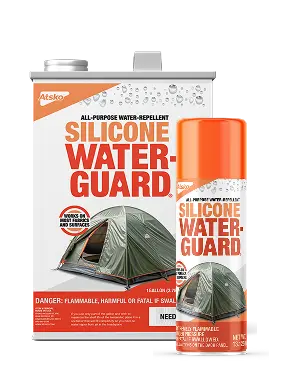
Sno-Seal, Atsko’s original beeswax waterproofing, is built around the solid-wax approach this page describes — it stays fixed in the outer leather rather than migrating through it, which is why it doesn’t need constant reapplication the way oil- or grease-based treatments do. For split, suede, or leather/fabric combination boots where a heavy-duty repellent matters more than appearance, Silicone Water-Guard is a solvent-based option built to the same durability standard rather than a weaker water-based alternative.